
Summer tops should make hot-weather dressing easier, not leave you adjusting straps, fighting cling, or regretting a fabric choice by lunchtime. The most useful styles combine airflow, comfortable coverage, a fit that stays in place, and enough versatility to work with shorts, skirts, jeans, or lightweight trousers. In 2026, tanks, linen pieces, crochet textures, eyelet details, and simple elevated basics remain especially relevant because they balance seasonal style with repeat wear.
Quick answer: The best summer tops combine breathable fabric, comfortable movement, secure fit, and easy styling. Start with cotton tanks, linen shirts, halter tops, eyelet blouses, crochet or pointelle knits, and relaxed camisoles, then balance fitted tops with roomier bottoms and loose tops with cleaner, more defined silhouettes.
Key Takeaways
- Choose fabric before trend: linen, cotton voile, gauze, seersucker, and breathable lightweight knits generally work better in hot weather than heavy, dense materials.
- Keep at least one part of the outfit defined, such as a fitted top with wide pants or a loose blouse with straighter shorts.
- Test pale and thin tops in natural daylight because opacity can change dramatically outside.
- Tank tops, linen shirts, halters, eyelet blouses, crochet tops, and relaxed button-downs cover most casual, vacation, work, and evening summer plans.
- Build a small rotation around bottoms you already wear instead of buying several tops that only work with one outfit.
What Makes a Good Summer Top?
A good summer top starts with how the material behaves once the temperature rises. Airy fabric, space between the garment and your skin, and a comfortable neckline usually matter more after several hours outside than decorative details do. Styleblor’s broader guide to summer outfits for women follows the same fabric-first approach, especially when dressing for heat, humidity, sweat, and heavily air-conditioned indoor spaces.
Fit comes next because even a breathable top becomes annoying when the straps slide, the armholes gape, or the hem constantly needs retucking. Raise your arms, sit down, lean forward, and turn sideways before deciding whether a top fits well enough for a full day. The right piece should stay close enough to feel secure while leaving enough room for normal movement and airflow.
| Fabric or construction | Summer feel | Best use | Watch for |
| Linen | Airy, textured, relaxed | Shirts, shells, loose blouses | Creasing and possible sheerness |
| Cotton voile or lawn | Very light and soft | Blouses, camisoles, layered tops | Thin versions may need lining |
| Cotton gauze | Breezy and casual | Beach, weekends, travel | Can look very relaxed |
| Seersucker | Light with built-in texture | Shirts and structured tops | Usually more casual than sleek |
| Cotton-modal knit | Soft with easy stretch | Tanks, tees, fitted basics | Check whether pale colors show sweat |
| Crochet or pointelle | Open, textured, decorative | Vacation and casual outfits | May require a camisole underneath |
| Lightweight poplin | Crisp and polished | Button-downs and work looks | Less airy than gauze or voile |
| Heavy synthetic knit | Smooth but often warmer | Limited hot-weather use | Can feel dense in humidity |
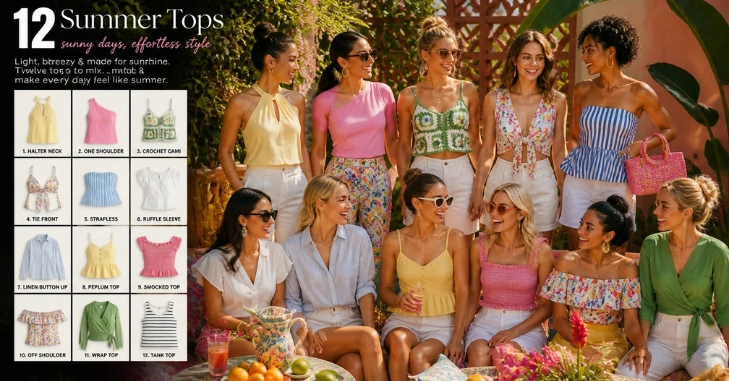
12 Summer Tops Worth Building Outfits Around
1. The Classic Tank Top
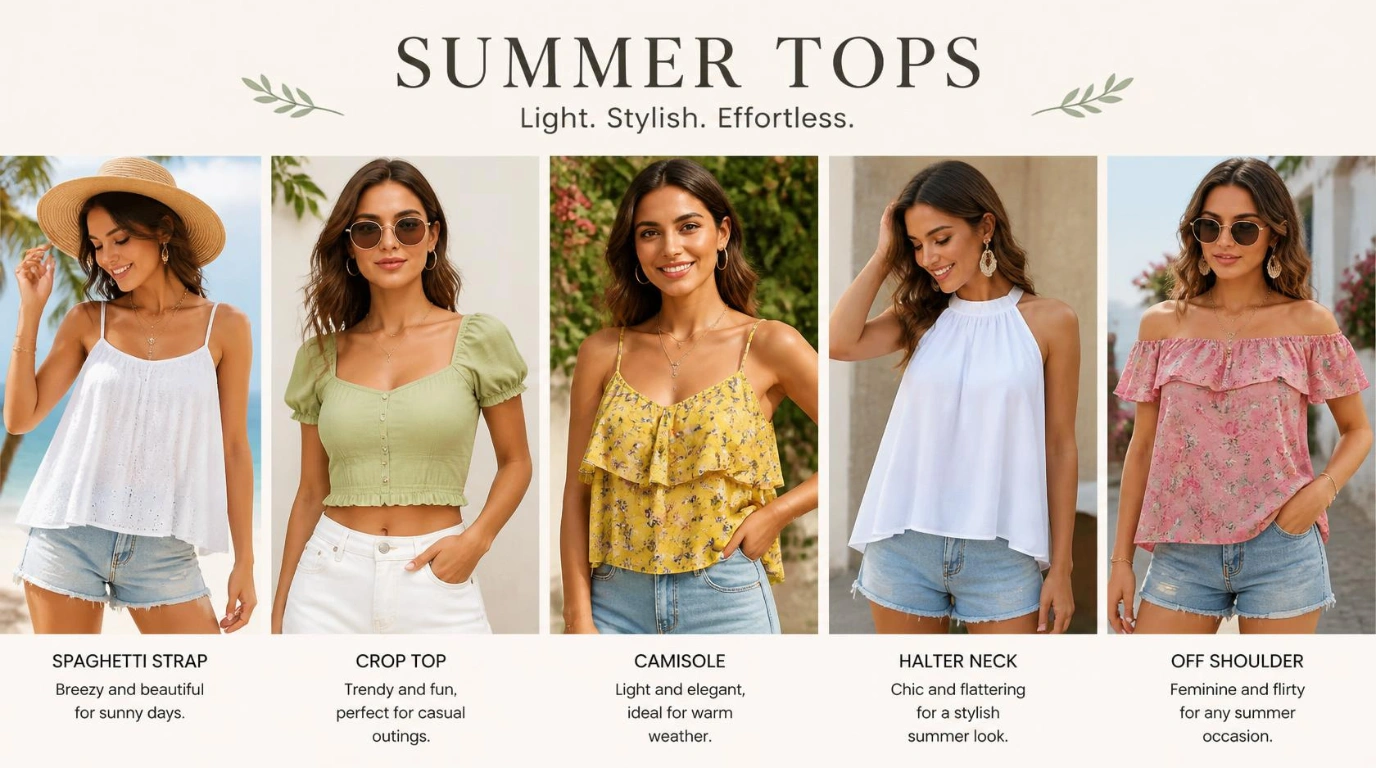
A simple tank is one of the hardest-working summer tops because it works under a shirt, blazer, or cardigan and still stands alone when the temperature climbs. Ribbed cotton and cotton-blend versions usually give enough structure to feel intentional with denim, linen pants, or a skirt. Current summer styling coverage continues to treat the tank as a core piece because changing the bottom, layer, and accessories can take it from errands to dinner without changing the base.
For a useful everyday version, look for armholes that sit close without cutting into the underarm and straps wide enough for the support you prefer. A hem near the waistband is easier to tuck than a very long tank and generally cleaner with high-rise bottoms. With relaxed denim shorts or jorts, a fitted tank also gives the outfit one clear point of definition, which Styleblor’s jorts styling guide recommends for balancing a roomier lower half.
2. The Boatneck or High-Neck Tank
A boatneck or high-neck tank gives the simplicity of a basic sleeveless top with a slightly more polished line. The extra neckline coverage makes it particularly useful with tailored pants, long skirts, or work-friendly separates where a low scoop neck might feel too casual. It also creates a strong visual frame around the shoulders, so the outfit rarely needs a complicated necklace.
Choose a soft rib knit for casual wear or a smoother, denser knit when you want the top to hold its shape through a workday. Pair a close-fitting version with wide-leg linen pants, a bias-cut maxi skirt, or relaxed jeans to create contrast without adding bulk. If the top itself has a strong neckline, simple earrings and an uncluttered bag usually finish the outfit better than several competing accessories.
3. The Linen Button-Down
A linen button-down earns its place because it can work as a top, a lightweight layer, a beach cover-up, or an air-conditioning solution. Wear it buttoned and loosely tucked for a polished daytime look, or leave it open over a tank, swimsuit, or fitted camisole when you want more coverage without much weight. Linen also fits naturally into a summer wardrobe built around breathable separates, and Styleblor’s guide to linen pants for women shows how effectively the fabric transitions from relaxed vacation dressing to sharper city outfits.
Pay attention to the weave rather than assuming every linen shirt will feel equally cool. A thin, open weave feels breezier but can become translucent in bright sunlight, while a denser linen-cotton blend usually offers more coverage and fewer dramatic creases. If you plan to wear the shirt mostly as a layer, a slightly oversized cut gives you more flexibility around tanks and dresses.
4. The Halter Top
A halter top makes the neckline the focus by opening the shoulders and bringing the eye upward. It works especially well with high-rise pants, straight denim, long skirts, or simple shorts because those bottoms let the neckline remain the main design feature. Styleblor’s complete halter top guide also emphasizes checking the neck, bust, sides, and back before styling, since comfort depends heavily on how securely the top sits while you move.
Try the top for several minutes rather than judging it immediately in the mirror because a neck tie that feels fine at first can become uncomfortable later. Open-back versions also need enough stability through the side seams to keep the front where you want it. For casual plans, wear a ribbed cotton halter with denim shorts, while a smooth black or cream version looks more polished with wide trousers and a low heel.
5. The Camisole
A camisole is useful when you want less fabric without committing to a strapless or very cropped silhouette. Straight necklines feel minimal, cowl necks lean dressier, and lace-trim versions introduce a softer romantic detail that works particularly well with plain denim or tailored trousers. Because the straps are narrow, checking their adjustability and the fit across the bust matters more than simply choosing your usual top size.
For daytime, a cotton or linen-blend cami works easily with loose shorts and an open shirt. For evening, satin or a satin-look fabric can pair with a bias skirt or wide-leg trousers once the temperature drops. If you like romantic details, Styleblor’s coquette style guide shows how to balance lace-trimmed camisoles with straightforward denim and simple accessories, rather than turning the entire outfit into a theme.
6. The Crochet or Pointelle Top
Crochet and pointelle tops add texture when the rest of a summer outfit is simple. They can make plain shorts, linen pants, or a solid skirt feel more considered without relying on a loud print or complicated accessories. Crochet also remains part of the broader 2026 warm-weather fashion conversation, especially in relaxed, vacation-oriented outfits.
The important buying question is how open the knit actually is. Some versions are dense enough to wear alone, while others need a camisole, bralette, or swimwear underneath, which can make the outfit warmer than it first appears. Check the fabric against daylight and decide on the underlayer before buying so the top works with clothing you already own.
7. The Eyelet Blouse
Eyelet gives a blouse built-in ventilation and visual detail at the same time, which helps explain why it returns so often in summer collections. White and cream versions are especially versatile with denim, colored shorts, and linen trousers, while black eyelet creates a slightly sharper evening look. Current 2026 summer trend coverage also highlights eyelet and embroidered details as an easy way to make lightweight tops feel more distinctive.
Check whether the body is lined, partially lined, or completely sheer because that decision changes how warm and practical the blouse will feel. A cotton lining usually makes more sense in summer than a dense synthetic one, especially if the blouse already has sleeves. When the eyelet pattern is busy, keep the bottom fairly simple and let the texture do the decorative work.
8. The Babydoll or Peplum Top
A babydoll or peplum top creates volume through the lower part of the garment, making it a useful alternative to fitted summer basics. These tops feel especially comfortable when you don’t want fabric sitting close to your waist on a hot day. The extra movement can also look polished with simple shorts or straight-leg trousers, as long as the fabric has enough structure to hold its shape.
Because the top already has volume, pairing it with an equally full bottom requires more care. Straight denim, slim Bermuda shorts, or a clean column skirt usually gives the silhouette a clearer outline than a heavily gathered skirt. If you prefer loose pieces on both halves, keep the fabrics light and make sure either the waist, neckline, or footwear adds some definition.
9. The Tube or Bandeau Top
A tube top creates one of the cleanest summer silhouettes because no shoulder straps interrupt the neckline. It can work well beneath an open linen shirt, lightweight blazer, or oversized button-down when you want a minimal base layer. The simplicity also makes it useful with statement skirts, patterned pants, or longer denim shorts.
Fit matters more than almost anything else with this style because the top has fewer support points. Look for a secure upper edge, enough stretch to move comfortably, and construction that does not roll or slide when you raise your arms. If you expect to walk, dance, or spend an active day outside, a style with internal grip, a firmer band, or removable straps may feel easier than a completely unstructured version.
10. The Relaxed Short-Sleeve Button-Up
A short-sleeve button-up sits between a T-shirt and a full linen shirt, making it useful when you want more structure without long sleeves. Boxy camp-collar shirts work with denim, linen shorts, and wide-leg pants, while softly tailored versions can move into casual offices or dinner plans. Prints are an option, but solid white, striped, navy, or soft neutral versions usually earn more repeat wear.
The best fit has enough room across the back to move without becoming so oversized that the shoulder seams collapse far down the arm. Wear it closed and tucked with trousers, half-tucked with shorts, or open over a tank when the day includes both outdoor heat and cold indoor spaces. That last formula also fits Styleblor’s broader summer strategy: use one removable lightweight layer instead of making the entire outfit warmer.
11. The Off-the-Shoulder Top
An off-the-shoulder top creates a more dressed-up summer look without requiring heavy fabric or elaborate construction. It works particularly well for dinners, vacations, rooftop plans, and casual events where a basic tank feels too plain. Cotton poplin and lightweight woven versions tend to look crisper, while stretch knits create a softer and more fitted line.
Before buying, raise your arms and check what happens to the neckline because some elastic styles migrate upward with every movement. A neckline that constantly needs repositioning will become more irritating the longer you wear it. Pair the exposed shoulder line with clean trousers, a long skirt, or simple denim and keep jewelry relatively restrained.
12. The Lightweight Knit Top
A lightweight knit top works well for summer days that move between outdoor heat and strong indoor air conditioning. Sleeveless polos, fine-gauge shells, and thin short-sleeve knits look more structured than basic jersey but still pair easily with casual bottoms. They are especially practical for work, travel, or evening plans when a gauzy beach top feels too relaxed.
The word “knit” does not automatically mean breathable, so check thickness and fiber content before deciding. Dense acrylic or heavy polyester can feel much warmer than a cotton, modal, or lightweight blended knit of the same shape. Hold the fabric to the light, stretch it gently, and choose enough density for coverage without turning the top into a sweater.
Which Fabrics Are Best for Summer Tops?
Linen, lightweight cotton weaves, gauze, seersucker, and breathable blended knits are useful starting points because they can create airflow without requiring an extremely revealing cut. Styleblor’s summer-dress fabric testing also distinguishes between open weaves, such as voile, lawn, gauze, seersucker, and handkerchief linen, and denser fabrics that tend to feel less airy in serious heat. That distinction matters for tops too, because two garments labeled “cotton” can feel completely different when one is thin voile, and the other is dense jersey.
Lining can also change the experience of a summer top. A beautiful eyelet or sheer blouse may look airy from the outside but feel much warmer if a dense synthetic layer backs the entire body. Check both the outer composition and lining label, then decide whether the garment still suits the weather and activity you actually expect.
How Should Summer Tops Fit?
Start with movement instead of the mirror because summer clothes often reveal fit problems only after you begin walking, sitting, or lifting your arms. The neckline should return to place after movement, straps should stay where you put them, and the side seams should not twist dramatically around your body. A top that requires repeated adjustment at home is unlikely to become easier after several hours outside.
You also need enough space for air to circulate, but oversized doesn’t automatically mean cooler. Very large tops can add unnecessary fabric, while a close-fitting tank in a breathable knit may feel comfortable without feeling compressive. Look for a shape that gives the fabric room to move and then use the bottom half of the outfit to create the proportion you prefer.
Easy Summer Outfit Formulas
A summer top becomes more valuable when it works with several bottoms already in your closet. Instead of shopping for isolated pieces, think in formulas that can repeat with different colors and accessories. Styleblor’s guides to maxi skirts and jean shorts both reinforce the same practical idea: proportion improves when one part of the outfit defines while the other moves.
| Plan | Top | Bottom | Shoes | Optional layer |
| Everyday errands | Ribbed tank | 4–5 inch denim shorts | Sneakers or flat sandals | Open linen shirt |
| Hot office day | High-neck tank | Wide-leg linen pants | Loafers or slingbacks | Lightweight blazer |
| Beach or pool | Crochet top or open shirt | Swimwear or relaxed shorts | Slides | Linen button-down |
| Casual lunch | Eyelet blouse | Straight jeans or shorts | Leather sandals | None |
| Vacation sightseeing | Cotton cami | Maxi skirt or loose trousers | Supportive sandals | Short-sleeve shirt |
| Evening | Halter or satin cami | Long skirt or tailored pants | Low heel | Light jacket |
| Trend-focused weekend | Boatneck tank | Jorts or capri pants | Flats or sneakers | Cropped cardigan |
How to Build a Small Summer Top Rotation
You don’t need twelve different silhouettes to build a useful summer wardrobe. A strong starting rotation could include one dependable tank, one polished sleeveless top, one loose woven shirt, one dressier neckline, and one textured or patterned option. Those five categories cover far more situations than several near-identical statement tops that only work with one pair of pants.
Choose your colors by looking at the bottoms you wear most often. If your closet is dominated by blue denim, white linen, black trousers, and neutral skirts, tops in white, black, navy, brown, cream, soft green, or one favorite accent color will combine easily. Styleblor’s capsule wardrobe guide can help if you want to expand this same repeat-wear approach across the rest of your closet.
Finally, make every new top pass a three-outfit test before you buy it. Picture one casual outfit, one slightly more polished outfit, and one outfit that combines it with pieces you already wear every week. If you cannot create three believable outfits without buying something else, the top may be more novelty than wardrobe solution.
The Bottom Line
The best summer tops are the pieces you can wear through real heat without constantly fixing the neckline, worrying about transparency, or wishing you had chosen a different fabric. Start with breathable materials and reliable fit, then build variety through necklines, texture, and proportion rather than collecting several versions of the same trend. A tank, linen shirt, polished sleeveless top, halter or camisole, and one textured option can cover most warm-weather plans while leaving plenty of room for personal style.
Frequently Asked Questions
What Are the Best Summer Tops for Very Hot Weather?
Loose linen shirts, cotton voile blouses, gauze tops, lightweight tanks, and other airy woven styles are dependable choices in high heat. The exact fiber matters, but weave and garment construction also determine how much air reaches your skin. Don’t assume every cotton or linen garment will feel equally cool, especially when a lining or dense knit changes how the fabric behaves.
Are Tank Tops Still in Style in 2026?
Yes, tank tops remain one of the most visible and versatile warm-weather basics in 2026 styling coverage. Current fashion editors pair them with everything from wide trousers and skirts to denim and transitional layers, rather than treating them as purely casual undershirts. Their simplicity is the advantage because the same tank can change character through the bottom, shoes, jewelry, and outer layer.
What Summer Tops Look Good With Linen Pants?
Fitted tanks, sleeveless knit shells, camisoles, halter tops, and neatly tucked button-downs all work with wide-leg linen pants. Because the pants already provide movement and texture, a cleaner or slightly more defined top often creates the easiest balance. A loose linen shirt can also work when you use a partial tuck, shorter hem, or visible waistline to keep the outfit from becoming one uninterrupted block of fabric.
What Tops Work Best With Summer Skirts?
Fitted tanks and camisoles work well with tiered or fuller skirts, while looser shirts and boxy tops pair easily with narrow slip or column skirts. The goal isn’t to follow a strict body-shape rule, but to give the outfit one area of visual structure. Styleblor’s maxi-skirt guide uses the same principle by recommending more defined tops with fuller shapes and allowing greater volume above slimmer skirt silhouettes.
How Can I Tell if a Summer Top Is Too Sheer?
Check the garment in front of a bright window or another strong natural-light source before removing the tags. Pale woven fabrics can look opaque under indoor retail lighting and reveal much more once direct daylight passes through them. If the top is borderline, decide whether you are comfortable adding an underlayer, because another camisole may change both the appearance and how cool the outfit feels.
What Color Summer Top Is Most Versatile?
White, cream, black, navy, brown, and other neutrals are easy to repeat because they coordinate with denim, linen, prints, and most skirt colors. A versatile wardrobe doesn’t need to be entirely neutral, though, and one or two accent colors can make familiar bottoms feel different. Choose those accent shades from colors already present in your shoes, bags, skirts, or patterned pieces so they connect naturally to the rest of the closet.