
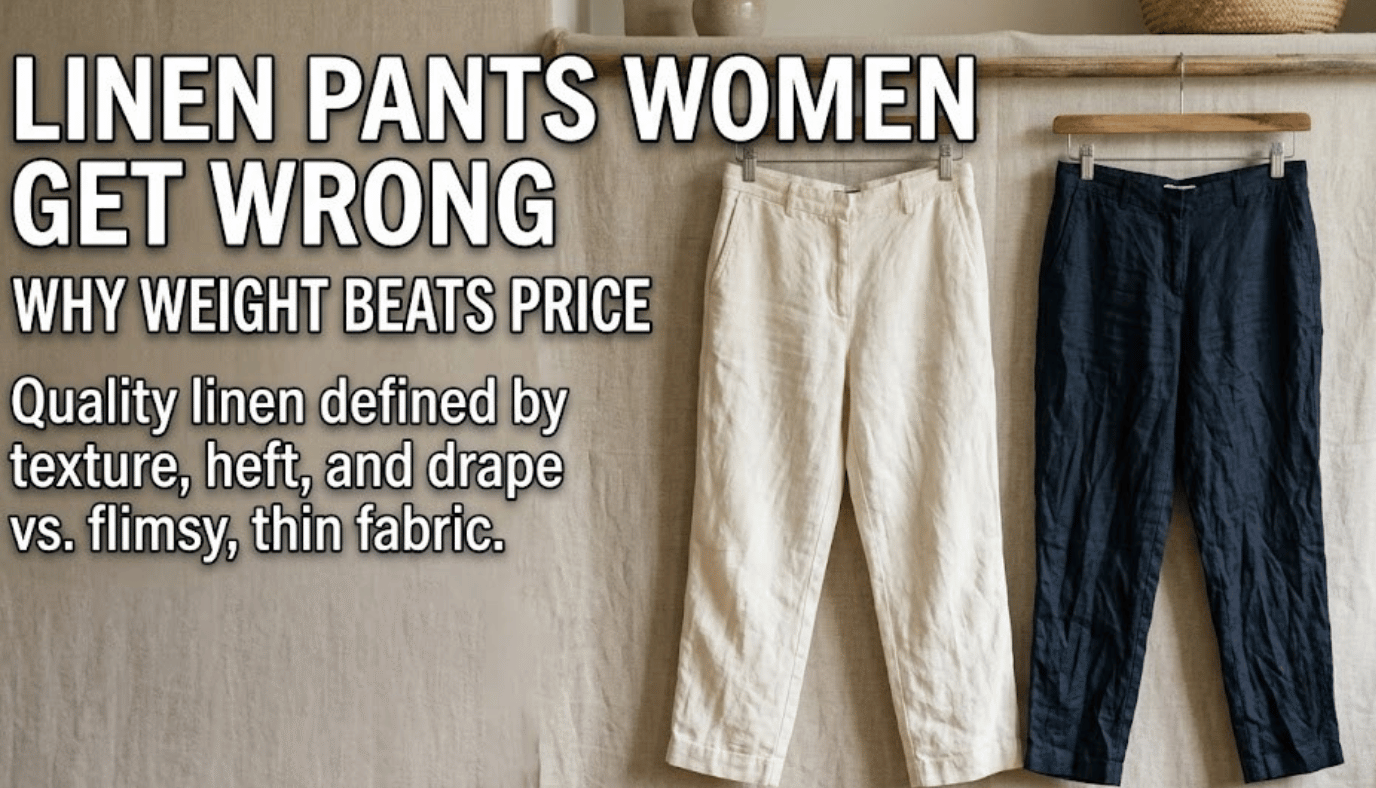
The pair that gets returned is almost always picked the same way. You hold it up under store lighting, like the color, like the way it falls over your arm, and take it to the register. Nobody flips the waistband and reads the fiber content tag. That skipped step is why so many linen pants women buy get worn once, photographed never, and folded to the back of a drawer.
Buy on cloth first. For an unlined summer pair, look for linen around 180 GSM or heavier, or a linen blend cut with cotton or lyocell if creasing bothers you. Check the composition tag, hold one leg up to a window, and treat cut and color as the second decision rather than the first.
The Mistake: Judging a Pair on the Hanger
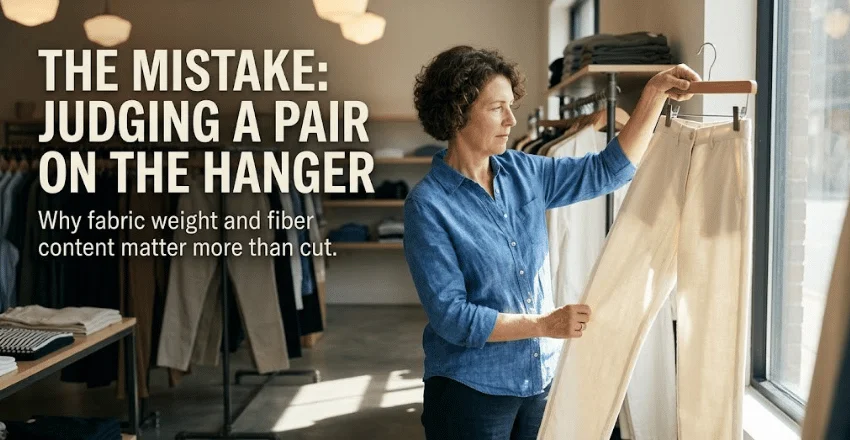
A hanger flatters everything. Fabric hangs straight, seams sit flat, and the store’s warm overhead light hides how much of it you can see through. Step outside at noon in a white pair and the story changes.
The complaints that follow are predictable. Pants go transparent in bright sunlight. Knees and seat bag out by lunch. The waistband relaxes two sizes over a long afternoon, or the whole pair shrinks in one hot wash and never comes back. None of that is the cut’s fault. It’s the cloth doing exactly what its weight and fiber content said it would.
Weight is the number that decides most of it, and almost nobody checks it.
Linen Weight and Blend: A Quick Reference
GSM stands for grams per square meter, the figure mills use to describe how much cloth is in a yard of fabric. Some brands print it. Most don’t, so ounce weight, price, and feel become your proxies. Use this as a shopping card.
| Fabric spec | Hand and drape | Daylight opacity | Creasing | Sensible use |
| 100% linen, under 150 GSM (about 4.4 oz) | Gauzy, shirt weight, floats | Poor. Light passes, outlines show | Heavy, sets fast | Cover-ups, or lined only |
| 100% linen, 150 to 180 GSM | Soft, fluid, very little body | Borderline. Fine in navy, risky in white | Heavy | Dark colors, slip shorts underneath |
| 100% linen, 185 to 220 GSM | Some structure, still cool | Good in every color | Moderate, falls out as you walk | The everyday unlined pair |
| 100% linen, 230 GSM and up | Crisp, holds a pleat, hangs heavy | Full | Sharp creases, but they read tailored | Office pants, wide leg with volume |
| 55% linen, 45% cotton | Softer, rounder, slightly warmer | Good, cotton fills the weave | Noticeably less than pure flax | Travel and long wear days |
| Linen with viscose or rayon | Silky, heavy drape, clings a little | Varies, check the light test | Least of any blend, best recovery | Fluid, wide leg, evening |
| Linen with lyocell (Tencel) | Smooth, cool, quiet sheen | Good | Low, and it rebounds after hanging | Warm weather work pants |
| Linen with 2 to 3% elastane | Slight give at the waist and seat | Good | Moderate | Tapered and straight fits |
Key Takeaways
- Around 180 GSM is the practical opacity threshold for unlined summer pants. Below it, color has to do the work.
- Pure flax breathes best and creases most. Cotton, lyocell, and viscose blends trade a little coolness for a lot of crease recovery.
- Expect a first wash to move a garment by roughly 3% to 7%, more in hot water. Garment-washed pairs move far less.
- Real dollar figures start near $40 for 100% linen and run past $150 for contemporary tailoring.
- Steam beats ironing, and air drying does more for the life of a pair than any detergent.
Why So Many Pairs Fail
Mills sell by weight, stores sell by photograph
Fabric buyers order by GSM because that single number predicts hand, opacity, and how the cloth behaves on a body. That number rarely survives the trip to the product page. What you get instead is a styled photo shot in flat studio light, three color swatches, and a line about breathable natural fiber. You cannot see weight in a photograph.
The word linen on a tag covers a lot of ground.
A tag reading “linen blend” can mean 55% flax, or it can mean 15% flax carried by rayon. Both are legal. Both feel pleasant in the store. Only one behaves like linen in August, and only one keeps its shape when you sit through a long dinner.
Warm weather clothing hits this problem across the board, not only in pants. The same trap catches summer dresses and light gowns. That is why our guide to lightweight fabrics in beach wedding gowns spends so long on lining, and on how sheer cloth behaves in daylight.
A soft finish hides the weight until the first wash.
Enzyme washing and stone washing make cheap flax feel expensive. The finish breaks down the crispness that raw linen has, so a 145 GSM cloth can feel as substantial as a 200 GSM one on the rack. Then it goes through your machine, the finish relaxes, and the real weight shows up. That is the gap between how a pair felt in the store and how it looks at a barbecue three weeks later.
The Fix: Six Checks Before You Pay
Run these in order. The first two settle most decisions, and you can do both in under a minute standing in a fitting room.
- Hold one leg up to real light: a window, a doorway, the flash on your phone behind the cloth. If you can read your hand through it, the pair needs lining, a slip short, or a darker color.
- Read the composition tag, not the marketing copy. Anything under 50% flax is a rayon or cotton pant with linen texture. That may be what you want. Decide knowingly.
- Pinch and release a fistful of fabric. Count how long the crease holds. Pure flax keeps it. A lyocell or viscose blend lets it fall out in seconds, and that tells you more about your Tuesday than any care label will.
- Check the rise and the inseam in numbers. Brands typically spec a full-length pair around 30 inches and a cropped one near 25 to 27 inches. A 25-inch inseam sits at the ankle on someone 5 feet 4 and mid-calf on someone 5 feet 9.
- Sit down in them. Then stand and look at the knees. Fabric that keeps the sit marks for more than a few steps will do that all day.
- Buy your true waist size, not one up. Linen relaxes with body heat. Sizing up for comfort produces a pair that slides down by afternoon, and the shrinkage you were hedging against mostly does not happen if you wash cold and air dry.
What Linen Pants Women Buy Cost in 2026
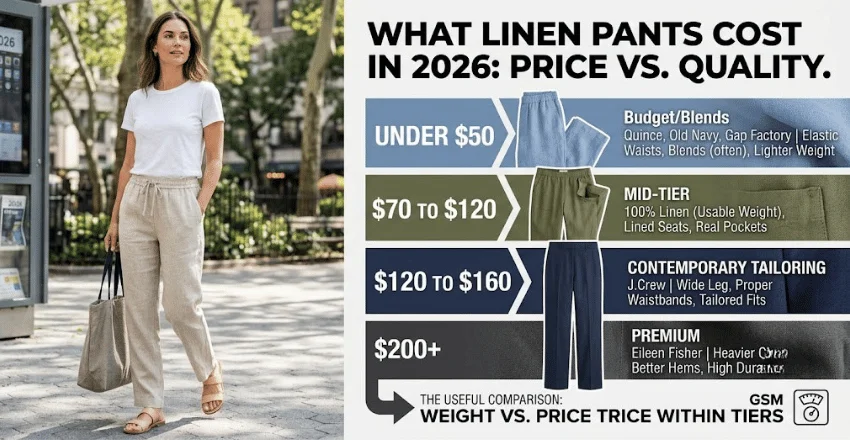
Price tracks weight and finishing more honestly than it tracks brand, though not perfectly. Here is what the market looked like in July 2026 across US retailers, checked on the product pages themselves.
- Under $50. Quince lists a 100% European linen pair at $42 with a 25-inch inseam and an elastic waist. Old Navy and Gap Factory sit in this band too, usually with blends rather than pure flax.
- $70 to $120. The mid tier, where you start seeing lined seats, real pockets, and a proper waistband facing. Most of what we saw here was 100% linen at a usable weight.
- $98 to $160. Contemporary tailoring. J.Crew prices its Soleil linen pant from $98 to $158, the Cosmo pant at $118, and a wide-leg linen pant at $148.
- $200 and up. Heavier Belgian and Italian cloth, better hems, and finishing that survives more washes. Eileen Fisher anchors this end.
The useful comparison is not tier against tier. It is weight against price inside one tier, because a $60 pair at 200 GSM outperforms a $130 pair at 150 GSM on every day you actually wear it.
Cut, Rise, and Length That Hold Up
Once the cloth is right, shape is a question of proportion and of how much volume you want to carry. Height matters here more than size does.
Wide leg is the default for a reason: it moves air, it hides the sit marks, and heavy flax hangs beautifully in it. Straight leg reads tidier and travels better. Tapered and barrel shapes need a firmer cloth, or they collapse at the calf. Pleats add width right where the hip is widest, which is worth knowing before you commit. The same volume math that governs how a pleated skirt handles volume applies to a pleated pant.
On rise: a high rise with a wide leg gives you the long line most people are after. A mid rise suits a cropped or tapered fit better, since a short leg under a high waist can cut the body in half.
Length is the detail that separates a good pair from an expensive-looking one. Full length should skim the top of the shoe you really wear. Cropped should hit at the narrowest part of the ankle, not across the widest part of the calf.
Styling a Pair Away From the Beach
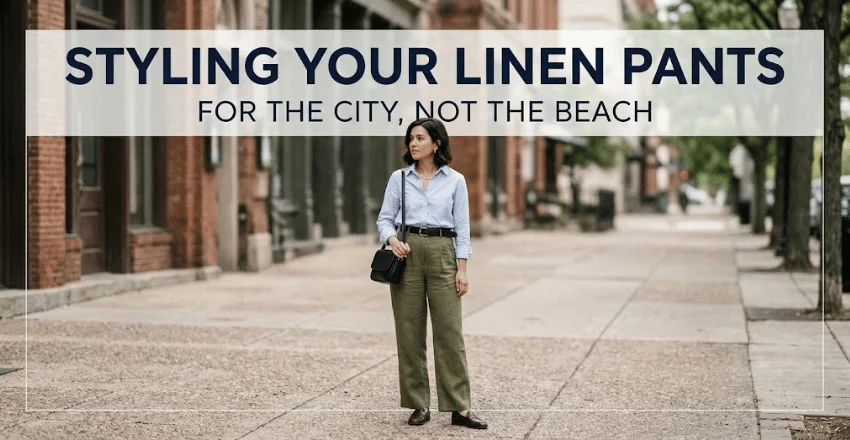
Linen reads vacation by default, so the styling job is adding structure somewhere else.
A fitted knit tank, a tucked poplin shirt, or a fine-gauge crewneck all pull the outfit back toward city. Half tucks beat full tucks on tops that sit against the waistband, since linen bulks up wherever it’s gathered.
Shoes decide the register. Flat leather sandals and canvas sneakers keep it weekend, while a loafer, a slingback or a low block heel takes the same pants to an office. Add a belt with a real buckle and a structured bag, and a $42 pair stops looking like a $42 pair.
Color does quiet work too. Olive, navy, black, and clay all look less resort than white or natural, and they solve the opacity problem at the same time.
Care and Longevity: Getting Five Summers From One Pair
Linen is one of the few fabrics that improves with age, so the goal of care is not to keep a pair pristine. It is to keep the fibers strong while they soften.
Wash cold on a gentle cycle, and wash less often than you think. Flax releases odor easily, so an airing on a hanger overnight often does the job. Skip fabric softener, which coats the fiber and cuts the breathability you paid for. Skip bleach entirely on natural and undyed pairs, because it yellows flax rather than whitening it.
Air dry, always, if you can manage it. Heat is what does permanent damage, and a line-dried pair keeps its measurements for years.
For pressing, steam beats a hot iron. A steamer relaxes the fiber without flattening the texture, and it resets the knee and seat bagging that shows up on wide-leg styles after a long day of sitting. Ten seconds on each knee, hanging, is usually enough. Store the pair folded rather than hung if the waistband is elastic, since gravity stretches elastic over a season.
Repair beats replacement with this fabric. A split seam, a stretched buttonhole or a frayed hem is a fifteen-minute job at a tailor, and the cloth around it is often stronger than it was new. The same logic applies below the hem. Good shoes outlast several summers of pants if you look after them. Our notes on cleaning suede shoes without wrecking the nap cover the pairs most likely to end up under these.
Next time you’re standing in a fitting room, do the window test before you look at the mirror. It takes five seconds, and it is the single check that decides whether the pair you’re holding gets worn for five summers or for one afternoon.
If you want to know about Wide-Leg Jeans by Height, then visit our Fashion category.
Linen Pants FAQ
Yes, though less than people fear. Testing across garment linen puts typical first wash shrinkage at roughly 3% to 7%, rising toward 10% in hot water and a hot dryer. Cold water and air drying keep it at the low end. A pair labeled garment washed or pre-shrunk has already taken most of that hit at the factory.
Low weight and a pale color, in that order. Under about 180 GGSM, there’s enough fiber in the weave to block light. White and natural show the most, since light colors reflect rather than absorb. A dark pair at the same weight can look fully opaque.
Mid-weight pure flax and linen cotton blends, by a wide margin. Both get softer over years instead of pilling. Viscose heavy blends feel the nicest new and lose the most over time, because wet viscose fibers are weak and the fabric thins where it rubs.
Stop fighting it, then reduce it. Hang the pair straight from the dryer or the line while it’s faintly damp, and most of the creasing drops out on its own. Pick a blend if your day involves a car and a desk. Keep a travel steamer at work if it involves both.
A heavier flax in a dark color, pressed once with a steamer, sits comfortably in most business casual rooms. Skip the drawstring waist and the cropped hem for that. A flat front, a real closure, and a clean full-length hem do the work.