
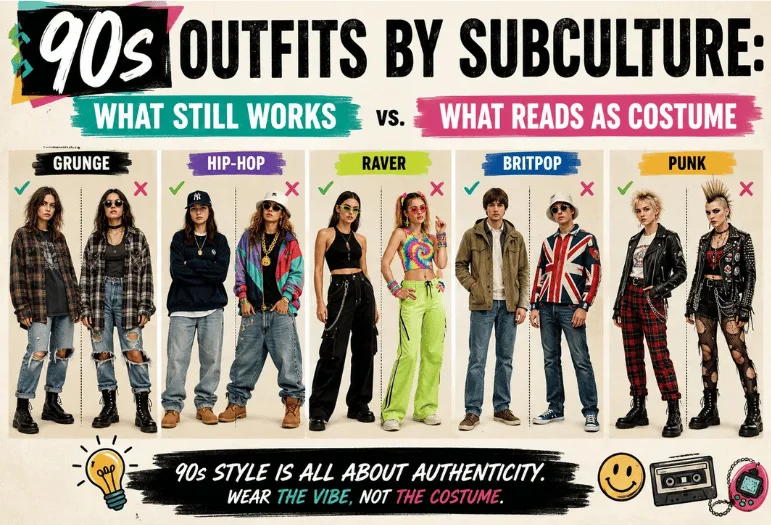
Ask ten people to describe 90s outfits, and you get ten different answers. That is not confusion. The decade held at least six separate style movements, and several of them openly disliked each other. Grunge kids and club kids were never shopping in the same stores.
So the ranking listicles get it wrong from the first line. The decade was not one look. Grunge, minimalism, hip hop streetwear, preppy plaid, rave gear, and mall pop each had their own uniform, their own music, and their own price point. Sort by subculture and the whole thing suddenly makes sense.
Key takeaways
- Six distinct subcultures, not one aesthetic. Pick the one that matches how you already dress.
- Minimalism and grunge translate almost unchanged. Rave gear mostly does not.
- One or two period pieces per outfit. Three or more tips into costume.
- Keep the silhouette, modernize the fit. Shoulders and rise give a costume away first.
- Real vintage is no longer cheap. A genuine pair of 90s Levi’s runs $50 to $300.
The six 90s outfits, side by side
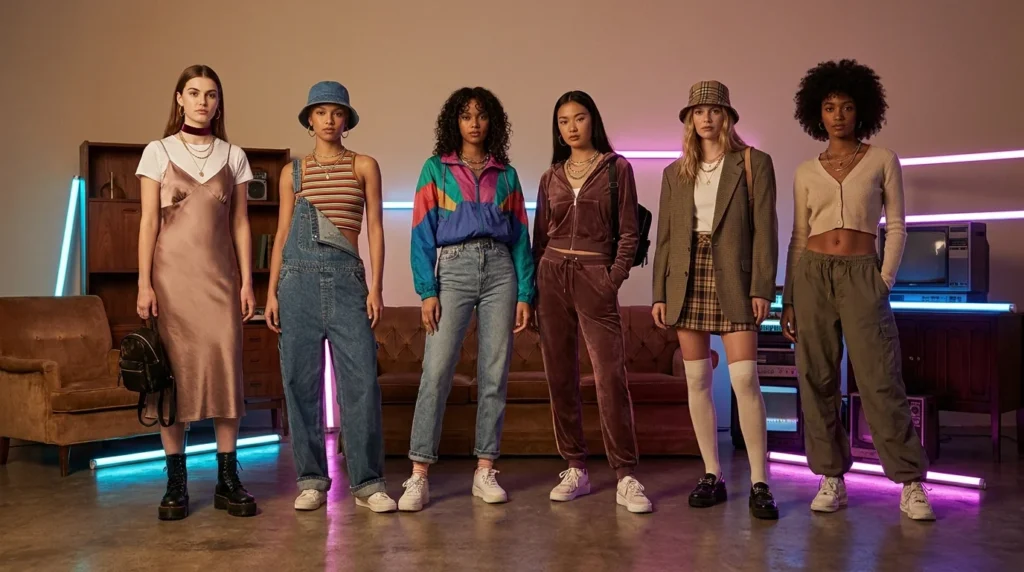
Here is the whole decade on one screen, with an honest verdict on each.
| Subculture | Defining pieces | Wearable now? |
| Grunge | Oversized flannel, band tee, slip dress layered over a tee, ripped denim, Dr. Martens | Yes, nearly all of it |
| Minimalism | Bias-cut slip dress, neutral column, trench, flat sandals, zero logos | Yes, and it reads expensive |
| Hip hop and streetwear | Oversized denim, logo sweatshirts, jerseys, Timberlands, gold hoops | Yes, if the fit looks deliberate |
| Preppy plaid | Plaid two-piece set, cropped cardigan, knee socks, mini shoulder bag | Half. Knee socks are the problem |
| Rave and club kid | Mesh, neon synthetics, phat pants, platform boots, kandi stacks | Mostly costume. One piece maximum |
| Mall pop | Baby tee, butterfly clips, flare jeans, chunky sneakers, mini backpack | Yes, with a longer tee |
Grunge
Grunge came out of Seattle and out of not caring. Flannel worn open over a band tee. Torn jeans, thermal layers, Dr. Martens laced halfway up and left loose at the top. People forget the slip dress worn over a t-shirt, which Courtney Love and Kate Moss both turned into an ordinary daytime move.
Marc Jacobs put the look on a runway for Perry Ellis in spring 1993 and lost his job over it. Fashion schools teach that collection now. Almost every piece still works, because it was cut loose to begin with and the fabrics were soft, cheap, and forgiving.
Minimalism
Then the exact opposite. Calvin Klein showed bias-cut slip dresses for spring 1994, and one of them now sits in the Museum of Modern Art collection. The palette was narrow: black, camel, ivory, oyster. No hardware, no logo, nothing shiny.
Carolyn Bessette Kennedy wore this better than anyone alive, usually a slim shift or a gray midi under a trench, with flat sandals and hair pushed back. Narciso Rodriguez cut her wedding dress in 1996. This is the one look from the decade that needs no translation at all, since it was already stripped of period markers. If you want more slip dresses and column dresses, that is the thread to pull.
Hip hop and streetwear
Oversized denim, and genuinely oversized: wide through the leg, long in the rise, belted well below the waist. Logo sweatshirts and basketball jerseys on top. Karl Kani, FUBU, and Phat Farm built the vocabulary. Tommy Hilfiger got pulled into it by artists rather than by marketing, which is why those rugby shirts still carry weight.
Wheat Timberlands finished it. So did gold hoops, bamboo earrings, a bandana, or a bucket hat. Tupac, Aaliyah, TLC, and Missy Elliott all dressed differently from each other, and that variety is the part most modern recreations flatten.
Preppy plaid
Clueless arrived in 1995 and handed the decade a uniform. Costume designer Mona May dressed Cher in a yellow plaid Jean Paul Gaultier skirt suit, after testing blue and red versions first. Blue had no power. Red looked like Christmas. The rest of that closet ran to cropped cardigans, tiny shoulder bags, knee socks, and a red Alaia dress.
Half of it survives. Plaid two-piece sets come back to stores most fall seasons and read as current. Knee socks with a mini skirt do not, and on anyone past their teens they land squarely in Halloween territory.
Rave and club kid
This is the hardest one to carry into daylight. Mesh tops over bright synthetics. Phat pants cut so wide they swallowed the shoes. Add visors, tinted round sunglasses, kandi bracelets stacked to the elbow, and Docs painted neon.
All of it was built for a dark warehouse at 3 a.m. Wear one item and stop there. A platform boot with plain denim looks intentional, and our platform boots and chunky shoes coverage goes deeper. The full kit will only ever look like a costume.
Mall pop
This is the version most people picture first. Baby tee, butterfly clips, flare jeans slung low, a mini backpack, chunky white sneakers. Spice Girls, early Britney, the Delia’s catalog arriving in the mail.
Easy to wear, easy to overdo. Modern crop lengths sit far higher than a real baby tee did, so size up and let the hem reach your waistband. It also layers well into cooler seasonal outfits once a cardigan goes over the top.
The rule that keeps you out of a theme party
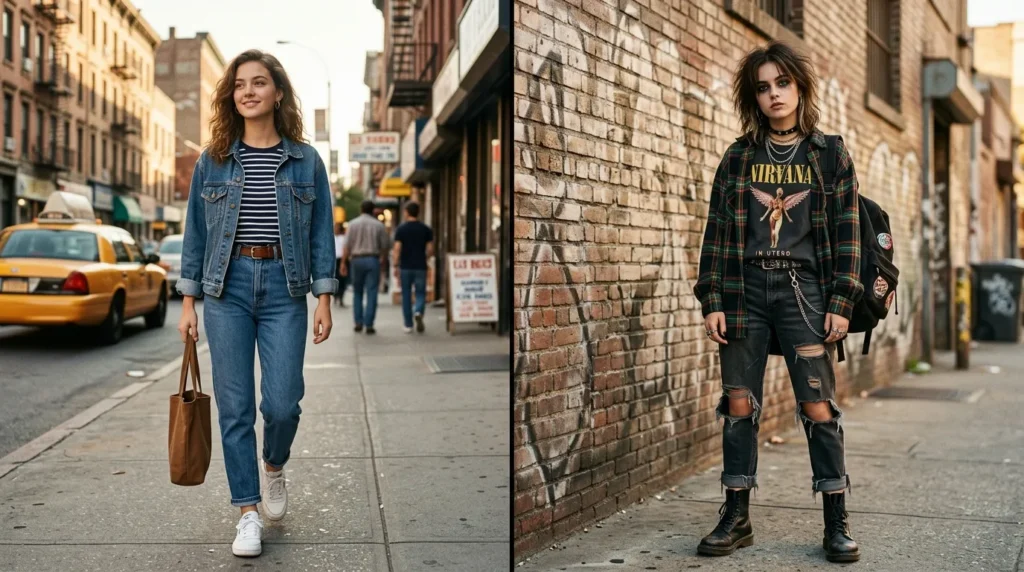
Keep the silhouette. Update the fit. A 90s silhouette in a modern fit reads as style. The identical silhouette in a period-accurate fit reads as a rental. Shoulders expose it fastest. True vintage blazers and sweatshirts carry a dropped seam and a boxy chest that photograph as dated the second you sit down.
Then there is the count, which matters more than any single item. One or two period pieces per outfit. A slip dress with current sandals is styling. That same dress with a choker, butterfly clips, platform boots, and a tiny backpack is a costume, and every person in the room clocks it instantly.
Test yourself with one question. What would a stranger name first, the outfit or the decade? If they would name the decade, remove something.
Where the real pieces are, and what they cost
Genuine vintage stopped being cheap years ago. Thrift chains price by category now, and resale sellers price by trend. Estate sales, small town charity stores, and church rummage sales are where underpriced pieces still hide, mostly because nobody sorting them is watching fashion cycles.
| Piece | Where to look | Typical price |
| Vintage Levi’s 501 from the decade | eBay, Depop, thrift bins | $50 to $300, US-made pairs mostly $100 to $200 |
| Vintage slip dress | Etsy, estate sales | $35 to $85 |
| Vintage graphic or sports tee | Flea markets, vintage stores | $20 to $80 |
| Real Nirvana or Metallica tour tee | Specialist sellers | $200 to $500 and up |
| Dr. Martens 1460, new | Brand site, Zappos | About $170 to $180 |
| Timberland 6-inch Premium, new | Brand site, department stores | Around $210 |
Two new pieces and one real one is usually the smarter split. New gives you the fit and the sizing you expect. Vintage gives you the fabric weight and the fade, which no reproduction has ever matched. Our vintage fashion coverage tracks how these prices keep moving.
One warning on sizing. Vintage labels run small and inconsistent, so measure a garment you already own flat, in inches, and buy to those numbers rather than the tag.
Where to start this week
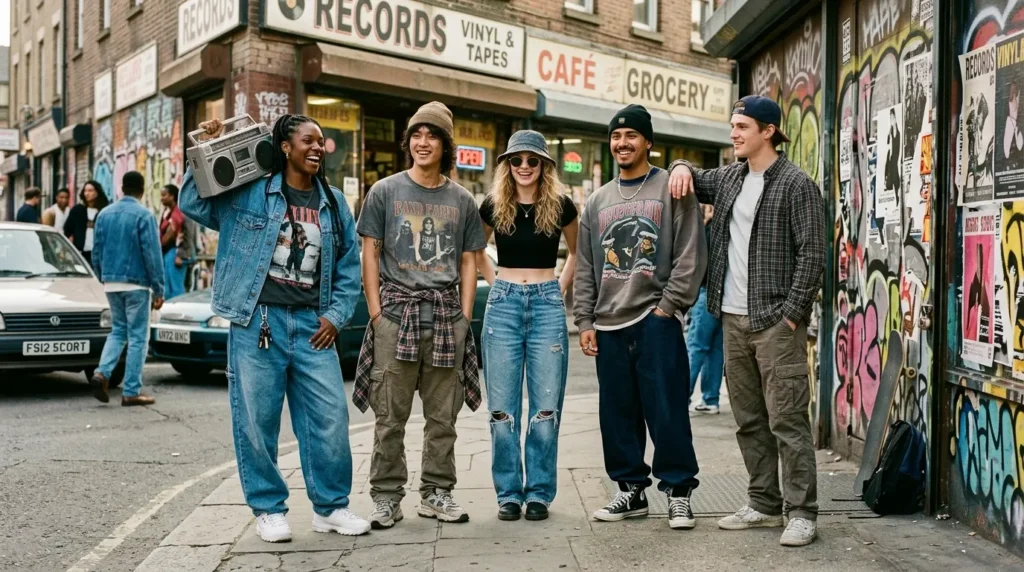
Choose one movement. Buy a single real piece from it, then build everything else from clothes you already own in a current fit. Wear it twice before adding anything else. Done that way, the decade ends up reading as your taste rather than a rental.
Conclusion
The best 90s outfits aren’t about copying an entire decade—they’re about borrowing the elements that still feel relevant today. Whether you’re drawn to grunge, minimalism, hip-hop streetwear, or preppy plaid, the key is to keep the iconic silhouette while updating the fit and styling for a modern wardrobe.
Start with one standout vintage-inspired piece, pair it with contemporary basics, and let your personal style lead the way. Done well, 90s fashion looks timeless rather than like a costume, proving that the decade’s biggest trends still have a place in 2026.
FAQs
A slip dress, with a good flannel a close second. Both were cut loose from the start, so neither fights a modern body.
Rarely. A genuine pair of vintage Levi’s often costs more than a new pair off the shelf. You are paying for the fade and the cut, not for savings.
Three or more period items at once, plus accessories that only ever existed in one decade. Butterfly clips and a velvet choker together will do it on their own.
Yes, and it usually beats picking one. A minimalist slip dress over a grunge band tee is exactly what people were doing in 1994.