

Almost every disappointing pair starts the same way. You pull them on in the fitting room, check that the waist button closes, look at the mirror from the front, and buy. Nobody reads the inseam tag. That one skipped number is why so many jean shorts ride up, gap at the back, and look wrong the second you sit down.
Pick the inseam first, the rise second, and the stretch third. A 2– to 3-inch inseam reads as a cutoff. Four to five inches is the safe daily range for most people. Anything past seven inches reads as a Bermuda. And leg opening, not length, is what stops the climb between your thighs.
Inseam Lengths In Inches, And Who Each One Suits
Use this as a quick reference. Inseam is measured flat, from the crotch seam straight down to the hem, and it is the single number that predicts how a pair will behave on you.
| Inseam | Where it lands | Who it suits |
| 2 in. | High on the thigh, near the hip crease | A deliberately leggy look for beach days and festivals. Best on narrow hips and anyone who does not mind adjusting. |
| 3 in. | Upper thigh | The classic 90s cutoff line. Good if your legs are short to average and you want them to read longer. |
| 4 in. | Mid thigh | The safest everyday length. It clears the spot where thighs press together, so it stays put through a walk. |
| 5 in. | Just past mid thigh | Strong pick if you carry weight on the thigh or want real coverage while seated. |
| 7 in. | Two or three inches above the knee | Long torsos, taller frames, and anyone who wants to wear denim to an office. |
| 9 to 11 in. | At or a little below the knee | The Bermuda and jort length. Reads polished on 5 ft 7 and up, or on anyone in a heel. |
Key Takeaways
- A 4- to 5-inch inseam is the range that works for the widest group of people.
- Ride-up is caused by a narrow leg opening, not by the hem being too short.
- Look for 98% cotton with 2% elastane. Zero stretch walks upward, and 5% stretch bags out at the thigh.
- A gaping back waistband is a shape problem. Sizing up widens it.
- Expect $25 to $40 at mass market, $55 to $80 at mall denim, and $150 and up for premium.
The Mistake Happens At The Inseam Tag
Waist size gets all the attention because it is the number that stops you from buttoning up in jean shorts. Inseam is the number that decides everything after that.
Two pairs marked size 27 can differ by three inches of leg. One sits at mid-thigh and stays there all afternoon. The other lands right at the hip crease, so every step drags it higher, and you spend the day tugging.
Brands almost always publish that number. Abercrombie, Levi’s and Madewell all print the inseam in inches on the product page next to the wash name, and in a store it sits on the paper hangtag. Read it before the mirror talks you into anything.
Why Does Denim Climb Between Your Thighs?
This is a friction problem with three causes, and only one of them is length.
- The leg opening is too narrow. When the hem circumference sits close to your thigh circumference, the fabric has nowhere to go, so it walks up. On a straight 4-inch cut, look for a leg opening around 22 to 24 inches.
- The denim has no give. Rigid 100% cotton holds a beautiful shape and cannot stretch across a stride, so it travels instead. A little elastane lets the fabric move and return.
- The hem lands in the gap. Anything under 3 inches sits exactly where thighs meet, which is the worst possible place to ask a hem to stay still.
Width where your body is widest is what keeps a hem quiet. Our pleated skirt volume guide shows the same physics on a different garment. Fold count changes how much room the fabric gets at the hip, and denim answers to that rule too.
How To Pick Your Inseam In Six Moves?
Work through these in order. Each one narrows the choice, and th..e sixth is the one people skip.
- Measure a pair you already like. Lay them flat, run a tape from the crotch seam to the hem, and write the number down. That is your baseline.
- Adjust the baseline by an inch. Add one if that pair rides up on you. Take one off if the hem feels heavy or fussy when you walk.
- Check the leg opening on the size chart. If the brand publishes it, a wider opening at the same inseam is the better buy every time.
- Sit down in the fitting room. Hems move up an inch or two when you fold at the hip, and standing tells you nothing about that.
- Match the rise to your torso. A long torso wants a high rise so the waistband has somewhere to sit. A short torso is cut in half by one.
- Buy the length you will wear on a normal Tuesday. Not the one that looked good on somebody with a different job and a different summer.
Rise, And Why Sizing Up Will Not Fix A Gaping Waistband
A back gap is a shape problem dressed up as a size problem in jean shorts. The waistband is a straight band of fabric; your lower back curves, and denim with no stretch has no way to follow that curve.
Going up a size makes the gap wider. You have added circumference at the exact place that already had too much of it.
The real fix is a tailor, and it is cheap. Expect around $15 to $25 for a small dart or a nipped center back seam, which is less than the price difference between two brands.
On rise itself: high rise sits at or near the navel and grips the narrowest part of the waist, which is why it gaps less and rides up less. Mid rise sits an inch or two lower and moves more freely. Low rise is back in circulation for 2026, and it needs a flat leg opening to stay put, because the whole garment has less anchor.
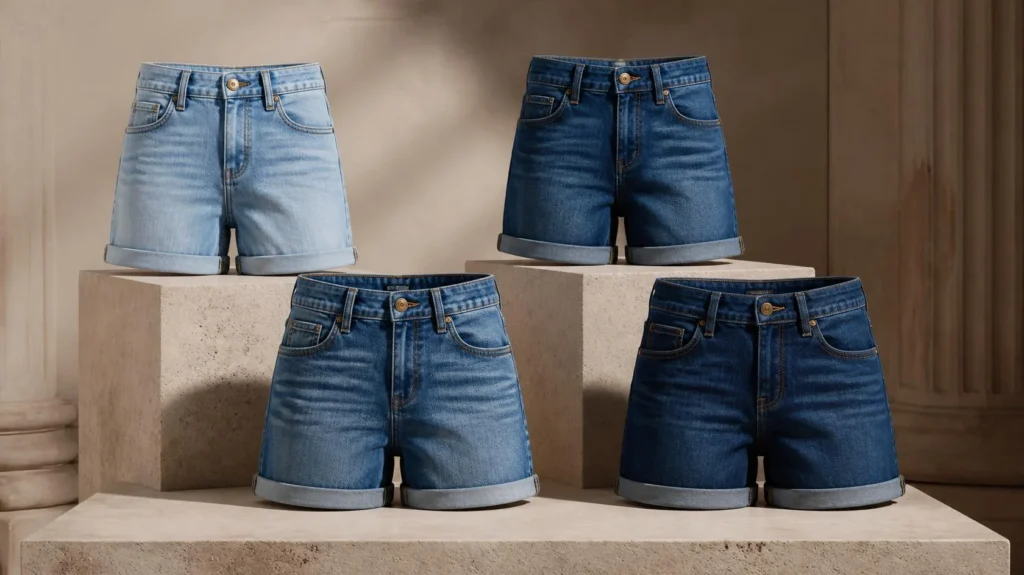
Four Cuts Of Jean Shorts, And The Trade-Off Each Makes
Every cut on the market buys you something and charges you something. Here is the honest version.
| Cut | Typical inseam | Pros | Cons |
| Mom, high rise | 2.5 to 3 in. | Holds the waist, tucks well, no gap | Climbs fastest, least coverage seated |
| 90s cutoff | 3 to 3.5 in. | Raw hem softens beautifully, timeless line | Usually rigid, so no give across a stride |
| A-line or dad | 4 to 5 in. | Wide leg opening, strongest ride-up resistance | Can read boxy on shorter legs without a heel |
| Bermuda or jort | 9 to 11 in. | Polished enough for an office, full coverage | Needs height or a heel, and it is warmer |
Our pick, if you are buying one pair to do the most work: a 5-inch A-line in 98% cotton and 2% elastane, mid-blue, high rise. It has the leg opening to stay where you put it, plus enough length to sit down in. It also dates far more slowly than a 2-inch cutoff or an 11-inch jort.
What A Decent Pair Costs In 2026?

Prices sort into four bands, and the jumps between them buy different things.
- Mass market (Old Navy, Target, Gap): $25 to $40: thin cotton blends, generous stretch, one or two seasons of wear.
- Mall denim (Abercrombie, Levi’s, American Eagle): $55 to $80. Abercrombie’s denim shorts sat between $60 and $75 across six published inseams when we checked in July 2026.
- Contemporary (Madewell, Reformation, Everlane): $78 to $110. Heavier cotton and a hem that holds its color through a summer of washing.
- Premium (AGOLDE, Rag & Bone, Frame): $150 to $230.
Moving from mall to contemporary buys you cotton quality. Moving from contemporary to premium buys you a fit block and a wash, not more durability. Pay that only when the fit is genuinely better on your body. For more of the same buying logic across other garments, browse our fashion archive.
Cut Your Own From A Pair Of Old Jeans
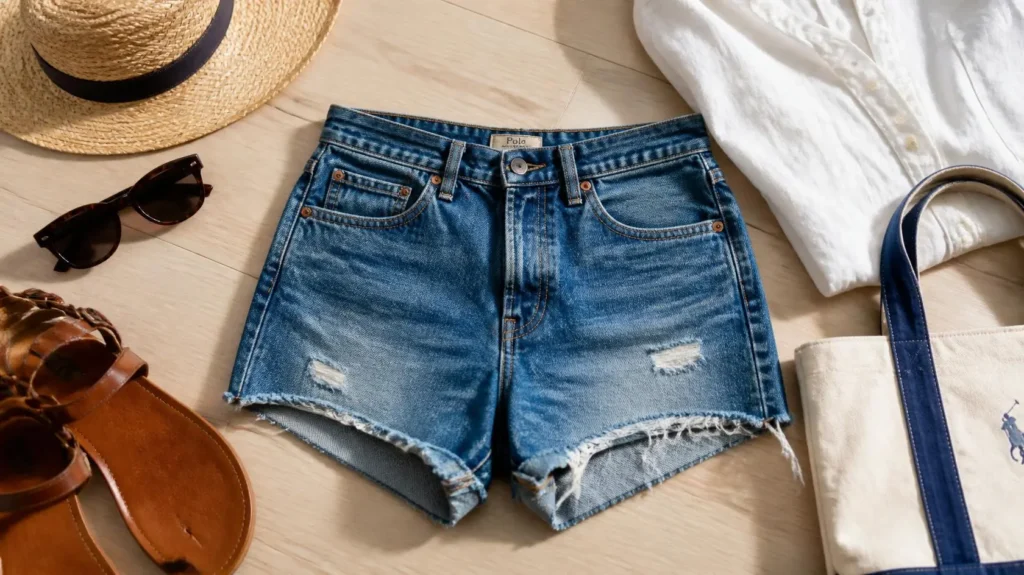
Plenty of the sharpest fitting pairs in circulation started life as jeans with a blown-out knee for jean shorts. The rise already fits, which is the hard part to solve. All that is left is the hem.
- Start with jeans whose waist you already like. Wide-leg and straight-leg both work. A tapered leg gives you a narrow opening, which is the thing you are trying to avoid.
- Put them on and mark with chalk. Mark the outer seam where you want the finished hem to land, then step out of them.
- Cut two inches below the mark. This is the rule that saves the project. Denim always looks shorter off the body than on it, and you cannot add fabric back.
- Cut the second leg using the first as a template. Lay them flat, line up the seams, and trace. Freehanding the second leg is how you end up with a half-inch tilt.
- Try them on and trim in half-inch passes. Angle the cut up slightly toward the outer seam. That tiny lift makes the leg look longer.
- Fray the edge. Pull the white weft threads out with tweezers for a controlled fringe, or throw them in a hot wash and dryer once for a rougher one.
Wash Them So The Frayed Hem Holds

Denim cutoffs fail at the hem long before they fail anywhere else. Those threads that make the fringe look good will unravel into a mess if you let them.
Wash cold, inside out, on a gentle cycle, and skip the fabric softener. Softener coats cotton fiber and flattens the texture that gives raw denim its character. Hang dry from the waistband rather than the hem so the weight of the water is not pulling on the cut edge.
One hot tumble dry is useful, though. It blooms a fresh cut into a proper fringe, and after that a low or no-heat dry keeps the fringe from growing another inch every month.
Wash every four or five wears, not every wear. Between washes, air them overnight.
Give the rest of the outfit the same attention. Our walkthrough on how to clean suede shoes without wrecking the nap covers the sandals and sneakers most people wear with denim in July. Those go patchy faster than anything else in a summer wardrobe. use,
useow d a tape measure, check the inseam on the pair you already reach for, and shop from that number instead of the size on the tag.
FAQ
Four to five inches, for most people. It sits below the widest part of the thigh and above the knee, which is the section of leg that reads longest.
No. Rigid cotton relaxes about a half size after two or three wears, so buy the size that closes with effort. Size up, and you will be wearing a belt by August.
Not at all. Short cutoffs are still everywhere. What changed this year is length: Bermuda cuts at 9 to 11 inches showed up across summer 2026 collections at nearly every price point.
A rolling hem means the leg opening is fighting your thigh. Move up an inch of inseam or pick a straighter cut. Cuffing and pressing the fold with a hot iron holds it for a day, not a season.
In a casual office, a 7-inch or longer pair in a dark wash with no distressing passes. Add a loafer and a tucked shirt. Anything with a raw hem still reads as weekend.