
It is 95F on the sidewalk and 68F at your desk. Heat dressing fails for reasons nobody photographs: sweat marks, chafing, cling, sheerness, and a thermostat you do not control. Cute is the easy part. Staying comfortable in real heat takes a plan.
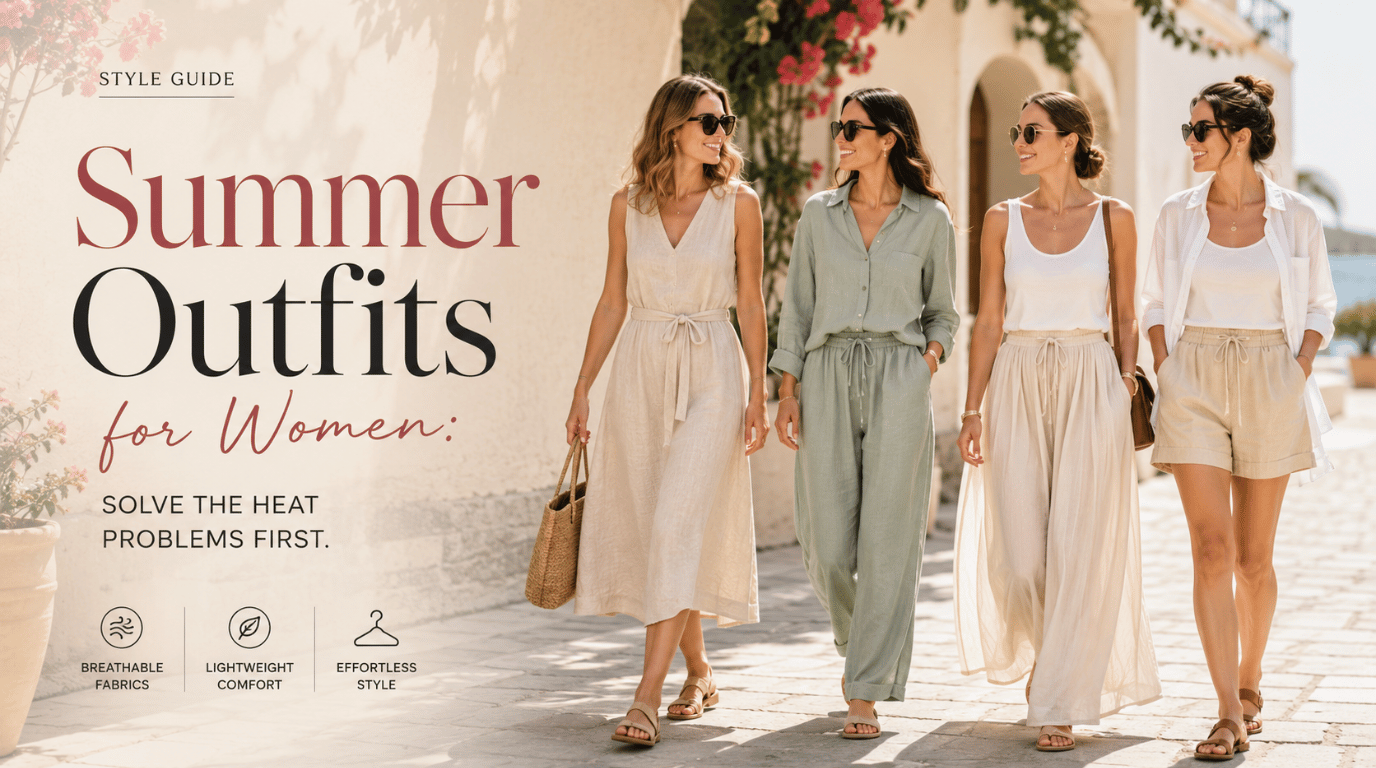
The most wearable summer outfits for women start with fabric and color, not silhouette. Choose linen, Tencel, or a cotton modal blend. Skip heather gray and pale blue, which show sweat marks fastest. Add slip shorts under skirts, one light layer for cold offices, and a lined bottom for bright sun.
Key takeaways
- Heather gray and pale blue show sweat marks first. Prints, white, and black hide them.
- Linen and Tencel breathe. Rayon clings the second you get damp.
- Slip shorts with a 7-inch inseam end chafing between the thighs.
- Do the daylight test before you buy, not in the parking lot after.
- One packable layer solves the 68F office.
Problem one: sweat marks and the colors that betray you
Before the pretty part, the physics. For more season-specific styling once you have the basics down, our seasonal outfits archive covers the rest of the calendar. Sweat visibility is a contrast problem. Damp fabric and dry fabric bounce light differently, and mid-tone colors show that gap hardest.
Heather gray is the worst offender because the yarn is already two-toned, so a damp patch reads as a third shade. Pale blue sits right behind it. White is safer than people expect. It reflects light, and a fresh damp patch barely registers, though white does yellow at the underarm over a few seasons. Black hides marks too, until salt rings show up. The quiet winner is a busy print.
Pattern breaks the outline of a mark before your eye can read it. A ditsy floral, a stripe, a small geometric: all of them buy you an hour you would not otherwise get. That is why print dresses dominate every August street style feed.
- Safest colors: prints, white, black, navy, deep jewel tones
- Riskiest colors: heather gray, light gray, pale blue, dusty pink, khaki
Fabric ratings for breathability, sweat visibility, and cling

Fiber decides more than cut does. Which fabric keeps you coolest without clinging to damp skin? Read the ratings below, because these are the fabrics people wear all summer, and only half of them earn it.
| Fabric | Breathability | Shows sweat | Clings when damp | Best use |
| Linen | Excellent | Low, texture hides it | Low | Pants, shirts, wide dresses |
| Tencel lyocell | Excellent | Low | Very low | Office pieces, slip skirts |
| Cotton modal blend | Good | Moderate | Low | Tees, everyday knits |
| 100% cotton jersey | Good | High | Moderate | Loose tops only |
| Rayon or viscose | Moderate | High | High | Skip in real heat |
| Silk | Moderate | Very high | Moderate | Evening, air conditioning |
| Non-wicking polyester | Poor | Low | Moderate | Traps heat, holds odor |
Two numbers explain the table. Tencel moves moisture roughly 50% better than cotton, so its surface stays dry to the touch. Linen creases at the elbow and hip within about 15 minutes of sitting, which is the trade you accept for airflow. Between the two, Tencel is the fabric that keeps you coolest without clinging to damp skin.
Problem two: chafing between the thighs
This ends more outfits than any trend does. Skin rubs, heat softens it, and by block three you are limping. Skirts and dresses cause it because nothing sits between your legs. Slip shorts fix it, but only the right ones. The inseam has to run past the point where your thighs actually touch, which for most people means 5 to 9 inches.
A 7-inch inseam covers most bodies. Check the hem too, because a rolled band digs in worse than the chafe did.
- Choose a flat, bonded hem. Elastic bands roll and then bite.
- Skip lace trim under a dress. The texture abrades damp skin.
- Keep an anti-chafe balm stick in your bag for $10 to $16. It buys you a few hours, not a day.
- The powder works for low-activity days and quits the moment you sweat hard.
Cooling mesh slip shorts run $20 to $40 a pair. Buy two.
Problem three: cling on damp skin and sheerness in bright sun
Cling and sheerness are separate failures that show up together. Rayon and thin jersey grab wet skin and map every line underneath. Fabric with a little body solves it: linen, poplin, a structured Tencel, or a knit with a dense gauge. A half-inch of air between cloth and skin does more than any shapewear.
Sheerness is easier to test than to fix. Hold the garment up to a window before you buy it, or shine your phone flashlight through the back panel. Direct noon sun is far brighter than store lighting, so anything borderline indoors will be transparent outside. White and cream bottoms need a lining or a nude slip, full stop, and the same rule applies to the lightweight summer dresses everyone reaches for in July.
One more trick. Match your underwear to your skin tone rather than to the garment, since white under white glows in sunlight. Seamless styles disappear under thin cloth better than lace does.
Problem four: 95F outside, 68F at your desk
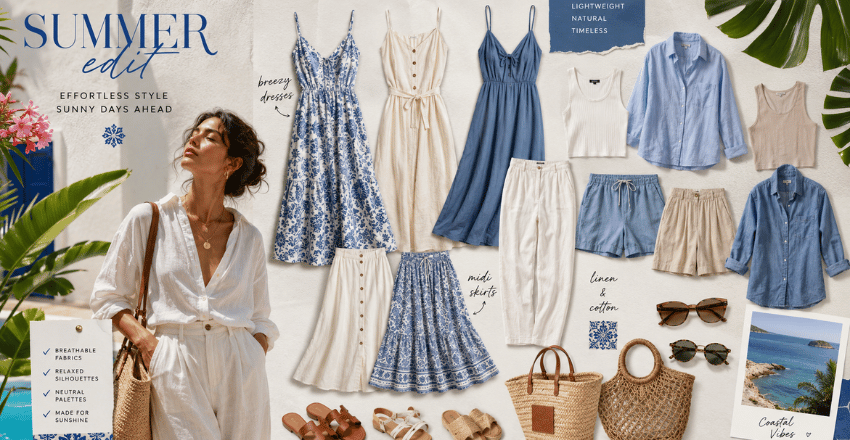
That is a 27-degree swing, twice a day. Dressing for one end guarantees misery at the other. The fix is not a heavier outfit. It is a base you can wear in the heat plus one layer that never leaves the building. Leave a cardigan or a light blazer on your chair permanently. Then your commute outfit can be genuinely sleeveless. Closed shoes matter more than sleeves in a cold office, since ankles and feet chill first. We cover this in more depth in Elegant Thanksgiving Outfit Ideas.
Fabric weight matters here too. Two thin layers beat one medium layer because you can shed half of it. Your outer piece should fold to the size of a paperback, so keep it unstructured and unlined. A thin scarf in your bag doubles as a shoulder cover for over-air-conditioned trains, restaurants, and movie theaters.
Outfit formulas: summer outfits for women by situation
Pick the situation, then the pieces. Each formula below assumes the fabric rules above.
The hot commute
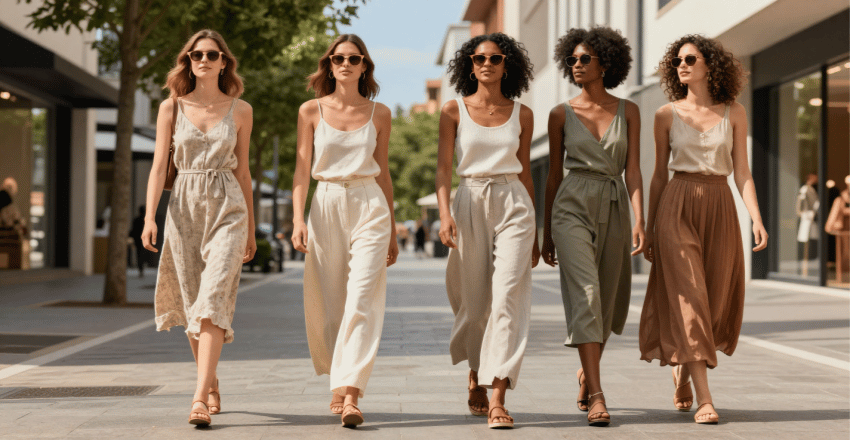
Printed midi dress, slip shorts underneath, flat sandals in your hand or on your feet. Nothing tucked, nothing tight at the waist. Change shoes at your desk if the walk is long.
The office
Tencel wide-leg pants, a sleeveless shell in white or a small print, and the blazer that lives on your chair. This reads polished on camera and survives a 68F room. Linen pants work too if you accept the creases.
The weekend
Linen shorts, an oversized cotton modal tee, and a cap. Loose everything. If you are walking a lot, swap sandals for something with a real footbed.
Evening out
Silk or satin finally earns its place after sundown, when the temperature drops and the venue is cooled. A bias-slip skirt with a fitted knit tank looks expensive and moves. Keep the shoulders bare and the hem light.
The travel day
Airports are the worst version of the thermostat problem. Wear a knit set in a dark print, ankle socks, and easy slip-on shoes. Add compression if the flight runs past four hours.
What this costs
Real numbers, current US pricing, no aspirational nonsense.
- Linen shirt: from about $36 at Quince, from about $40 at Uniqlo
- Wide-leg linen pants: around $50 at either brand
- Unlined linen blazer: $80 to $130 depending on the season
- Slip or cooling shorts: $20 to $40 per pair
- Anti-chafe balm: $10 to $16
A full working summer rotation lands near $250 to $400 if you buy carefully and repeat pieces. That is cheaper than replacing three sweat-ruined tops in August.
Apart from that, if you want to know, then please visit our seasonal outfits category.
FAQ: summer outfits for women
A busy print. Pattern scatters the outline of a damp patch, so nobody registers it. White and black come next, and heather gray is the color to avoid.
Linen. Its fibers are hollow and loosely woven, so air moves through, and moisture evaporates. Cotton absorbs sweat and then holds it against your skin.
Wear slip shorts long enough to cover the contact point, usually a 7-inch inseam. Balm helps on short days. Reapply it every few hours.
Cotton or mesh versions barely register. Thick shapewear does trap heat, so pick the lightest pair that still covers the contact point. Comfort beats compression in July.
A sleeveless base in a breathable fabric, closed shoes, and one layer you leave at work. Never dress for your commute because of the air conditioning.
Your next step
Pick the failure that bothers you most this week. If it is sweat marks, change one gray tee for a print. If it is chafing, order two pairs of slip shorts before Friday. Fix one problem at a time, and the outfits stop feeling like a gamble.