
Business Casual for Women comes down to about seven essential pieces, and tailored mid-weight trousers can create more outfits than almost anything else in your wardrobe. This dress code is not simply a list of banned items; it is a level of structure your clothes must maintain from the first meeting to the last. Get the structure right, and the rest comes down to color, fit, and styling.
Quick answer: Business casual means tailored bottoms, a top with a finished neckline, and closed-toe shoes in leather or suede. Skip the matching suit, skip the jeans in most offices, and keep one structured layer within reach. Seven core pieces cover a full work week without repeating an outfit.
Where each office tier draws the line
Every handbook says the same vague thing. What differs is the tier of office you walked into, and each tier clears a different set of clothes. Here is what passes where.
| Office tier | What clears it below the waist | Shoes that pass | Denim and sneaker call |
| Client-facing (law, finance, consulting) | Wool-blend or crepe pants, knee-length pencil or A-line skirt | Leather pump, polished loafer, sleek ankle boot | Neither, on any day of the week |
| Standard corporate (most offices) | Ponte pants, chinos, pleated midi skirt, sheath dress | Loafer, low block heel, clean leather flat | Dark rinse denim on Fridays, sneakers rarely |
| Creative and tech | Dark denim, wide-leg twill, knit midi skirt | Leather sneaker, mule, Chelsea boot | Both fine when the top half is structured |
| Hybrid and remote-first | Anything solid that reads flat on camera | Whatever you can walk in, nobody sees them | Denim fine on camera, sneakers invisible |
Read the room of the mid-level people, not the founders and not the interns. Founders dress down because they can. New hires overdress for two weeks and then drift.
Key takeaways
- Structure beats formality. A knit with a firm shoulder outranks a limp silk blouse.
- Seven pieces, three of them bottoms, will build about fifteen workable outfits.
- Expect to spend $30 to $70 per piece at mass market, $90 to $160 at mid-tier brands, and $200 to $400 in contemporary.
- Denim and sneakers are a tier question, never a yes-or-no question.
- Fabric weight and hem length decide whether an outfit reads polished.
The 7 pieces that do the most work, ranked
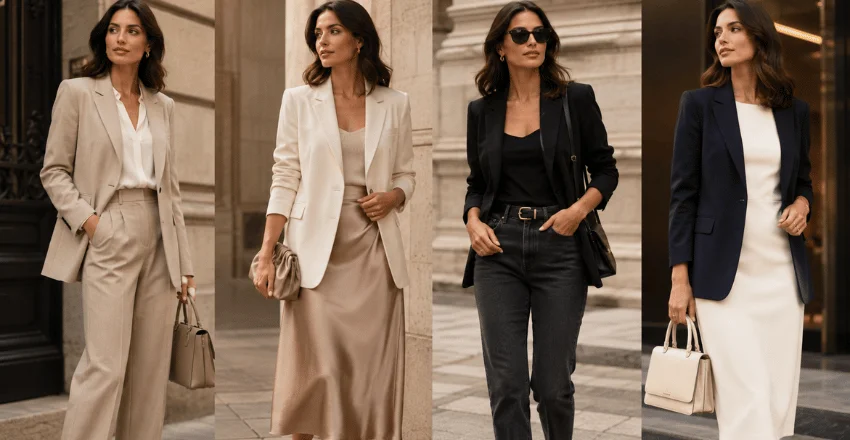
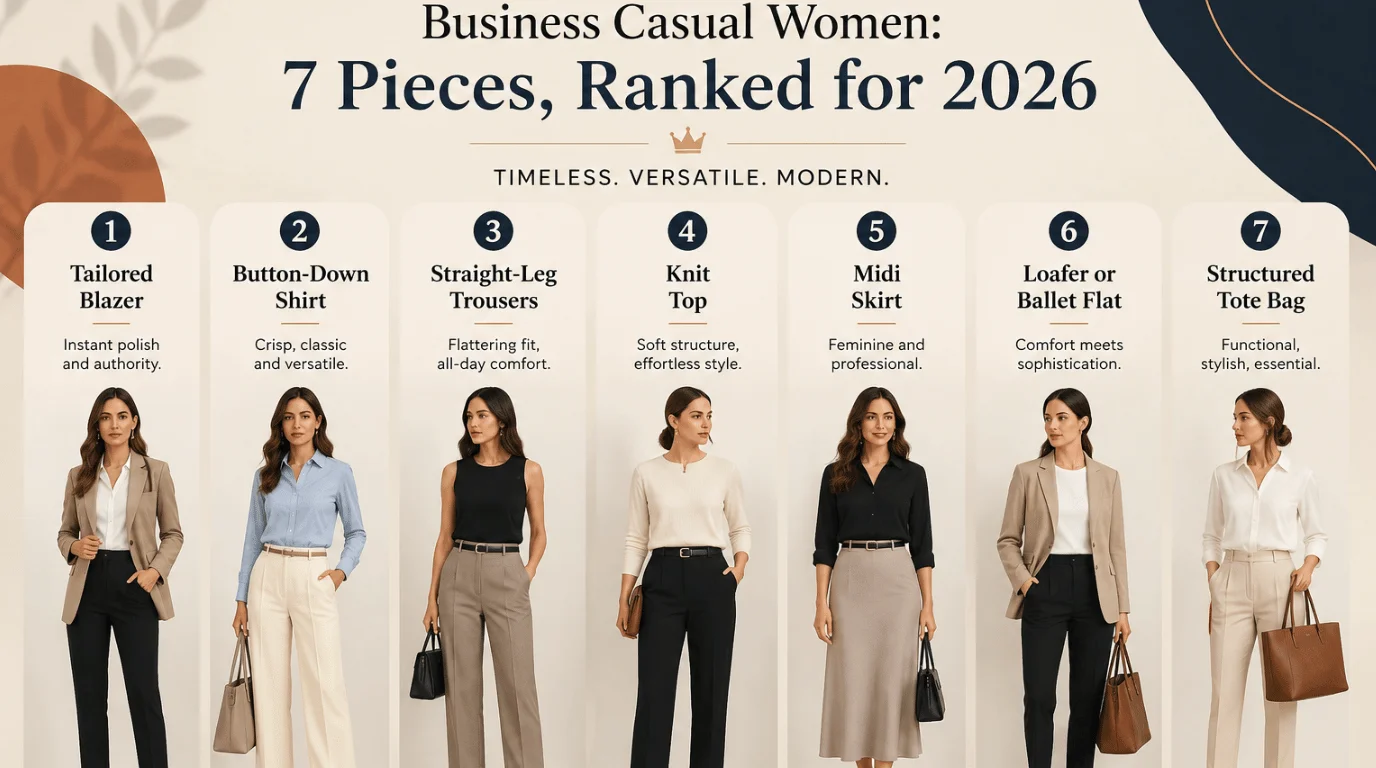
Ranked by how many finished outfits each one produces, not by how much anyone likes it. The count in brackets is roughly how many of the other six it pairs with cleanly.
- Tailored mid-weight pants, straight or slightly wide. [6] Ponte, crepe, or a wool blend in navy, charcoal, or black. One pair in a neutral will anchor most of a week, and a second pair in the same cut and a different color doubles the wardrobe for almost nothing.
- A soft-structured blazer. [6] Unlined or half-lined, cut to hit at the hip bone. This is the single piece that moves an outfit up a tier, which matters on the days you find out at 10 a.m. that a client is coming in.
- A fine-gauge knit top. [5] Merino or a good cotton blend in a crew or boat neck. It looks more finished than a T-shirt, needs no ironing, and layers under the blazer without bulk at the armhole.
- Leather loafers or a low block heel. [5] Closed toe, real leather or suede, stacked heel under two inches. Comfort here is not a compromise, because a shoe you limp in ruins the outfit above it.
- A pleated midi skirt [4]. Pleat depth decides how much width lands at your hip. Our guide to pleated skirt shapes and volume breaks that down by pleat type. Pressed pleats look more formal; unpressed read softer.
- A sheath or shirt dress. [4] One garment, no decisions, and it takes a blazer on top when the day turns formal. Knee-length or midi both work.
- A crisp button-front shirt in matte cotton. [4] Skip anything shiny, because a satiny sheen photographs badly and reads “evening” rather than “office.” Poplin and oxford cloth both hold a collar.
Fabric weight and hem break decide the polish
Two variables separate a sharp outfit from a limp one, and neither is the price tag. Weight comes first. Thin, floppy fabric collapses into wrinkles by lunch, while ponte, crepe, twill, and wool blends hold their shape through a full day of sitting.
Hem break comes second. Pants should touch the top of the shoe and stop there because a puddle of extra fabric reads as borrowed, and a floating hem reads as outgrown. Most brands cut work pants around 30 inches inseam, so a $15 hemming charge is the cheapest upgrade in the wardrobe.
Shoes break more outfits than tops do
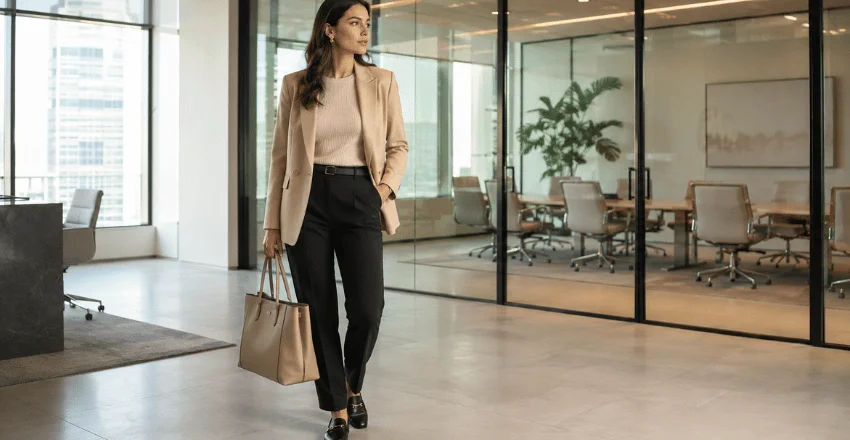
A great shoe rarely saves a mediocre outfit, but the wrong shoe sinks a good one from across the room. Closed-toe is the safe default in every tier above creative. Suede loafers and leather flats have quietly become the office standard, and both survive a commute better than heels do.
Suede has one catch: it marks. A wet sidewalk, one salt splash in February, and the nap flattens into shine. Learning to clean suede shoes without ruining the nap is worth the twenty minutes, because a brush and an eraser fix most of what a commute does.
- Safe in every office: leather loafer, pointed or almond flat, block heel under two inches, or ankle boot.
- Tier-dependent: leather sneaker, mule, knee boot, open-toe pump.
- Rarely lands well: flip-flops, running shoes, platform anything, or a heel over three inches.
What business casual women’s outfits should skip
Short list, and none of it is about being conservative. Each item below either distracts from a conversation or falls apart by 3 p.m.
- Distressed, ripped, or light-wash denim, in every tier, including tech.
- Spaghetti straps, strapless bodices, and deep cutouts. A wide shoulder strap or a shell under a blazer solves this.
- Anything sheer enough to need a second layer you didn’t plan for.
- Loud novelty prints and slogan knits, which age faster than any silhouette.
- Noisy jewelry. If it clatters on a keyboard, it clatters in a meeting.
Accessories, and where the line sits
Two visible pieces are the ceiling most offices settle on: a watch and one other thing. Metal that lives on your wrist every day gets scratched, so buy it knowing that, which is the whole argument behind our Cartier Love bracelet buying guide. A structured tote in a solid color finishes the outfit and carries a laptop, and that is the accessory worth real money.
What to wear, by scenario:
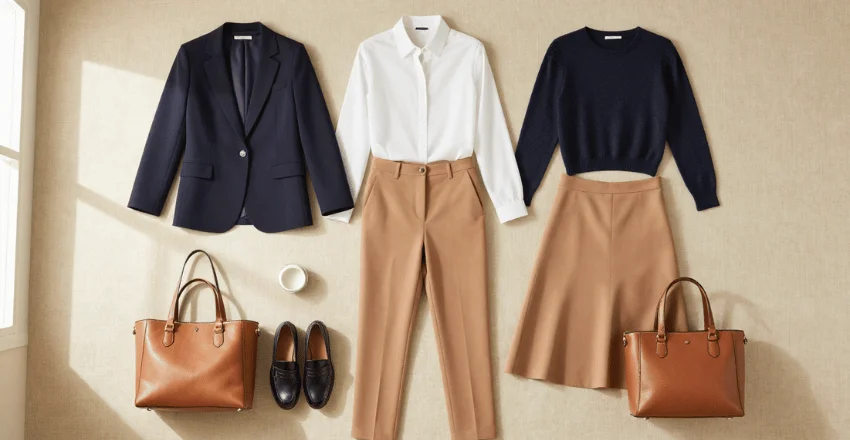
Your first day
Dress one notch above whatever the interview room looked like. Tailored pants, a fine knit, loafers, and a blazer you can take off within the hour once you read the room. Nobody remembers an overdressed first day, and everyone remembers the opposite.
A client meeting you found out about this morning
This is the blazer’s whole job. Pull it on over the knit you already have on. Swap a flat for a low heel if one lives under your desk, then check that the hem of your pants still sits clean on the shoe. Three minutes, one tier up.
A hot 95-degree week
Hot weather is where most office advice stops at the word “linen” and gives up. Better answers for how to stay cool: an unlined cotton or linen-blend overshirt in place of the blazer. Choose a wide-leg pant in light twill over a skirt that needs bare legs. Swap the knit for a woven shell. Rumpled linen still reads as effort in July, and a damp knit does not.
Hybrid Fridays and camera days
On camera, the frame stops at your ribs, so spend the effort above the waist and stop worrying about the rest. Solid colors read cleanly, small patterns shimmer, and a collar or a firm neckline gives the shot an edge to sit against. Denim below is fine on the days you never stand up.
Start with the pants and the blazer, wear them for two weeks, and see which tier your office actually sits in before you buy anything else. If you want more garment-level detail while you shop, the rest of our fashion guides archive covers the individual pieces in depth.
Apart from that, if you want to know about wide-leg jeans by height, then please visit our fashion category.
Frequently asked questions
In standard corporate and creative offices, yes, in a dark rinse with no fading, no rips, and a straight or wide leg. Client-facing offices say no, and they mean it. The test is whether the denim reads as pants rather than as weekend wear.
Leather sneakers in white, black, or bone clear a creative or tech dress code, and they clear a standard office on a Friday. Canvas and running shoes do not. Keep the sole slim, because a chunky trainer pulls the whole outfit down a tier.
A wide-strap shell or a sleeveless shift is fine in most offices, especially under a blazer. Thin straps and bare shoulders are not. Older, more traditional workplaces still expect covered shoulders, so check what senior women wear before you commit.
Smart casual allows trend pieces, bolder prints, and statement shoes, and it drops the expectation of a third layer. Business casual women’s wardrobes lean on classic cuts and quieter colors instead. Same formality level, different vocabulary.
Navy, charcoal, black, cream, camel, and olive mix with each other in almost any combination. Add color in one place, usually the top or a scarf. Head-to-toe brights are a personal-style choice, not a dress-code problem.