
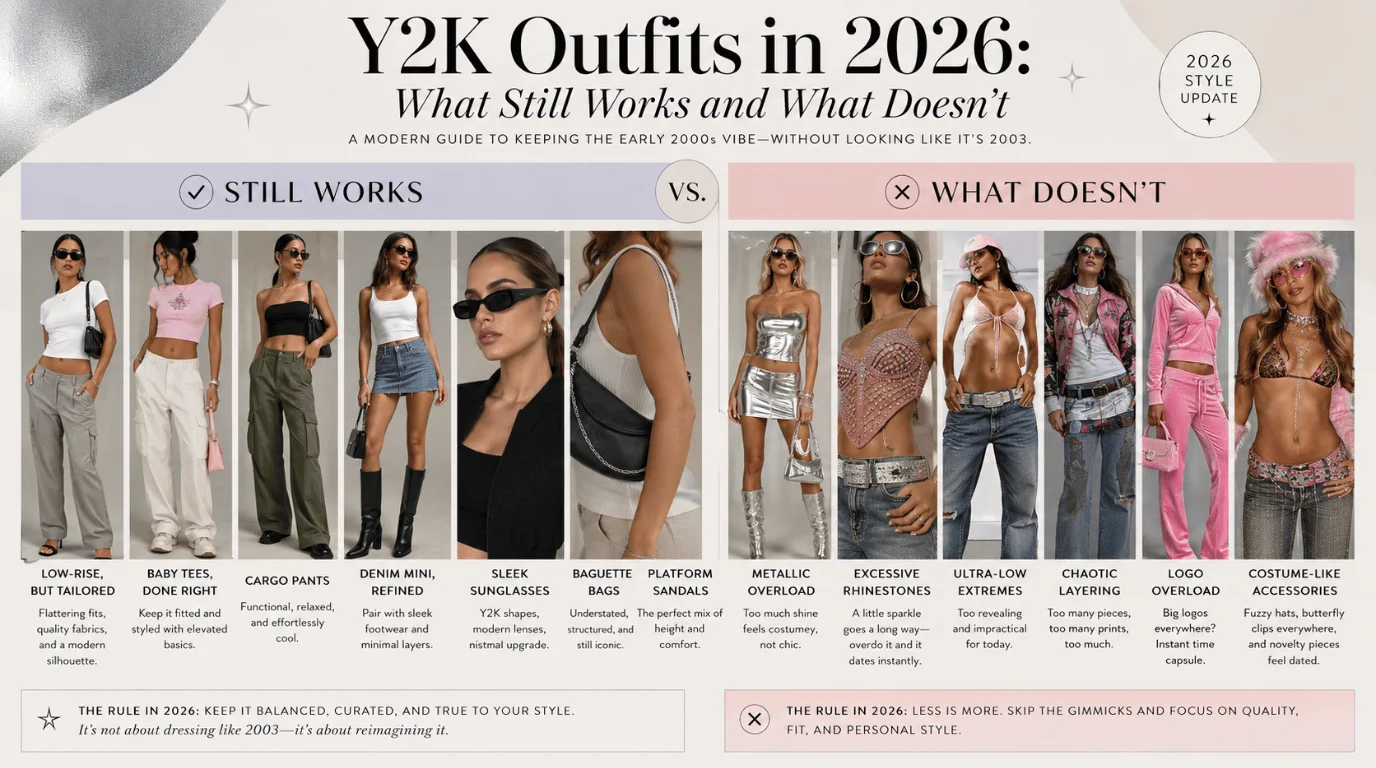
The revival turned a corner in the last eighteen months. Head-to-toe 2003 cosplay, the version that peaked around 2022, has thinned out badly. What replaced it is quieter: one loud reference per look, everything else current. Rises crept back up, rhinestones stayed, and butterfly clips mostly did not. Elsewhere on the site: Winter Coat Essentials.
That shift is why so much styling advice online now reads stale. The Y2K outfits worth building in 2026 pull from one narrow slice of 1999 to 2004 instead of the whole blur, and they hang that reference on modern denim proportions. Boho Style is a useful companion read here.
Where the revival stands right now
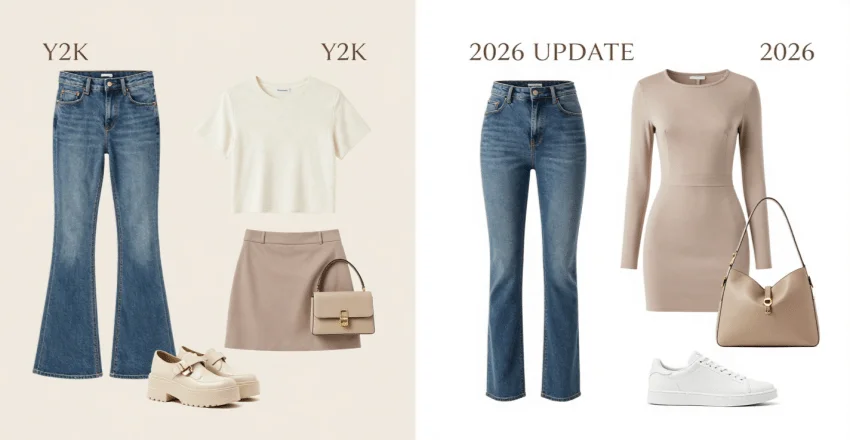
This 2026 version keeps the shine, the logos, and the bootcut, then drops the extreme proportions. Jeans sit near the navel rather than the hip bone. Skirts run a few inches longer. Tops are fitted instead of shrunken. You get the reference from one statement piece and current shoes, not from a full costume.
Here is what actually counts as the look now, piece by piece, against what the same piece meant twenty years ago.
| Piece | Then (1999 to 2004) | Y2K Outfits in 2026: Now |
| Jeans | 2 to 3 inch rise, hip bones showing, heavy flare | 7 to 8 inch rise, sits under the navel, soft bootcut |
| Skirts | Micro mini around 11 inches, pleated or denim | Pleated mini at 15 to 17 inches, or a low-waisted maxi |
| Tops | Shrunken baby tee, logo print, cropped at the ribs | Fitted tee or lace-trim cami, ending at the waistband |
| Outerwear | Cropped puffer, velour zip hoodie, denim jacket | Full-length trench, boxy leather bomber, long cardigan |
| Shoes | Pointed kitten heel, chunky platform sneaker, wedge flip-flop | Ballet flat, low kitten heel, slim retro sneaker |
| Jewelry | Stacked charm bracelets, plastic choker, body chain | One metal cuff or bangle, thin chain, small hoops |
| Bags | Rhinestone baguette worn under the arm | Full-size shoulder bag or a real tote |
Key takeaways
- Pick a wave before you shop. The 1999 to 2001 futurism slice and the 2002 to 2004 McBling slice do not mix well.
- A 7- to 8-inch rise reads modern. Below about 6 inches, you are in costume territory.
- One statement piece per outfit. Two is the ceiling, and the second one has to be small.
- Buy new denim; buy the loud stuff secondhand.
- Modern shoes are what stop the whole thing from reading as fancy-store cosplay.
Wave one, 1999 to 2001: the futurist slice
The first wave was obsessed with the future, not with nostalgia. Designers were dressing for a millennium that felt like it might arrive with jetpacks. That produced silver and gunmetal fabrics; mesh layered over solid jersey; frosted lip and hair; tinted wraparound sunglasses; and slip dresses cut on the bias in slippery synthetics.
Denim in this window was low but not extreme. Bootcut ruled, the flare started at the knee, and the rise still covered the hip bone on most bodies. This is the slice that ages best. Metallic and mesh read as futurism rather than as a specific year, so a silver cami with straight-leg jeans looks styled instead of dated.
Wave one also happens to be the cheapest to test, because most of it lives in fabric and finish rather than in a logo you have to buy.
Wave two, 2002 to 2004: McBling and the low-rise peak
Then the mood flipped from futurism to money. McBling is the shorthand for what followed: visible logos, rhinestones spelling out words, velour tracksuits, trucker hats, and denim cut so low it needed its own choreography. Paris Hilton and early Britney Spears set the template, and the whole thing was loud on purpose.
Six pieces define this wave:
- Bootcut or flared jeans with a 2 to 3 inch rise and whiskering across the front
- Rhinestone-covered baby tees and cropped logo hoodies
- Velour tracksuits in candy colors, worn as separates
- Micro-pleated mini skirts over bare legs or wide-leg pants
- Tiny shoulder bags carried in the crook of the elbow
- Stacked plastic and charm bracelets up the forearm
Wave two carries the most recognition and the most risk. Wear three of those items together, and you have a Halloween costume. Wear one against plain modern clothes, and you have a good outfit.
The 2026 reinterpretation: same references, new proportions
What changed is the ratio, not the vocabulary. Designers and stylists kept the shine, the bootcut, and the logo, then rebuilt every measurement around a body that spent five years in high-waisted denim. So the jeans sit higher. The tops are longer. The shoes are flatter and narrower. Nothing about the reference disappeared; it just stopped being the whole silhouette.
How to wear Y2K outfits now without looking costumed
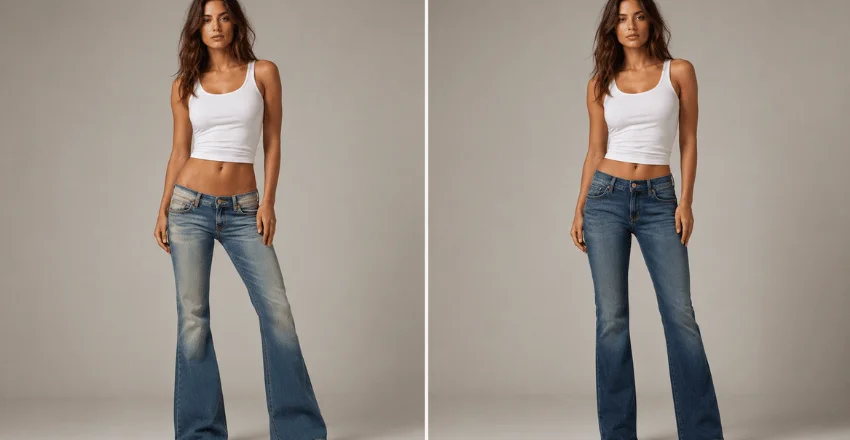
These six rules do most of the work. They are written in the order you should apply them while getting dressed.
- Set the ratio first. One statement piece per outfit, two at absolute maximum, and the second has to be small. A rhinestone tee plus a velour jacket plus a baguette bag is three items, which is one too many by a wide margin.
- Check the rise with a tape measure. Lay the jeans flat and measure from the crotch seam to the top of the waistband. Seven to eight inches reads current. Under six inches is the measurement that separates a wearable low waist from a costume one.
- Keep one half of the outfit plain. Loud top, quiet bottom. Loud bottom, quiet top. Never both.
- Modernize the shoes. This is the single biggest lever. A ballet flat or a low kitten heel under flared denim pulls the whole outfit into this decade.
- Swap charm stacks for one metal piece. A single bangle does what six plastic bracelets used to do. If you want the version that lasts, a Cartier Love bracelet is the grown-up end of that idea, and a plain gold cuff is the affordable one.
- Skip the era-accurate makeup. Frosted eyeshadow and thin brows date an outfit faster than any garment does.
Three pieces that tip an outfit into costume territory
- The trucker hat with a slogan. Swap it for a plain baseball cap or a solid-color bucket hat.
- The plastic butterfly clip set. Swap it for two small metal claw clips or a single butterfly pin at the back.
- The full velour tracksuit worn as a set. Split it. Wear the pants with a white tee or the jacket over jeans.
What to buy new and what to thrift secondhand
Denim is the one thing worth buying new. Fit is the whole game with a low waist, and returns matter. Everything loud—the logo tees, the tracksuits, and the rhinestone belts—is better secondhand because the originals cost less and read as genuine rather than as a reproduction.
Real US price bands by retailer tier, based on what we saw on the main pieces this season:
| Retailer tier | Examples | Tee or cami | Jeans | Best used for |
| Mass market | Old Navy, Target | $12 to $25 | $35 to $50 | Trend pieces you will wear one season |
| Mid-market | Abercrombie, Madewell, J.Crew | $30 to $50 | $70 to $110 | The denim that carries the outfit |
| Contemporary | Reformation, Free People, Anthropologie | $60 to $110 | $130 to $200 | One hero piece per season |
| Designer and resale | Diesel, Jaded London, Marc Jacobs | $90 and up | $195 to $400 | Embellished, patchwork, and studded denim |
| Thrift and vintage resale | Local stores, online resale | $6 to $20 | $18 to $45 | Logo tees, tracksuits, belts, bags |
Two traps wait for you in thrifted early 2000s garments. The first is vanity sizing running the other way. A size 8 from 2003 fits closer to a modern size 4, so ignore the tag and check the flat waist measurement in inches. Second is stretch content. Most denim from that era was 100 percent cotton or carried 1 percent elastane, so it has almost no give. A pair that feels snug in the store will not relax later.
Secondhand suede is its own category of risk. Platform mules, moccasins, and slouchy boots from that period show up cheap and usually arrive flattened and marked, so plan to clean suede shoes properly before the first wear.
Shoes, accessories and hair that finish the look
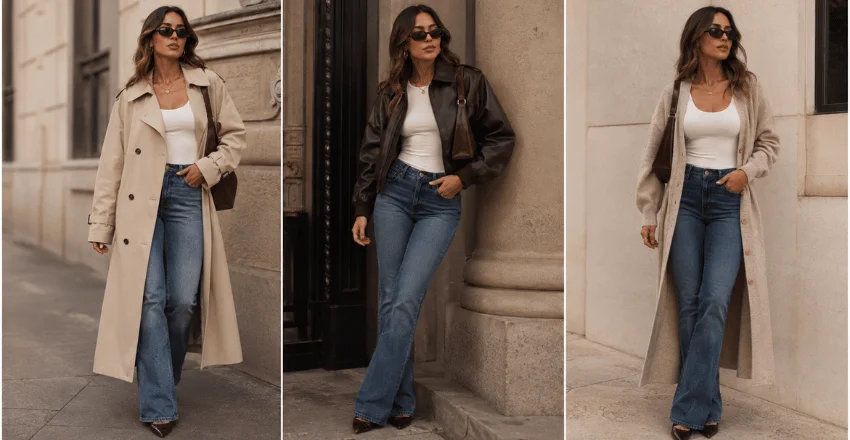
Shoes decide whether the outfit reads as styled or as dress-up. Ballet flats, slim retro sneakers in white or silver, and a low pointed kitten heel all work under flared denim. Chunky platform sneakers technically belong to the era, but they pull the proportions straight back to 2003.
Accessories should stay small and metal. One thin belt, one bangle, small hoops, and a bag you can actually carry things in. Rhinestone baguettes are fun, and they are also the fastest way to make an outfit look like a theme. Hair matters more than people expect. Soft face-framing layers do the job the old chunky highlights used to do, and a layered shag haircut sits naturally alongside this whole look without dating it.
Start with one piece this week
Buy the denim first. A soft bootcut with a 7-inch rise, in a mid-blue wash, will carry every other reference you want to add for the next two years. Add one loud secondhand piece after that, keep the shoes modern, and stop there.
Apart from that, if you want to know about wide-leg jeans by height, then please visit our fashion category.
Frequently asked questions
Their looks are built from the clothing of roughly 1999 to 2004: low-rise bootcut denim, cropped tops, micro minis, metallics, visible logos, and small bags. That term now covers a wider stretch than the original years, so most people use it loosely for anything with an early-2000s feel.
Bootcut denim, baby tees, slip dresses, metallics, and small shoulder bags are all still worn. Trucker hats, full velour sets, plastic chokers, and ultra-low rises now read as dated to most people.
Seven to eight inches is the current sweet spot. Six inches is the point where the fit starts to demand a specific body and a specific top, and anything under that is a deliberate throwback.
A tee runs $12 to $50 depending on tier, jeans run $35 to $200, and embellished designer denim sits between $195 and $400. Thrifted logo tees and tracksuits routinely come in under $20.
Yes, and it usually looks better. Wave-one pieces, metallics, slip dresses, and clean bootcut denim were never age-specific. Skip the novelty accessories, and the proportions do the rest.