

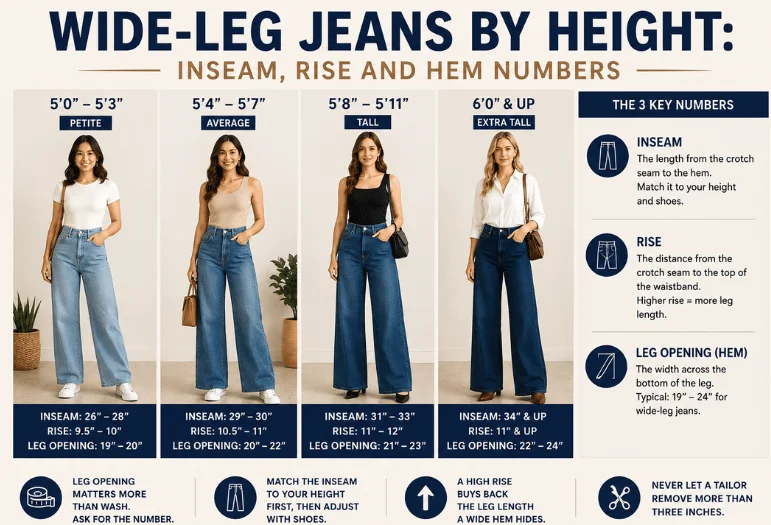
Petite and tall versions of the same jeans often share one leg opening—onlythe inseam moves, from roughly 27.5 inches up to 34. So the identical width of denim hangs on a leg six inches shorter, and the whole proportion flips.
Three numbers decide whether wide-leg jeans read sharp or swallow you: inseam, rise, and leg opening. Under 5 foot 4, hunt for a 26 to 28 inch inseam and a narrower 19 inch hem. From 5 foot 9 up, take the longer block and the wider sweep. The wash is the last thing to worry about.
What to look for, and what to avoid
Most shopping guides sort denim by color and brand. That sorts nothing useful. Here is what the tag should tell you before you commit, and what should send the pair back on the rack.
| What to look for | What to avoid |
| A leg opening printed in inches, usually 19 to 23 | The word “wide” with no measurement anywhere on the listing |
| An inseam within two inches of the length you want | Buying long and planning to remove four inches later |
| A rise that lands at your natural waist and stays there | A rise that cuts across the softest part of your torso |
| Denim around 11 oz or heavier, so the leg falls straight | Thin, slinky fabric that clings and creases at the thigh |
| A brand that cuts petite and tall blocks, not one length | A single regular inseam offered to every customer |
| A finished hem clearing the floor by about a quarter inch | A hem that drags and frays within a month of wear |
Key takeaways
- Leg opening matters more than wash. Ask for the number.
- Match the inseam to your height first, then adjust with shoes.
- A high rise buys back the leg length a wide hem hides.
- Never let a tailor remove more than three inches.
- Budget $15 to $45 for the alteration, on top of the denim.
Wide-Leg Jeans: The three numbers on the tag
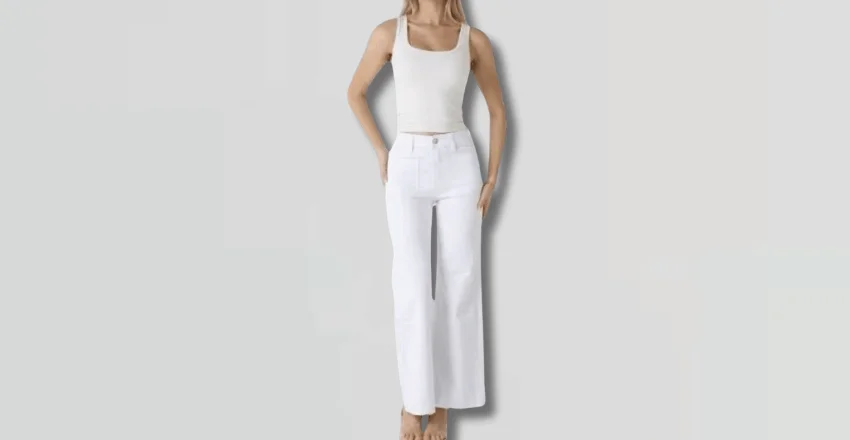
L.eg opening is the width across the bottom of the leg. Brands print it, and it usually falls between 19 and 23 inches for a true wide cut. Anything under 18 is closer to a relaxed straight. Past 24, you are into the palazzo territory that swallows most frames.
Here is the part almost nobody mentions. One well-known style lists a 19-inch leg opening in its petite block. The tall block lists the same 19 inches. Only the inseam moves: 27 and a half in one, 34 in the other.
Divide it out. On the petite pair, the hem is about 69 percent as wide as the leg is long. On the tall pair, that drops to 56 percent. Same style, different garment.
Volume behaves this way in every garment, not only denim. Read our breakdown of pleat types and volume, and the trade-off will feel familiar. Fullness costs something somewhere, and short frames pay in leg length.
Rise is the third number, measured from the crotch seam to the top of the waistband. On the same style above, it runs 9 and three-quarters inches petite, about 10 and three-quarters inches regular, and 11 and an eighth inches tall. An inch of rise moves your visual waistline an inch. That is not a small thing under a wide leg.
| Your height | Inseam to target | Rise | Leg opening | Best for |
| 5’0″ to 5’3″ | 26 to 28 in | 9.5 to 10 in | 19 to 20 in | Keeping the hem off the floor in a flat shoe |
| 5’4″ to 5’7″ | 29 to 30 in | 10.5 to 11 in | 20 to 22 in | Wearing one pair with both sneakers and a low heel |
| 5’8″ to 5’11” | 31 to 33 in | 11 to 12 in | 21 to 23 in | A full column of denim with no break at the shoe |
| 6’0″ and up | 34 in and up | 11 in and up | 22 to 24 in | The dramatic sweep, once you find the length |
Under 5 feet 4, keep the opening narrow
Short frames do not need to skip this cut. They need a smaller version of it, and that is a genuinely different garment from a shortened regular pair.
Start at a 19 or 20 inch leg opening and a 26 to 28 inch inseam. That ratio still reads full through the leg without turning your lower half into a rectangle. Pair it with a rise near 10 inches so the waistband sits above your hip bones. Every inch you gain up top is an inch of visible leg you keep below.
Cropped versions solve it from the other direction. Hit an inch above the ankle bone, and you skip the tailoring bill entirely.
The mistake worth naming is the one everyone makes. You find a pair you love, it comes only in a 32-inch inseam, and you tell yourself a tailor will fix it. Four inches later, the widest part of the leg sits at your calf instead of your ankle. The fabric flares from the wrong point, and the pair never hangs the way it did on the model. Buy the shorter block. If the brand does not make one, walk.
The 5-foot-5 to 5-foot-8 middle
This is the easiest range to shop and the easiest to get lazy in. Standard 29- to 30-inch inseams were drafted for you, which means the pair will look acceptable straight off the rack and excellent with about twenty minutes of thought.
Three things separate acceptable from excellent here:
- Pick your shoe first, then hem to it. A 30-inch inseam that works over a boot puddles over a sandal.
- Take the wider opening, 21 or 22 inches, if you want the cut to read as deliberate rather than as roomy.
- Watch the thigh. Mid-height frames often get a leg that is generous at the ankle and tight at the top, which kills the straight fall.
Buy two pairs at different lengths if the denim earns it. One for flats, one for heels. That is cheaper than two rounds of alterations on a single pair.
5 foot 9 and up, take the width
Tall shoppers have the opposite problem. Width is never the issue; length is, and it is a supply problem rather than a fit problem. You can carry a 22- to 24-inch opening without looking overwhelmed, which is why the most dramatic versions of this cut look best on long legs.
Finding a 34- or 36-inch inseam in that opening is the hard part. Most brands stop their tall block at 34, and only in their bestselling washes. When you find one, buy it in two colors. Tall denim leaves the racks faster than any other size, and last season’s discontinued fit is not coming back.
One warning. A 34-inch inseam paired with a 24-inch sweep needs weight behind it, ideally 12-oz denim or heavier. Light fabric at that scale flaps.
Long torso or short torso changes the rise..
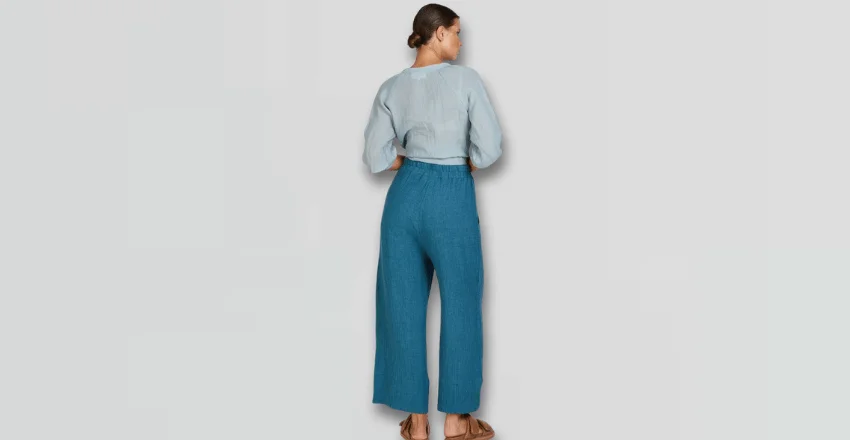
Height tells you the inseam. Torso length tells you the rise, and the two are not the same measurement. If your torso runs long relative to your legs, a rise near 11 inches keeps the waistband from sitting mid-abdomen and stops the leg line from starting too low.
Short torso, and that same 11-inch rise can push the waistband into your ribs, which is uncomfortable by lunchtime. Try the 10 to 10 and a half inch range instead. Stand sideways in the mirror and check where the waistband lands against your bottom rib. That single look tells you more than any size chart.
Hemming and tailoring, in inches
Getting the length right is the difference between wide-leg jeans that look expensive and a pair that looks borrowed. The numbers are specific and not negotiable.
- Back of the hem: about a quarter inch off the floor in the shoes you will actually wear. Only a peek of toe should show at the front.
- Maximum you should remove: two to three inches. Past that, the flare starts higher than the designer drafted it, and the silhouette changes.
- Plain hem: roughly $15 to $35 at a US tailor in 2026, depending on the shop and the fabric weight.
- Original hem preserved, sometimes sold as a euro hem: roughly $25 to $45. It keeps the factory topstitching and the faded wear line at the ankle, which is worth the extra on any pair over $100.
- Taper at the ankle: skip it. Narrowing a wide leg fights the whole point of the cut, and it rarely hangs right afterward.
Bring the shoes to the fitting—every time. Pinning to bare feet is guesswork, and a half-inch error shows from across a room on a hem this wide.
One more thing on price. A $37 pair from a mass-market chain plus a $30 eurohem lands close to $70. That usually hangs better than an unhemmed $148 pair sitting two inches too long. Fit beats price tier almost every time.
Shoes and tops that hold the proportion

Long hems need a shoe with some substance under them. Loafers, ankle boots, a low block heel, and a structured sneaker all give the hem something to break against. Put a delicate ballet flat under a 22-inch opening, and it disappears, so the leg looks like it ends nowhere.
Suede is the usual casualty. The hem sweeps across the toe box every step, and the nap picks up scuffs fast. Our guide to cleaning suede shoes is worth bookmarking before you pair them.
Up top, the fix for looking boxy is definition at the waist rather than a tighter shirt. A full tuck works. So does a front tuck, or a cropped knit that ends at the waistband. Try a fitted tee under an open blazer too: the vertical line of the jacket balances the horizontal spread of the hem.
What fails is volume meeting volume. An oversized sweatshirt over a 23-inch sweep gives the eye no waist to find, and the whole outfit reads as one shape.
Barrel and horseshoe cuts curve inward at the ankle and behave differently, so do not assume advice written for those transfers here. It does not.
The bottom line
Buy for your inseam and your rise, hem to your shoes, and let the leg opening do the styling. If you are under 5 feet 4, the narrow 19-inch sweep in a petite block is the pair we would recommend first. Over 5 feet 9, go the other way and take the widest opening you can find in a 34-inch length.
Measure a pair of pants you already love before you order anything. Then browse our fashion archive for the pieces that will sit above them.
Wide leg jeans FAQs
Yes, though the field around them has widened. Barrel, straight and bootcut all share shelf space now, and stylists have stopped naming one correct silhouette. The wide cut has held long enough to count as a staple rather than a trend.
Look for 26 to 28 inches with a 19 or 20 inch leg opening. A petite block at that length usually needs no alteration at all in a flat shoe, and at most an inch off for a sandal.
Expect $15 to $35 for a plain hem and $25 to $45 to keep the original factory hem. Prices run higher in large cities and on heavy raw denim.
Check the fabric weight and the listed measurements. A good pair states its leg opening, rise, and inseam, and the denim holds a straight fall when you lift the leg and let it drop. Cheap denim lists none of that, and the leg collapses in on itself.
Anything with a defined toe and a bit of height: loafers, boots, mules, chunky sneakers. Save the flat sandals for a cropped length.