


Hold two black dresses side by side in daylight. One of them is brown. That drift, from true black to a tired brownish gray, separates a long black dress that reads expensive from one that reads worn out. It starts with the fiber rather than the cut.
Floor length is not automatically formal. A black maxi in cotton jersey is a weekend dress; the same length in matte crepe or silk satin clears black tie optional without argument. Cocktail is the one code where a sweeping hem can work against you. Funerals want the opposite: long, matte, and covered.
Start with the invitation, not the closet
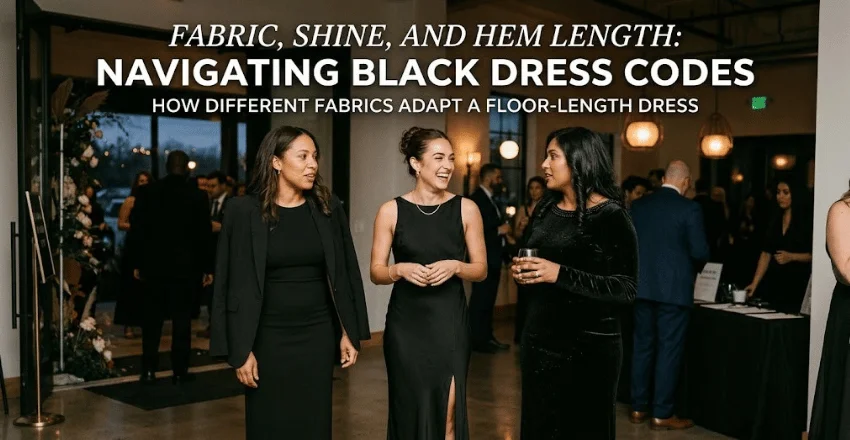
Dress codes read fabric weight and shine as much as hem length. A gown in duchess satin with a sweep train says one thing. The same silhouette in a soft rayon knit says something else, even though both stop at the floor. There is more on this in Sweater Dress Fabric.
Here is how the common codes treat a floor-length black gown.
| Dress code | Does floor length clear it? | Look for | Skip |
| Cocktail | Rarely | Knee or midi hem, structured crepe | A sweeping hem, any train |
| Semi-formal/dressy casual | Yes | Matte crepe, ponte, clean neckline | Head-to-toe sequins |
| Black tie optional | Yes, it’s home ground | Column or A-line, fluid drape, one slit | Cotton jersey, day-dress straps |
| Black tie / formal | Yes | Silk, satin, velvet, beading, a hem that sweeps | Visible knit texture, casual hardware |
| Funeral or memorial | Yes, the safest length | Matte surface, sleeves or covered shoulders | Slits above the knee, sheer panels, shine |
| Office party | Yes, with a jacket | Ponte or heavy crepe, low sheen | Thigh slit, thin straps alone |
Key takeaways
- Cocktail is the one dress code where floor length usually reads as too much.
- Black tie optional and black tie are where a long gown works hardest.
- Hem to the floor, not to a number: measure in the shoes you will wear.
- Polyester holds black longest. Rayon fades first.
- Cold water, inside out, no dryer. That is most of the battle.
Cocktail: the code a floor-length hem usually fails
Cocktail sits between a work dress and a gown, and the hem is how hosts read it. Most cocktail guidance puts the hem between just above the knee and mid-calf. Tea length, which stops a few inches above the ankle, is the outer edge. Floor length crosses into black tie territory, and at a cocktail party that lands as overdressed rather than elegant.
There is one exception worth knowing. A narrow black column in matte fabric can pass at an evening cocktail event in a hotel or a restaurant. Wear it with flat sandals and nothing louder than stud earrings. It fails at an afternoon one. Daylight makes the length obvious, and so does a garden setting where every other guest stops at the knee.
If the invitation says cocktail and you own only the long version, the fix is a hem rather than a styling trick. Shortening a lined dress to mid-calf costs less than most people expect, and it gives you something you will wear far more often.
Black tie optional and black tie: where the long hem earns it
These two codes are where a floor-length black gown stops being a compromise. Black tie optional lets guests go fully formal or stop just short, so a long dress is always correct and never too much. Black tie proper expects it.
Fabric separates the two. For black tie optional, a fluid crepe or a matte jersey with clean seams is enough. For black tie, the surface should catch light: silk satin, velvet, taffeta, or beading across the bodice. A hem that brushes the floor instead of clearing it by an inch also reads more formal, which is why gowns get hemmed for heels.
Weddings add a layer of judgment. Black at a wedding stopped being taboo years ago across most of the US, though an evening ceremony reads it differently than a coastal one. The fabric rules behind beach wedding gown fabrics apply to guests too: heat, wind, and sand all punish a heavy floor-length hem.
Funerals and memorials: the quiet rules
Long is the safest length here, and matte is the safest finish. Nobody at a service is reading hemlines for formality; they are reading them for restraint. A floor-length black dress in crepe, ponte, or wool, with sleeves or a covered shoulder, suits almost any service, religious or not.
Shine and skin cause the trouble. Satin catches every camera flash and photographs like eveningwear. A slit above the knee, a sheer panel, or a low back moves the dress from mourning to party on one detail alone. Cover the shoulders when the service is in a church, a mosque, or a synagogue. A thin cardigan does it without a coat.
Shoes matter more than usual, because services often move outdoors to a graveside. Block heels sink less in grass than a stiletto does, and a long hem sweeping wet ground picks up whatever is on it.
Where a long black dress goes when there is no dress code
Most wear happens outside of invitations. A black maxi in a stable knit carries dinner, travel, a gallery opening, or a long day when you would rather not think about an outfit again.
Three things move it up or down the formality scale faster than the dress itself.
- Shoes. Flat leather sandals read weekend, a pointed pump reads evening, and boots under the hem read fall.
- The second layer. A denim jacket takes it down two steps. A tailored blazer takes it up two.
- Sheen. Visible shine reads dressy at 10 am no matter what else you do.
Hem-to-heel math, in inches
Brands cut floor length for a body they have guessed at. Most spec a maxi somewhere between 50 and 60 inches from shoulder to hem, drafted for a woman around 5 feet 6 inches tall. Petite lines usually run 2 to 3 inches shorter. Tall lines run about 2 inches longer.
Ignore the size chart and measure yourself instead. Run a tape from the hollow at the base of your throat straight down to the floor, standing in the shoes you plan to wear. That one figure decides everything else.
Then aim for the clearance below.
- Flats or a 1-inch sandal: the hem should sit half an inch off the floor. Any longer and you walk on it.
- A 2 to 2.5-inch block heel: the forgiving zone. Hems cut for this height still work with flats indoors.
- A 3 to 4-inch heel: where most gowns get hemmed. Switch to flats, and you are suddenly dragging 3 inches of fabric.
- Ankle boots in fall: add roughly 1 inch for the sole stack before you decide.
Heel height moves the hem one-for-one, and that is the part people miss. A dress hemmed for a 4-inch stiletto carries 4 inches of spare length the second you kick the shoes off at a reception. Suede heels are the usual pairing under a black hem, and they are also the ones that suffer. Learn how to clean suede shoes safely before the first wear.
Budget for alterations. A straight, lined hem runs about $25 to $50 at most US alteration shops. A bias-cut or pleated hem costs more, often $60 to $120, because the fabric has to hang for a day before anyone can cut it level.
Why black fades, and which fibers hold it
Black is not one color. Dye houses mix it warm, on a brown base, or cool, on a blue base. That is why a black blazer over a black dress so often looks wrong in a photo. Fiber then decides how long that color survives.
| Fiber | How the black gets in | How it fails |
| Polyester | Disperse dye forced into the fiber near 265°F under pressure, then trapped as it cools | Color holds; oil marks and a shine build up at the seat and hem |
| Cotton and cotton blends | Reactive dye bonded chemically to the fiber | Hot water and rubbing lift it to a chalky gray |
| Viscose, rayon, modal | Dye takes easily, but the fiber swells and weakens when wet | Fades first and fastest; creases can set permanently |
| Silk | Acid dye | Sunlight turns it brown across the shoulders |
| Wool, ponte, triacetate | Acid or solvent dye | Color holds, but pilling scatters light and reads gray |
Rub a new dress with a white tissue at an inside seam. If gray comes off, the dye is sitting on the surface instead of inside the fiber, and that garment will mark a car seat and a pale coat. The trade calls it poor crocking. You can call it a return.
A wash routine that keeps black black
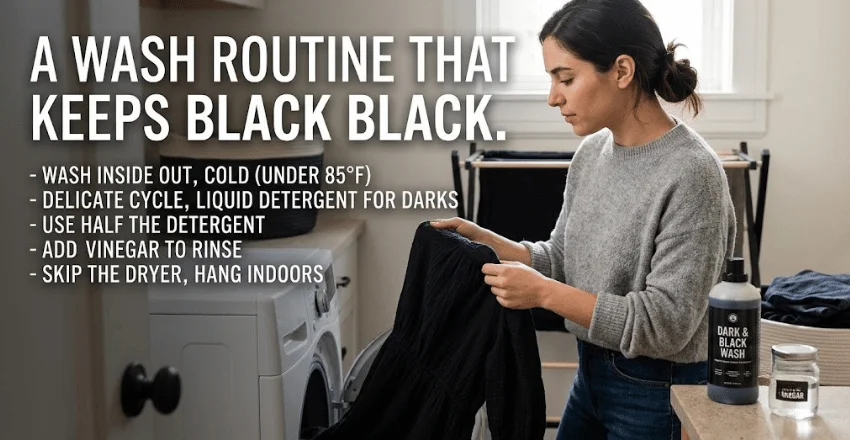
Fading is mostly mechanical. Hot water opens the fiber, agitation abrades the surface, and a hot dryer finishes the job.
- Turn the dress inside out. The outer surface is the one that shows abrasion.
- Wash cold, under 85°F, on a short delicate cycle with a liquid detergent made for darks. Powders carrying optical brighteners leave a haze on black.
- Use half the detergent you think you need. Residue is what dulls dark fabric.
- Pour half a cup of distilled white vinegar into the rinse every few washes to strip that residue.
- Skip the dryer. Hang the dress inside out, away from a window, because sunlight is harder on black than any wash cycle.
- Wash after two or three wears rather than every wear. Spot clean the underarms and steam the rest.
Buying it: price bands and what to check on the rack
US price bands have settled into three tiers by retailer. Mass market sits around $40 to $90 and is almost always polyester or a poly-rayon blend. Contemporary brands run roughly $120 to $250, where real crepe, a full lining, and a hem worth altering start showing up. Occasion and designer labels open near $400 and climb.
Whatever the tier, five things are worth checking before you pay.
- The lining. An unlined black skirt goes translucent in sunlight and against a flash.
- The rub test. White tissue at an inside seam, as above.
- Seam allowance. Wider than half an inch means a tailor can let it out later.
- Hem depth. A deep hem hangs straight. A rolled quarter-inch hem ripples.
- Fabric weight. Light knits cling and show every line, while heavier crepe skims.
Volume is the other decision, and it works the same way it does on a pleated skirt, where folds add volume at the hip.
Accessories that do not fight the dress

Black absorbs light, so anything you add sits on top of it with no midtone to soften the jump. Metal is the easiest way in. Yellow gold warms a cool blue-black, while silver and white gold sharpen a warm one.
Keep it to one strong piece. A single wide cuff, or a Cartier Love bracelet worn daily, does more against a plain black column than a stacked wrist and a necklace together.
For layers, match the finish before you match the shade. A wool coat over crepe works. A glossy puffer over the same crepe reads like two outfits fighting. If the coat’s black runs warmer than the dress, leave it open and let the contrast look deliberate.
If you want to know about Drop Waist Dress Guide then visit our Dresses category
Before you order
Measure hollow to floor in the shoes you will actually wear, then hold that number against the brand’s stated length. Do it before you order, and price a hem into the total. That single measurement is the difference between a dress you keep for ten years and one that lives in a garment bag.
Frequently asked questions
Yes, at most US weddings now. Evening and black tie ceremonies are the safest bet. For a daytime or beach wedding, or when the couple has asked guests to avoid black, pick another color.
Yes. It is the most conservative length available. Keep the fabric matte, cover the shoulders, and skip the slit.
A 2- to 3-inch block heel handles grass, stairs, and long stretches of standing better than anything else. Flats work when the dress was hemmed for them.
Cold water, inside out, a liquid detergent for darks, no dryer, and no drying in sunlight. Most graying comes from abrasion and detergent residue rather than lost dye.
Polyester and polyester blends. The dye sits inside the fiber instead of on it, so it survives washing better than cotton or rayon does.
One metal, one statement piece, and a coat in a matte finish. Match warmth to warmth: gold with a brown-black dress, silver with a blue-black one.