
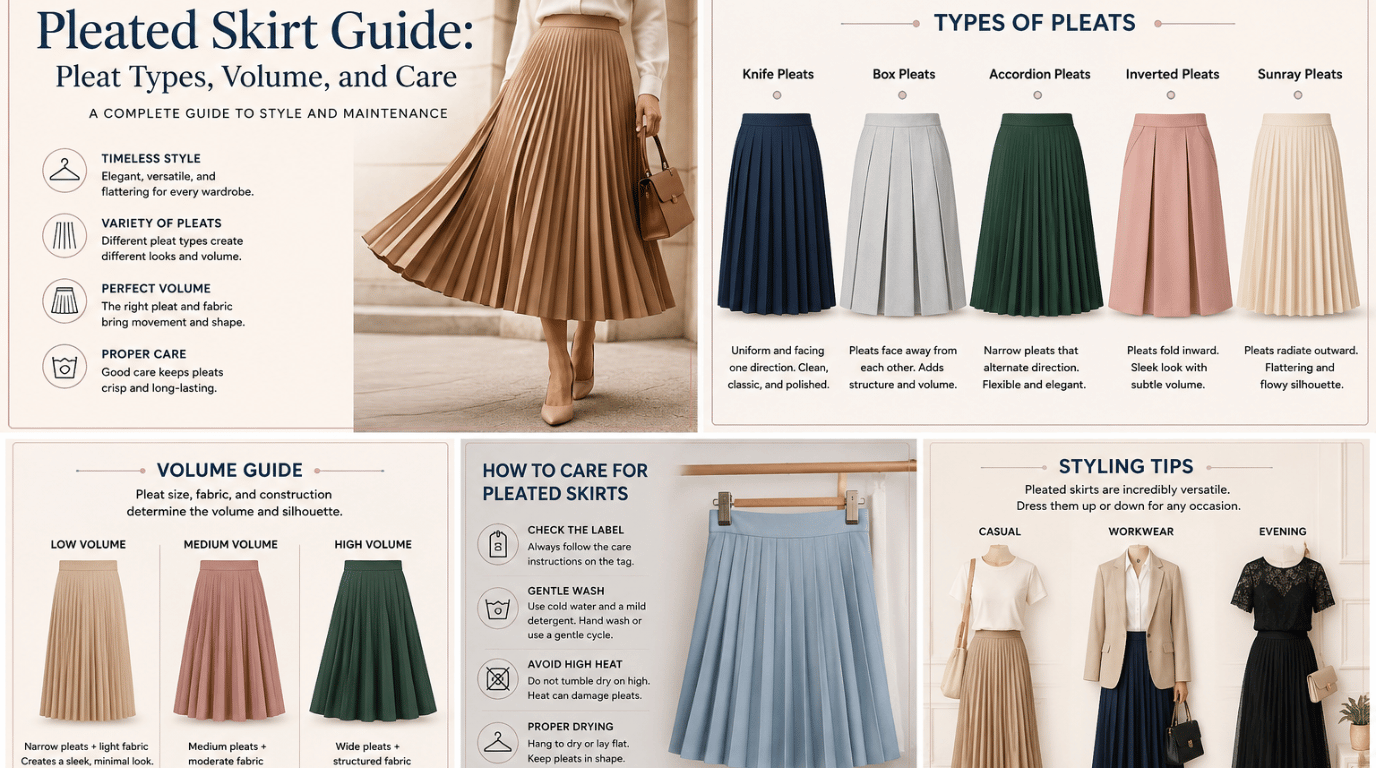
Most shopping advice treats every pleated skirt as one garment. It is not. A knife fold and a box fold sit on the hip in completely different ways, and one of them will add three inches you never asked for. Pick the fold first, then argue about color.
The pleat type decides everything. Knife folds lie flat and add the least width at the hip. Box folds stand away from the body and add the most. Accordion and sunburst pleats fall softly and swing when you walk. Heat-set polyester holds its shape through washing, while wool and cotton folds relax and need pressing again.
Key takeaways
- Knife folds add roughly 1 to 2 inches at the hip. Box folds can add 4 inches.
- Polyester is thermoplastic, so its pleats are permanent. Wool and cotton folds are not.
- Cold water, a mesh bag, no fabric softener, no dryer, and then hang it by the waistband to dry.
- Steam vertically along each fold line. Never slide a hot iron sideways across the panel.
- Midi is the default length now, and the hem should miss the widest part of your calf.
- Expect $40 to $70 at mass markets and $90 to $160 at contemporary labels.
Which Pleated Skirt Type Suits Your Shape
Every fold is fabric doubled back on itself. How wide that fold is, and whether it faces one direction or two, sets how far the skirt stands off your body. That is the number nobody quotes on a product page.
| Pleated skirt style | How it hangs | Volume at the widest point | Fabric it needs | Who it flatters |
| Knife | All folds face one direction, flat and orderly | Low, about 1 to 2 inches | Almost anything: wool, cotton, poly crepe | Straight and pear shapes |
| Box | Pairs of folds turn away from each other and stand proud | High, 3 to 4 inches | Structured cotton, wool flannel, heavy twill | Narrow hips that want curve |
| Inverted box | The fold turns inward, so the surface reads flat until you move | Low at rest, high in motion | Mid-weight wovens with some body | Nearly everyone, the safe pick |
| Accordion | Narrow zig-zag folds, half an inch or less, springy | Moderate, close at the hip then flaring low | Heat-set polyester or a poly blend | Broad shoulders, since it balances the top |
| Sunburst | Cut on the bias, tight at the waist, wide at the hem | Very low at the hip, dramatic at the hem | Light chiffon, satin, fine polyester | Fuller hips, because they skim and release |
| Unpressed | Soft rolling folds with no crease line at all | Moderate, with a blurred edge | Drapey rayon, silk, Tencel | Anyone who dislikes crisp vertical lines |
The inverted box is the quiet winner for most people. It gives you room to walk without broadcasting volume, and the flat front panel photographs well. The same fullness math applies to pleated dresses, so a fold that works on your skirt will work on a dress in the same fabric.
Pressed and Unpressed Are Two Different Skirts
A pressed fold carries a crease from waistband to hem. It holds a hard edge, catches light along that edge, and reads formal. It also adds width, because the crease keeps fabric standing off your body instead of collapsing against it.
An unpressed fold is stitched only at the waist and left to fall. The fabric rolls instead of breaking. You get similar fullness with none of the sharp vertical lines, which is why designers reach for it in silk and rayon. If crisp uniform lines are not your thing, buy this version.
Care That Does Not Flatten the Pleats
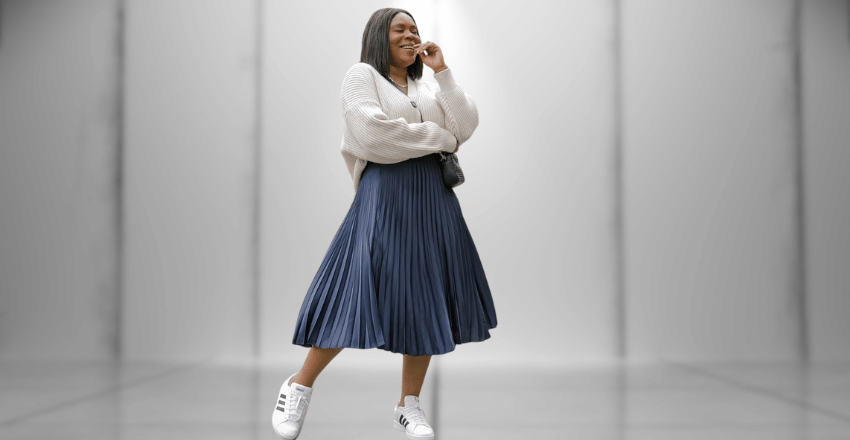
This is where good skirts die. Not in the wearing, but in the washing.
Washing
- Read the label first. Wool and silk versions usually say dry clean, and they mean it.
- Turn the skirt inside out and zip it into a mesh bag.
- Cold water, gentle cycle, mild detergent.
- Skip fabric softener, which coats the fiber and blunts the very edge you want to keep.
- Skip the high spin. Wringing is what kills a fold.
- Never tumble dry.
Hang it wet by the waistband on a clip hanger. Run your fingers down each fold once, top to bottom, and leave it alone. Gravity and air do the resetting for you as the fabric dries, so keep it out of direct sun.
Why Polyester Survives, and Wool Does Not
Polyester is thermoplastic. Heat softens the fiber, pressure sets the fold, and the fiber cools, locked into that new shape. Wash it, sit on it, ball it into a suitcase, and it springs back.
Natural fibers have no such memory. A crease in wool, cotton, or silk is nothing but steam and pressure holding the cloth somewhere it does not want to be. Sit through a long meeting, and the folds soften. Wash the skirt at home, and most of the stains vanish. That is not a defect, and it explains the dry clean label.
Ironing and Steaming
Steam beats iron nearly every time.
Hang the skirt, hold the steamer two to three inches off the fabric, and work top to bottom along each fold line. The cloth relaxes, and the pleats rehang themselves. If you must iron, use low heat with a pressing cloth, and press straight down. Sliding a hot iron sideways drags the fabric out of alignment, which is how skirts end up with a permanent bubble across the hip.
Packing and Travel
Do not fold it flat.
Gather the skirt along its own folds until it becomes a long rope, coil that rope loosely, and then slide it into a pillowcase or a cut-off stocking. The folds brace each other in transit. Heat-set polyester comes out ready to wear. Anything natural wants twenty minutes hanging in a steamy bathroom before you put it on. For more packing and fabric basics, our fashion guides cover the same rules across other garments.
Length, Proportion, and Shoe Height
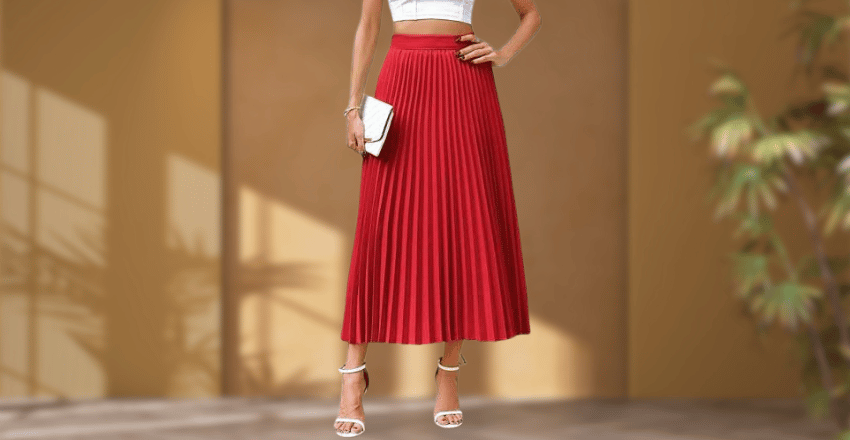
Midi is the default now, running from just below the knee to just above the ankle. The trap sits at the middle of the calf, the widest point of your lower leg. A hem landing exactly there stops the eye at the thickest part and chops the leg in half. Aim above that point or well below it.
Then match the shoe to the hem.
- Hem below the calf: a 2 to 3 inch heel or a boot with a visible shaft.
- Hem at the knee or just under: flats are fine, and so are low sneakers.
- Under 5 feet 4 inches: keep the hem higher and add heel height, or the skirt will wear you.
Ankle straps are the one thing to avoid here, since they draw a second horizontal line right where you need a clean run of skin. Our shoes for every hemline archive go deeper on heel shapes.
Static Cling and Windy Days
Polyester-plus tights build a charge fast. The skirt climbs your legs, the pleats collapse, and the silhouette you paid for disappears. Four fixes, cheapest first.
- Buy lined paper. A smooth acetate or polyester lining stops the outer layer gripping your legs.
- Slip shorts, roughly $15 to $25 a pair, handle cling and wind at the same time.
- A light mist of unscented hairspray on your tights kills the charge for a few hours.
- A thin hem weight sewn into the lining keeps the front panel down on a gusty day.
From Office to Weekend Without Changing the Skirt
For work, tuck a fine knit into the waistband, add a slim belt, and layer a structured jacket over the top. The tuck matters more than the jacket does. A loose top over a full skirt reads shapeless in a conference room every time.
For the weekend, keep the same skirt and swap everything else: a graphic tee half-tucked, a denim jacket, and low sneakers. Done. Browse our seasonal outfits for the cold weather version, which usually means opaque tights and a tall boot.
What You Should Expect to Pay

Price splits by construction, not by how pretty the skirt looks online.
| Tier | Typical price | What you get |
| Mass market | $40 to $70 | Heat-set polyester or chiffon for permanent folds. Uniqlo’s chiffon midi sits at $49.90. |
| Contemporary | $90 to $160 | Satin, crepe, or cotton poplin, usually lined, has a better waistband finish. |
| Premium | $150 to $230 | Printed silk or wool. J.Crew midi styles run $148 to $228 at full price. |
| Resale | $25 to $60 | Great value, though older wool folds often need a professional press first. |
Here is the awkward truth. A $50 polyester skirt will usually keep its folds longer than a $200 wool one. Spend on the hand of the fabric and the quality of the lining, not on the folds themselves.
Your Next Move
Start by identifying the fold type on the skirt you already own, then check whether the fabric is polyester or natural. That one answer tells you how to wash it, how to pack it, and whether the pleats will still be there next spring. If you are shopping for fresh, buy an inverted box in a lined polyester midi. It is the version that forgives the most.
Apart from that, if you want to know how to clean suede shoes, please visit our fashion category.
FAQ
Yes, if it is polyester and the label allows it. Use a mesh bag, cold water, and a gentle cycle. Wool, silk, and anything with a pressed crease should go to a dry cleaner instead.
Hang the skirt and steam it top to bottom along each fold line. Pinch the pleats back into place while the fabric is warm, then clip it to a hanger and let it cool undisturbed for an hour.
Knife folds, followed closely by a sunburst cut. Both sit close through the top of the skirt and release their fullness lower down.
Yes. Midi lengths in satin and chiffon have been steady sellers for several seasons, and the mini version keeps resurfacing with the 90s revival.
With a lining, no. Without one, yes, especially in chiffon or thin satin. Slip shorts also solve the wind problem, which a plain slip does not.