

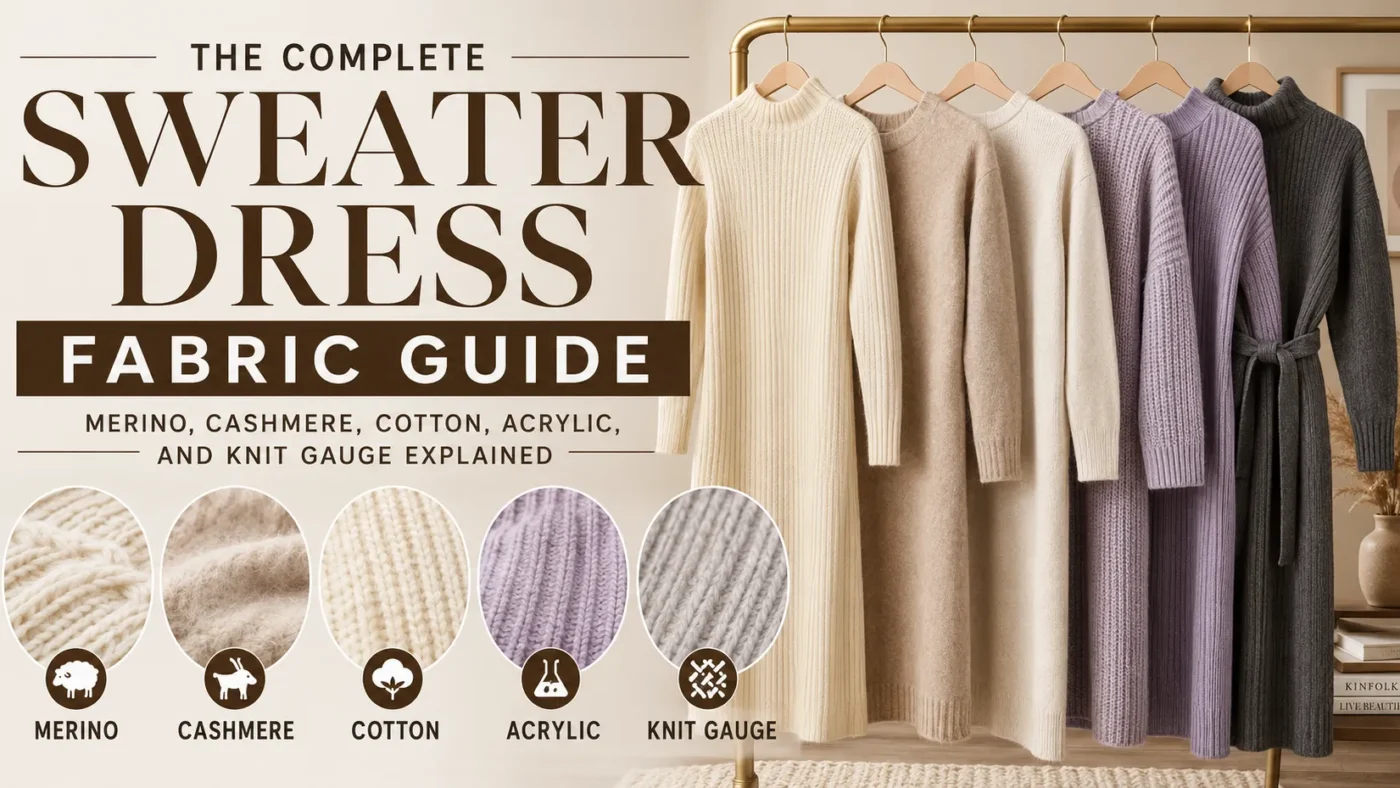
A $44.90 ribbed mock neck and a $149.90 Mongolian cashmere midi sit two rows apart on the same retailer’s page. From the thumbnail, they look like the same garment. Yarn is the whole difference. Nearly every complaint about a sweater dress- the static, the pilling, the seat that bags out by lunchtime- traces back to fiber and gauge rather than to the cut.
Short answer: merino gives the most balanced mix of warmth, shape recovery, and price, usually $60 to $100. Cashmere feels better and pills sooner. Acrylic blends cost the least and throw the most static. Cotton blends suit warmer climates and shoulder season wear. Fine gauge clings and shows everything; chunky gauge hides more but sags faster.
Fiber Decides Warmth, Pilling, And What You Pay
Fiber is the first filter when choosing a sweater dress, not the last. Two sweater dresses cut from the same pattern behave nothing alike once one is wool and the other is acrylic. The label on the inside seam predicts how your sweater dress will look, feel, and wear over the next six months better than any product photo. Here is what each of the five common fiber families gives you, with the price bands we saw across mainstream US retailers this season.
| Fiber | Warmth | Pilling risk | Cling | Typical US price | Care |
| Merino wool | High for its weight | Low | Low | $60 to $100 | Hand wash cold, dry flat |
| Cashmere | Highest, very light | High | Low | $110 to $150 | Hand wash, comb every few wears |
| Cotton and cotton-cashmere | Moderate | Low | Lowest | $50 to $85 | Machine wash cold, dry flat |
| Acrylic and poly blends | Moderate, holds sweat | High, pills weld on | High | $30 to $55 | Machine wash cold, skip the dryer |
| Wool with nylon or elastane | High | Low | Moderate | $70 to $120 | Hand wash, reshape while damp |
Read that table as a set of trade-offs, not a ranking. Cashmere wins on hand feel and loses on durability. Acrylic wins on price and loses everywhere else. The same logic governs any structured garment, which is why our pleated skirt guide spends as long on fabric weight as it does on shape. Fabric first, silhouette second.
Key Takeaways
- Merino is the default pick for cold weather at a sane price, thanks to natural crimp that pulls the knit back into shape.
- Cashmere is a hand-feel purchase. Under about $100, it is usually short staple, and short staple pills.
- Acrylic is a static machine. If you wear tights, this is the fiber that fights you.
- Gauge matters as much as fiber. Fine gauge drapes and clings; chunky gauge conceals and stretches.
- Sag is a storage problem far more often than a quality problem—folding fixes most of it.
Gauge Is The Number Nobody Prints On The Tag

Gauge counts needles per inch on the knitting machine, written as gg. A 3gg or 5gg knit is chunky, with big visible loops and a lot of air between them. A 12gg or 14gg knit is fine, smooth enough to read as jersey from across a room. Most of what sells sits between 7gg and 12gg.
That number changes how a sweater dress behaves in ways the styling advice on page one never mentions. A fine-gauge sweater dress follows the body closely, so it drapes beautifully and shows every line underneath it. A chunky-gauge sweater dress holds itself away from you and hides a great deal, at the cost of visual bulk across the hips and shoulders.
Weight follows gauge too. A chunky knit carries more yarn per square inch, and all of it hangs off the shoulder seam. That is why heavy pieces grow longer over a season while fine ones hold their length.
Product pages rarely give the gauge number, so use two proxies in the store. Hold the fabric up to a window: if you can see light through the stitches, you are in fine gauge territory. Then count the ribs across one inch. Four or fewer means chunky. Eight or more means fine, and it means you should think about what you wear underneath before you get to the register.
Why Knit Dresses Cling, And What Actually Stops It?
Two separate problems get filed under one word. Static cling is electrical: friction between two dry insulating surfaces, usually a synthetic knit and a pair of sheer tights, in air that indoor heating has dried to 20% humidity. Mechanical cling is physical, the fabric catching on skin or hosiery and riding up the thigh as you walk.
Dryer sheets get recommended for both. They only address the first, and only for a wash cycle or two. These fixes work better:
- Wear a smooth slip. A nylon or silk slip removes the friction pair entirely, and it solves mechanical cling in the same move.
- Change the tights. Opaque nylon at 60 denier or more, or wool tights, cling far less than sheer 15 denier.
- Moisturize your legs before you dress. Dry skin holds charge; hydrated skin bleeds it away.
- Run a wire hanger down the inside of the skirt. Any metal grounds the charge in about five seconds.
- Mist anti-static spray on the inside hem only. Sprayed on the face of a wool knit, it leaves a dull film.
- Keep it out of the dryer. Tumble drying is what charges synthetic fabric in the first place.
- Run a humidifier at 40% through the winter. This is the fix that ends the problem for the whole season instead of the afternoon.
Natural fibers barely need any of this. Wool and cotton hold enough moisture to dissipate charge on their own, which is one more reason the cheap knit ends up costing you attention every time you wear it.
How To Stop A Sweater Dress From Sagging?

Woven fabric has fixed thread lengths. Knitted fabric is a grid of loops that can borrow length from each other, which is what gives a knit its stretch and also what lets gravity redistribute it. Hang one on a hanger for a week, and the shoulders carry the entire weight of the garment. Wear it two days running, and the seat and hips bag out where your body loaded the loops.
None of that is permanent damage on a wool piece. Here is the method:
- Fold, never hang. In thirds, on a shelf. This one habit prevents most stretching.
- Rest it 24 hours between wears. Wool recovers on its own overnight; the crimp in the fiber pulls the loops back.
- Wash cold, by hand, and never wring. Press the water out between two towels instead.
- Block it while damp. Lay it flat, measure the length and the waist, then push the fabric back to those numbers with your palms and leave it to dry away from heat.
- Buy some recovery. Two to five percent elastane or a little nylon in the blend keeps a knit snapping back for years.
- Steam rather than iron. A hot plate flattens the loft that makes the knit warm.
Blocking is the step most people have never heard of, and it resurrects pieces they were ready to donate. Fiber choice sets the ceiling here: cotton has almost no memory and will stay stretched, while merino returns to shape again and again.
Cotton blends still earn their place for warmer climates, where a wool knit would be unwearable by 10 a.m. The same weight-and-drape thinking runs through our guide to choosing a gown for heat and wind. It applies to any garment you plan to wear in the sun.
Pilling, And The Two-Minute Fix
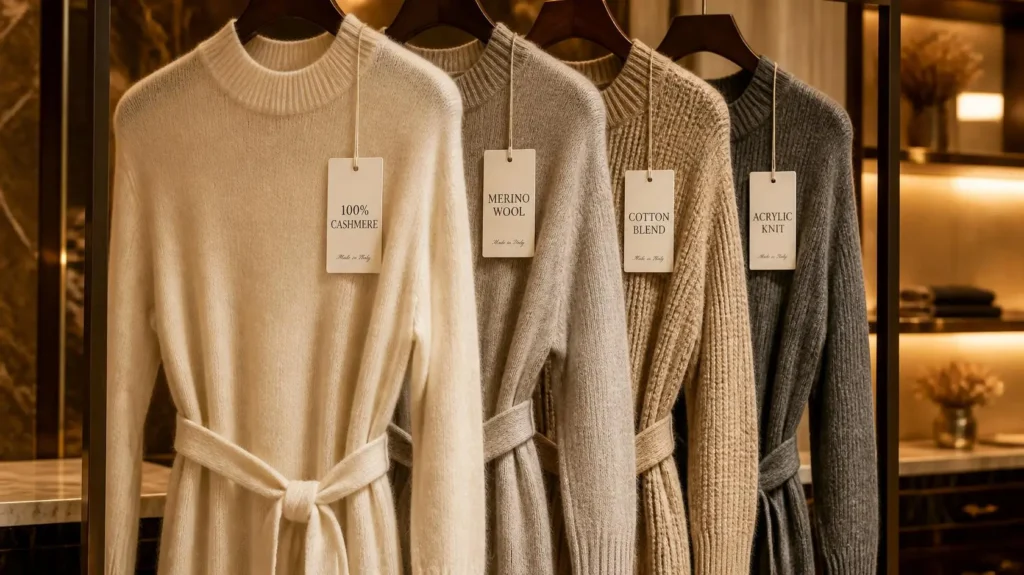
Pills form on a sweater dress when short fibers work loose from the yarn, migrate to the surface, and tangle into small balls that friction rolls tighter. Staple length is the whole story. Cashmere from a first combing runs long, above about 34 millimeters, and stays put. Cheap cashmere uses shorter offcuts, which is why a $90 cashmere sweater dress can look worn out in six weeks while a $300 one does not.
Acrylic pills for a different reason. The fibers themselves are strong, so once a pill forms, it refuses to shed and welds itself to the surface. A sweater comb, roughly $10, or a battery fabric shaver at $15 to $25 removes them in a couple of minutes. Lay the garment flat, keep it taut, and work in one direction.
Prevention is mostly about friction. Wash inside out, watch the spots that rub, and treat a new knit early rather than waiting for a bad month.
- Crossbody bag straps, seat belts, and inner arms pill first. Move the strap.
- Comb after every third wear, not after the thirtieth.
- Never put a wool knit in a washing machine with denim or towels.
Then, And Only Then, Styling
Styling advice runs before fabric advice everywhere online, and that order is why shoppers buy the wrong knit and blame the cut. Get the yarn and the gauge right, and the outfit takes about four seconds to assemble.
Fine gauge wants a slip and a boot with a shaft that ends below the knee. Chunky gauge wants a belt to define a waist that the fabric has erased, and it takes a longer boot without looking bottom-heavy.
Tall suede boots do most of the work in both cases, though they need their own routine. Our walkthrough on how to clean suede shoes without damaging the nap covers the brush-and-eraser method. Add one piece of hardware, a gold chain or a wide cuff, and stop there. Busy knits fight jewelry.
Before You Buy

Turn the garment inside out and read the composition label first, then hold it to the light to judge the gauge, then check the shape. That order takes 30 seconds and saves a return. For more on fabric behavior and garment care, browse our fashion guides and take the fiber label with you next time you shop.
FAQs
Cotton and acrylic knits, yes, on cold and inside out. Wool and cashmere, no. Hand wash those in cool water with a wool detergent, then dry flat. Dry cleaning is rarely needed for either, and the solvent dulls loft over time.
A seamless full slip beats shapewear on fine gauge, because shapewear edges print through a smooth knit. Chunky gauge hides almost anything, so a regular bra and briefs are fine.
Merino and cashmere at 7gg or heavier are warm down to about 40 degrees Fahrenheit with tights and a coat. Acrylic feels warm indoors and clammy outside, since it traps sweat instead of moving it.
Around $60 to $100 buys real merino that lasts several seasons, and that is the band we would shop first. Below $50 you are buying acrylic. Above $110, you are paying for cashmere quality, which is worth it only if the staple length is long, so check whether the brand says so.
Cotton and cotton-cashmere at fine gauge work well into the 60s, which makes them the sensible choice for shoulder season wear in the South or on the coast.