
Teaching is physical work. You crouch at student desks dozens of times, sit cross-legged on carpet for read-aloud, and stand for most of six hours. Then somebody hands you a glue stick. Clothes that ignore all that will fail you by third period.
So this piece treats teacher outfits like any other uniform for a demanding job. Every piece has to earn its place. The five tests are simple. Can you bend to a desk without adjusting anything? Does the fabric survive a cold wash and hide dry-erase marker? Are the pockets deep enough for a marker and keys? Can your shoes handle six hours upright? Can you shed a layer at 2 pm without a mirror? We cover this in more depth in Fall Outfits by Temperature.
Key Takeaways
- Crew, boat, and mock necks pass the bend test. Deep scoops and unlined wraps do not.
- Ponte knit, double knit,t and thick jersey wash cold, dry fast, and hide marker.
- A useful side seam pocket is roughly 6 inches deep, enough for a whole dry erase marker.
- Rotate two supportive pairs of shoes so the foam recovers between wears.
- A full five-day rotation runs about $310 to $600, and many brands offer 15% off with school ID.
The Job Description Nobody Writes Down
Choosing the right teacher outfits starts with what the day actually asks of your body. A first-grade teacher bends to student eye level roughly fifty times between the morning bell and dismissal. Read-aloud sessions mean sitting on the floor. Recess duty means asphalt, wind, and a whistle. Middle and high school classrooms shift the workload. There is less floor time but more standing, along with hallway duty during four-minute passing periods.
The hazards are consistent across every grade—dry-erase marker on a cuff. Tempera paint on a hip. Glue stick smears where a kid hugged you. Coffee, always coffee. None of that is unusual, so none of it should be a crisis, which is the whole argument for building your closet around washability first and practical fashion basics second.
Then there is the room itself. Many buildings sit near 64°F when you unlock the door at 7:30 and climb past 78°F by 2 pm.
The Bend Test Rules Out More Than You Think
Stand up. Bend forward as if you are reading a worksheet on a desk. Look down. If you can see anything you would not show a parent, that neckline is out.
Crew necks pass. Boat necks pass. Mock necks and high scoops pass. A deep V or a low scoop will gape every single time you lean, and a surplice wrap top needs a camisole underneath before it counts as classroom safe.
Skirt length follows the same logic, only harder. Sitting on the floor is the real test, not standing in front of a mirror. Anything above the knee fails once you fold your legs, and a stiff pencil shape stops you crouching at all. Knit midis that hit mid-calf pass both tests, and bike shorts underneath end the question completely.
Check the back too. Low-rise pants plus a short top means a gap every time you kneel at a desk. The fix is a mid- or high-rise waistband, plus a top that covers your hip bones. Pull-on knit waistbands beat rigid button flies for the same reason.
Fabrics That Hide Marker, Paint, And Glue
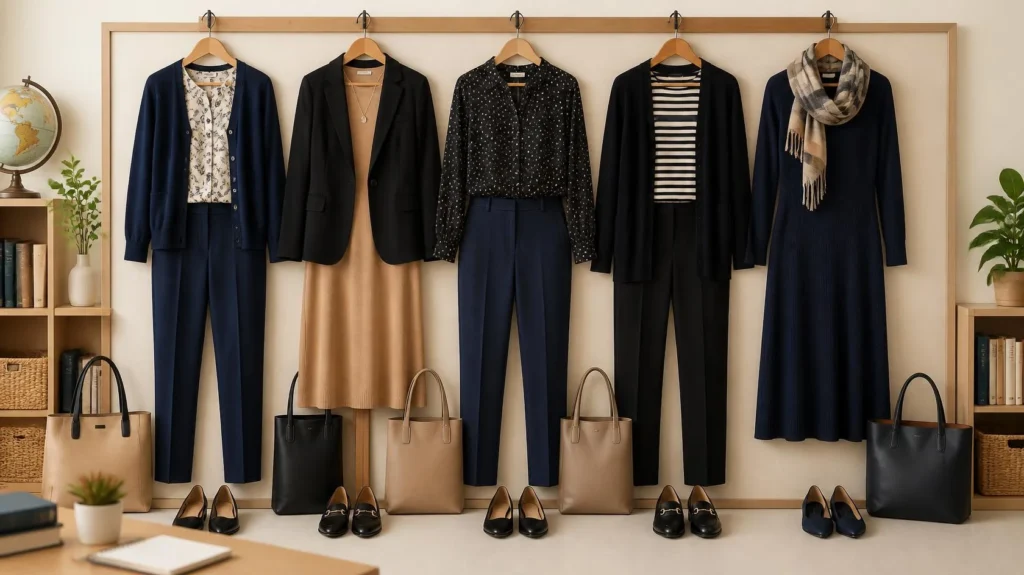
Smart teacher outfits are built for real classroom routines, not just the fitting room mirror. Choose pieces that can handle repeated washing and daily wear. Ponte knit is the true workhorse: thick, flexible, wrinkle-resistant, and ready to wear straight from a cold wash. Double knit and heavier jersey fabrics offer the same reliability. Cotton blends with a touch of spandex help maintain shape through an entire school year of washing while keeping your wardrobe practical and polished.
What fails is easy to list. Dry-clean-only silk. White linen. Pale gray, which shows every drop of anything. Loose weave knits that snag on desk corners and bulletin board staples.
Color does more work than fabric here. Mid-tone and dark shades hide stains, so navy, olive, rust, burgundy, and black carry the load. A small busy print hides a marker streak better than any solid, which is why printed knit tops are worth stocking. Save the pale colors for photo day.
Pockets Are Load-Bearing, Not Decorative
Count what you carry during one lesson. A dry erase marker, your phone, a badge or keys, a pen, tissues, and the hall pass somebody handed you.
That is the specification. A pocket that cannot hold a full marker without it poking out is decoration. Aim for side seam pockets around 6 inches deep, patch pockets on a utility cardigan, and dresses that come with genuine pockets rather than fake flaps.
Knit dresses with real pockets are the single highest value buy for elementary. If you are browsing washable dresses with pockets, put your hand in before anything else.
Shoes For A Six Hour Standing Day
Most classroom staff cover three to five miles a day on tile laid over concrete. That surface is unforgiving.
Four things matter: arch support, a cushioned, shock-absorbing midsole, a closed toe, and a sole that grips a freshly mopped hallway. Open toes lose to dropped scissors and spilled paint. Thin ballet flats offer nothing at hour four.
Prices are reasonable if you shop the practical end. A New Balance 577 walking shoe runs around $46, Dr. Scholl’s Time Off sneakers sit near $70, and a Jetset loafer lands about $50. Cushioned slip-ons like Rothy’s are around $99. If your feet already hurt, a Hoka Clifton at roughly $145 or a Dansko Professional near $140 is money well spent.
Buy two pairs and alternate them. Compressed foam needs about a day to bounce back, so wearing the same pair five days straight wears it out faster and hurts more. More options live in the shoes for standing all day archive.
Layering For A Room That Swings 15 Degrees
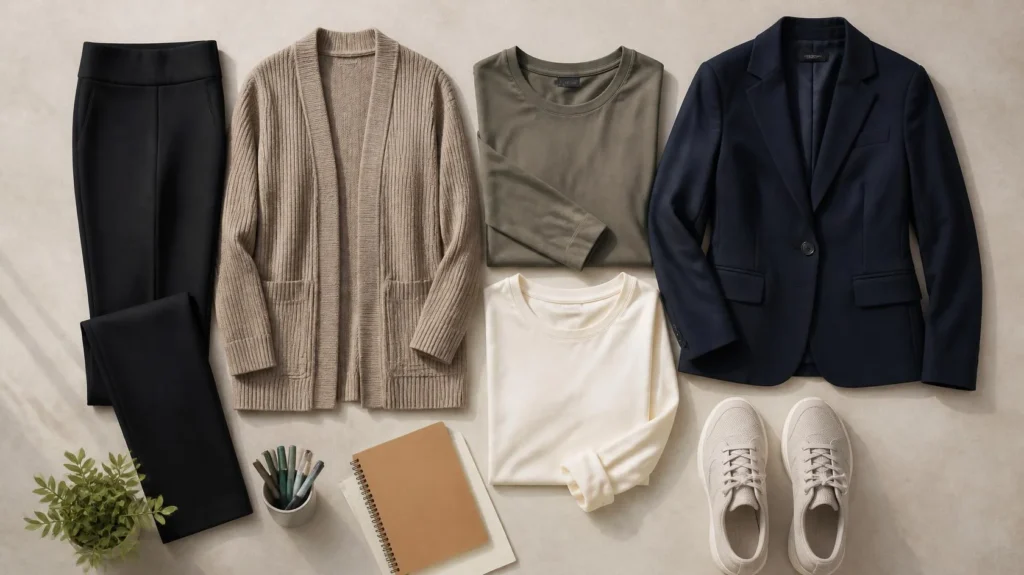
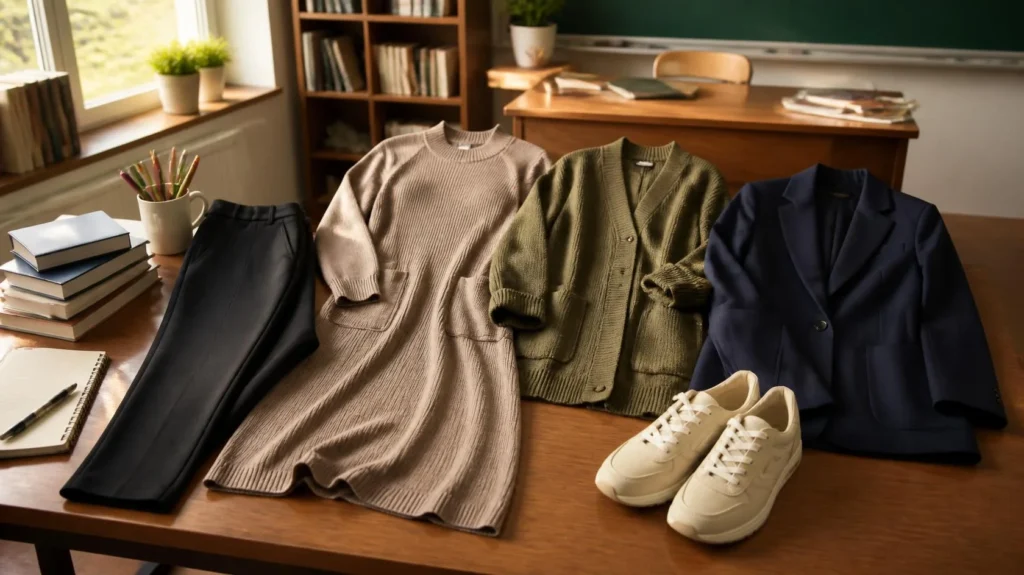
The best teacher outfits are built around practical layers, especially for classrooms where temperatures change throughout the day. Use three simple layers, with the middle one easy to remove in front of thirty students without disturbing your hair or comfort. Start with a washable, mid-tone short-sleeve knit top as the base. Add an open-front cardigan with patch pockets as the middle layer instead of a pullover you have to pull over your head.
Finish with a heavier jacket or blazer for the chilly first hour, then hang it on your chair once the room warms up. Avoid long scarves in elementary classrooms, where small hands can grab them and paint spills are common. If your building stays cold all winter, wear a thin long-sleeve tee under the knit top rather than a bulky sweater to maintain flexibility during bending, reaching, and moving around the classroom.
Teacher Outfits By Grade Level
Physical demands and dress code expectations both shift as students get older. The formula should shift with them.
| Grade band | Main physical demand | Formula that works | Dress code reality | Cost per outfit |
| Pre-K and Kindergarten | Floor sitting, constant bending, paint and glue | Ponte pants + printed knit top + utility cardigan + cushioned sneakers | Most relaxed, jeans usually fine | $60 to $110 |
| Grades 1 to 5 | Floor time plus outdoor recess duty | Knit midi dress + bike shorts + cardigan + supportive sneakers | Casual to business casual, spirit shirts on Friday | $70 to $130 |
| Middle school, 6 to 8 | Standing, hallway duty, fast transitions | Straight-leg pants + tucked knit top + loafers or low block heel | Business casual, denim often allowed Friday | $80 to $150 |
| High school, 9 to 12 | Standing, lab and shop safety rules | Dark pants or knit midi skirt + button front shirt + blazer + loafers | Business casual, closed toe required in labs | $90 to $180 |
| Art, science, PE and specials | Chemicals, paint, constant movement | Dark washable pants + smock or apron + non slip closed toe shoes | Practical exemptions are common | $50 to $100 |
One caution on the high school column. A blazer reads as authority with older students. It should still be machine washable.
A Capsule Closet And A Five Day Rotation
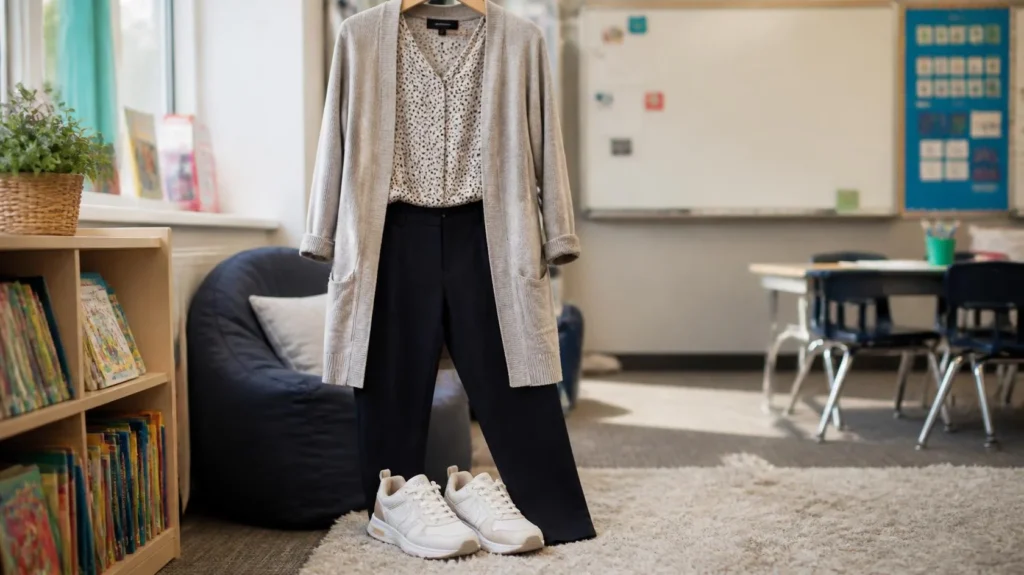
Ten pieces cover a full week and mix into far more combinations than five separate outfits would.
- Two pairs of ponte pants, black and navy, about $25 to $45 each
- One knit midi dress with pockets, about $40 to $70
- One knit midi skirt, about $30 to $55
- Three printed or mid-tone knit tops, about $15 to $30 each
- One utility cardigan with patch pockets, about $35 to $60
- One washable blazer for middle and high school, about $45 to $80
- Two pairs of supportive shoes, about $45 to $145 each
Total that up, and a complete rotation costs roughly $310 to $600. Loft, Madewell, Banana Republic and J.Crew all run 15% off with a school ID, and Target, Old Navy and Quince cover the lower end. Buy the shoes first and the tops last.
| Day | Outfit | Why it works |
| Monday | Black ponte pants, printed knit top, cardigan, sneakers | Print hides Monday marker chaos |
| Tuesday | Knit midi dress, bike shorts, cardigan, sneakers | One decision, full floor coverage |
| Wednesday | Navy pants, solid crew top, blazer, loafers | Meeting ready without a change |
| Thursday | Knit midi skirt, printed top, cardigan, second pair of shoes | Shoe swap lets the foam recover |
| Friday | Dark denim or navy pants, school shirt, sneakers | Spirit day, still passes the bend test |
Swap the cardigan for a lighter linen blend in May and a heavier one in January. Seasonal swaps are covered further in the seasonal outfits archive.
Start With One Week
Building practical teacher outfits does not require replacing your entire wardrobe in August. Start with one reliable pair of ponte pants with pockets and one supportive pair of shoes. Wear them through a full school week to understand how they handle your daily routine. Then add a comfortable dress, followed by a versatile cardigan that can complete more classroom-ready looks.
FAQ
Ten mixable pieces cover a five-day week with room to swap. Most educators find that two bottoms, one dress, one skirt, three tops, a cardigan, and two pairs of shoes are enough. Laundry once a week keeps it running.
It depends entirely on the district and often the building. Many elementary schools allow denim daily, while some high schools limit it to Fridays or spirit days. Dark, intact, no rips is the safe reading anywhere.
Usually only with a top that covers the seat, or under a knit dress. Ponte pants look far more polished and feel almost identical.
Open-toe shoes, dry-clean-only fabric, deep necklines, above-the-knee skirts, and anything pale enough to show a marker streak. Long necklaces and dangling earrings also get grabbed by little hands.
Budget $310 to $600 for a full ten-piece rotation, with shoes taking the biggest share at $45 to $145 per pair. Buying two quality pairs beats four cheap ones. Educator discounts trim another 15% off several major brands.