
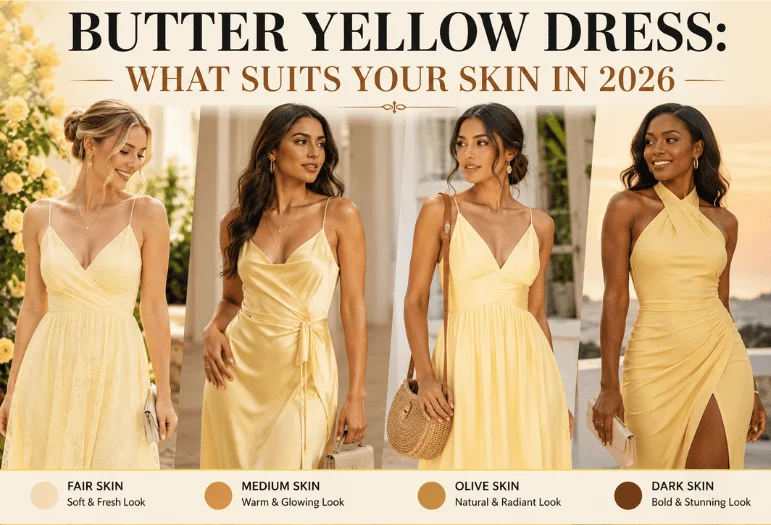
Hailey Bieber called this color played out in the summer of 2025. Spring 2026 answered with tubs of it at Chanel, Dior, Loewe and Sandy Liang, so the shade clearly did not read the memo. The useful question now is not whether to buy a butter yellow dress. It is which butter, and whether that particular one likes your face. For the full picture, read Skirt Types.
Butter yellow is a soft, warm pastel that sits between cream and lemon: pale, slightly golden, with none of lemon’s green edge. It flatters warm and neutral undertones most easily, and it reads rich on deep skin. Cool, pink-toned complexions are where it drains, unless a warm metal or a contrasting neckline breaks it up.
Butter, lemon, cream or pastel: which yellow are you holding?
Retailers use all four names for stock that photographs almost identically on a white background. In person, they behave nothing alike. Butter carries warmth and a little gray, which is what keeps it from looking like a highlighter. Lemon carries green. Pastel yellow carries chalk.
| Shade | What you are looking at | Undertone it suits | Pair it with | Where it goes wrong |
| Butter yellow (around #F3E5A9) | Pale golden yellow with a soft, slightly muted finish, like butter left out on the counter | Warm and neutral first, and it reads rich and expensive on deep skin | White, chocolate brown, denim, sage, tan | Photographs as ivory under flash, and can gray out very pink complexions |
| Lemon yellow (around #F6EB61) | Brighter, cooler, tilted toward green, with real saturation behind it | Cool and neutral, and it holds up against high-contrast coloring | Navy, crisp white, cobalt, silver | Turns acid under warm bulbs, and it fights golden jewelry |
| Pastel yellow (around #F7F0C0) | Chalkier and flatter than butter, more powder than cream, with the warmth washed out | Fair cool and neutral skin, in smaller pieces | Lavender, soft gray, pale pink | Flattens deep complexions and reads juvenile in a full skirt |
| Cream and ivory (around #F4EBD9) | An off-white with a faint yellow cast rather than a yellow with white in it | Almost everyone, which is why it is the safe default | Camel, black, tan, gold | Vanishes against pale skin, and it is a wedding-guest problem |
| Mustard (around #D2A324) | Yellow shifted deep and brown, with the most forgiving depth of the group | Warm, olive and deep skin, and it is the fallback when butter drains you | Rust, forest green, cream, dark denim | Reads heavy and autumnal in July |
Put the tag and the fabric together, and the name usually gives itself away. If the swatch looks slightly dusty next to a sheet of printer paper, it is butter. If it looks like it could glow, it is lemon.
Key takeaways
- Butter yellow survived its 2025 backlash and came back through the Spring 2026 collections, so it is a safe buy this year.
- Warm and olive skin wear it unaided; deep skin makes it look expensive; cool, pink-toned skin needs gold nearby.
- It is warmer than lemon, deeper than pastel yellow, and yellower than cream, in that order.
- Flash strips the warmth out and pushes it toward ivory, which is the whole wedding-guest argument.
- Matte cotton holds the color truest; satin blows out, and linen goes chalky as it creases.
How the shade won 2025, and why 2026 kept it

The color arrived on the Spring 2024 runways at Loewe, Givenchy and Louis Vuitton. It looked like a quiet reaction to several seasons of black and burgundy. Mass-market brands copied it through 2025 and copied it hard. By that June, you could buy a pale yellow slip, a pale yellow cardigan and a pale yellow tote in the same mall trip.
Saturation produced the inevitable backlash. Bieber declared the shade finished in mid-2025 and pointed everyone toward lemon instead.
She was early. Spring 2026 brought butter back at Chanel, Dior, Loewe, Eckhaus Latta, Aje and Sandy Liang. This time it showed up styled as a basic rather than as a statement. That shift matters more than the runway credits. In 2025, the shade was a sundress you wore once a summer. In 2026 it works the way a cream or a soft gray does, and that is the version worth spending money on.
Which undertones it flatters, and which it drains
Here is the test that settles it. Hold the fabric flat under your jaw, in daylight from a window, with no makeup and no store lighting. If your under-eye shadows lighten and your skin looks warmer, the shade is working. Watch for the opposite: a face that goes flat and slightly gray means the shade is pulling color out of you.
Warm and olive undertones
This is the easiest match in the group. Golden and olive skin shares the same warm base as the fabric, so the two settle together instead of competing. You can wear it head to toe without a single trick.
Cool and pink undertones
Cool skin is where butter gets difficult, because the yellow amplifies any pink or red already sitting in your cheeks. Stylists split on the fix. Some say drop to a cooler lemon; the more practical answer is to keep the dress and change what sits near your face.
Warm metal does most of that work. A heavy yellow-gold cuff throws a warmer reflection up toward your jaw, so the fabric stops reading against your skin directly. Real weight helps, like the pieces in our Cartier Love bracelet guide. A white or black neckline layered under a V does the same job for less money.
Deep skin
Pale yellow against deep brown skin is one of the highest-contrast combinations in a summer wardrobe, and it looks costly. The caution you sometimes read, that pastels wash out deep complexions, applies to the chalky pastel in the table above, not to butter. Butter has enough warmth to stay rich.
Fair, low-contrast coloring
If your hair, skin, and eyes all sit in a narrow range, a pale wash of yellow can flatten the whole picture into one blur. Go slightly deeper, toward a honeyed butter, or add contrast with dark shoes and a strong lip.
What to pair with a butter yellow dress
The governing rule is softness. Pair it with colors that have been muted the same amount, and almost anything works. Bring in something at full saturation, and the dress suddenly looks washed out next to it.
- Softest partners: aqua, sage, soft olive, lavender, pale coral, light pink
- Neutrals that never fail: white, cream, tan, camel, light to medium gray
- Depth when you want it: chocolate brown, navy, dark denim
- Skip: hot pink, bright turquoise, muddy dark olive
Black is the argument. One isolated black piece reads as an accident against a pale dress, so repeat it: black shoes and a black bag, or a black belt and black sunglasses. On metals, gold is the natural partner and silver reads cleaner and more modern, so pick by your undertone rather than by rule.
Shoes
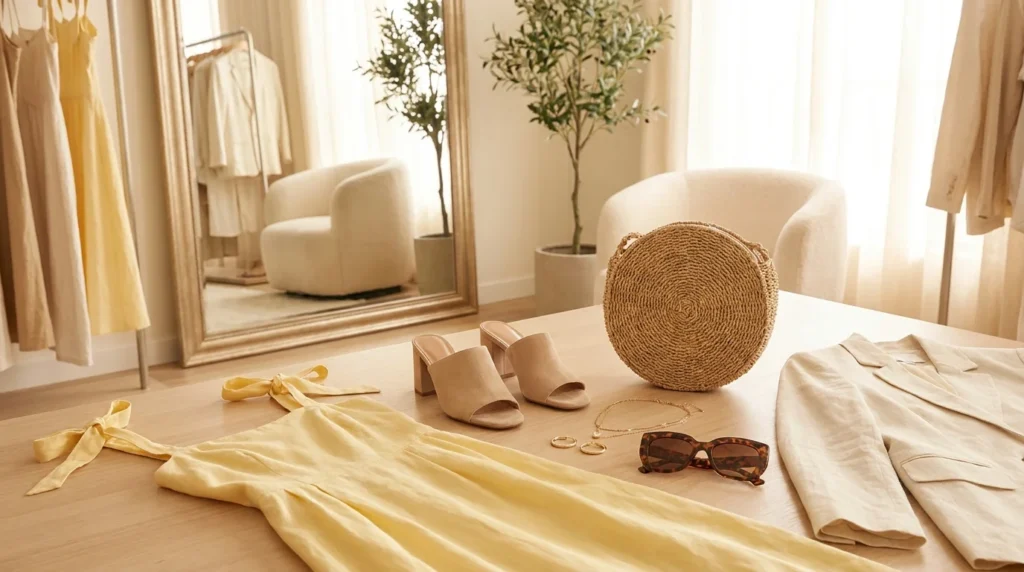
Tan and cognac are the workhorses, because they carry the same warmth without matching the dress. White sneakers keep it casual and black slingbacks make it evening. A nude sandal in your own skin tone quietly lengthens the leg. Tan suede is the prettiest of these and the least forgiving. Read up on keeping suede shoes clean before you wear a pale pair to anything on grass.
How it photographs, from golden hour to flash

This is the part that decides whether you love the dress or quietly retire it, and no ranking page seems to mention it. Direct midday sun blows out the pale end of the color, so the folds lose definition and the dress flattens into a single bright shape.
Golden hour is the opposite, and the most flattering hour you will get. The warm light deepens the yellow toward apricot, and the whole thing turns peachy. Tungsten bulbs at an indoor reception push it warmer again, closer to beige.
Camera flash is the troublemaker. A direct flash strips the warmth straight out and the fabric photographs as ivory, which is exactly why the wedding-guest question keeps coming up. Guests in pale yellow have been mistaken for the bride in group shots more than once.
The workaround is simple. Pick a butter with visible depth rather than the palest one on the rack. Skip high-shine satin. Then add a colored belt, bag, or shoe so the eye has something non-white to lock onto. If you are the one getting married rather than attending, the fabric-weight advice in our beach wedding gown guide is more useful to you than any of this.
Fabric and finish change the shade
Two dresses cut from the same dye lot can read as different colors, and the finish is why. Matte cotton poplin holds the truest version, which makes it the safest online order. Satin and charmeuse bounce light off every curve, so the highlights go near-white and the shadows go gold.
Linen starts beautifully and goes chalky as it creases, drifting slightly gray by mid-afternoon. Chiffon and georgette build depth in layers, so a three-layer skirt reads a shade deeper than the bodice. Knit and jersey hold the most pigment of all and look warmest on the body.
One more thing worth checking: pale yellow is not opaque. Hold the skirt up to a window before you take the tags off, because unlined versions under about $60 usually show everything.
What it costs in 2026
Most of what we saw this season fell into four bands. Old Navy and Target sit around $30 to $50, usually in cotton blends and usually unlined. Abercrombie, Madewell, J.Crew and Quince run roughly $70 to $130, which is where the fabric starts holding its shape. Reformation and the contemporary racks at Nordstrom land between $150 and $300, and designer opens somewhere near $500.
Buy it once, wear it five ways
- Daytime errands: white sneakers, a tan tote, small gold hoops. Nothing else.
- Work-adjacent: a chocolate brown blazer over the top, brown loafers, hair up.
- Dinner: black slingbacks and a black clutch, with black sunglasses pushed into your hair so the black repeats.
- Wedding guest: sage or aqua accessories, a colored bag, and no ivory anywhere near it.
- Fall carryover: a dark denim jacket, tall brown boots, and opaque tights once the temperature drops below 60.
Five outfits from one purchase is the honest test of any trend color. This one passes more easily than the neon and the burgundy before it.
Before you buy
Do the jaw test in daylight, check the lining against a window, and decide which of the five outfits above you would genuinely wear. Two that sound like you is a yes. None, and the color was never the problem.
FAQs
Yes, with one caution. Pick a version with enough depth that flash cannot bleach it toward ivory, and add a colored accessory so nobody in the group photo has to look twice.
It can. Cool, pink-toned skin needs help from warm metal near the face, or a contrasting neckline. Without either, the yellow tends to pull the color out of your complexion.
Tan or cognac for daytime, black for evening, nude in your own skin tone when you want the leg line. White sneakers work; white heels rarely do.
Gold if your undertone runs warm, silver if it runs cool. It blends into the dress and reads soft, while silver cuts against it and looks sharper.
It is. The Spring 2026 collections brought it back after the 2025 fatigue. It now behaves like a neutral rather than a novelty, which is what gives it a longer life.