

Most people buy statement earrings for one big night, wear them once, then leave them in a drawer forever. It is rarely a taste problem. By hour three, the lobe aches and the pair has tipped forward at a sad angle. Weight is the dividing line, and almost no shopping guide takes it seriously.
A single earring under five grams disappears on the ear. Between five and eight grams,s you will notice it after a few hours. Past eight grams, the lobe starts to fold, the post angles downward, and the ache arrives before the party ends. Weight, not size, sets your real limit.
Key takeaways
- Under five grams per side is all-evening territory. Over eight grams is a two-hour piece.
- Hollow metal and resin let a designer build a huge shape at half the mass.
- A wide flat back spreads pressure. A tiny butterfly back concentrates it.
- Adhesive lobe patches run about $12 for 60 and genuinely work.
- A big pair on the ear usually means no necklace.
Why Weight Is The Whole Ballgame?

Your lobe is soft tissue with no bone behind it. It holds a post through a channel about a millimeter wide. Hang twelve grams off that channel with statement earrings, and the tissue does what soft tissue does: it gives. Not dramatically, and not on night one. But the pull is constant for as long as the pair stays on. Eight grams is roughly 0.3 oz, about the weight of three pennies. That sounds like nothing in your palm. Hung off a millimeter of skin for five hours, it is a lot.
Retailers rarely publish gram weights, which is maddening. They publish drop length instead, so a listing says 2.5 inches and tells you nothing about whether the piece is solid brass or a hollow shell. Ask a boutique to weigh a pair before you commit. Online, the return window is your only test.
What A Lobe Tolerates Over An Evening?
These bands come from what jewelers and metalsmiths use as working rules. They line up with how a normal lobe behaves at a four-hour dinner.
| Weight per side (grams) | How it feels | Sensible wear window |
| 2 to 4 | You forget them | All day, every day |
| 5 to 7 | Present but easy | A full evening, six hours plus |
| 8 to 12 | Noticeable pull by hour two | Three to four hours with support |
| 13 and up | Lobe folds, post tilts | Photos, ceremony, then swap out |
Nothing here is a medical rule. It is a comfort rule, and comfort decides whether a $180 pair gets worn twice a year or twice a month. For more on how accessories sit against an outfit, our jewelry and accessory guides go deeper on pairing.
Statement Earrings By Type, Rated On Weight And Comfort
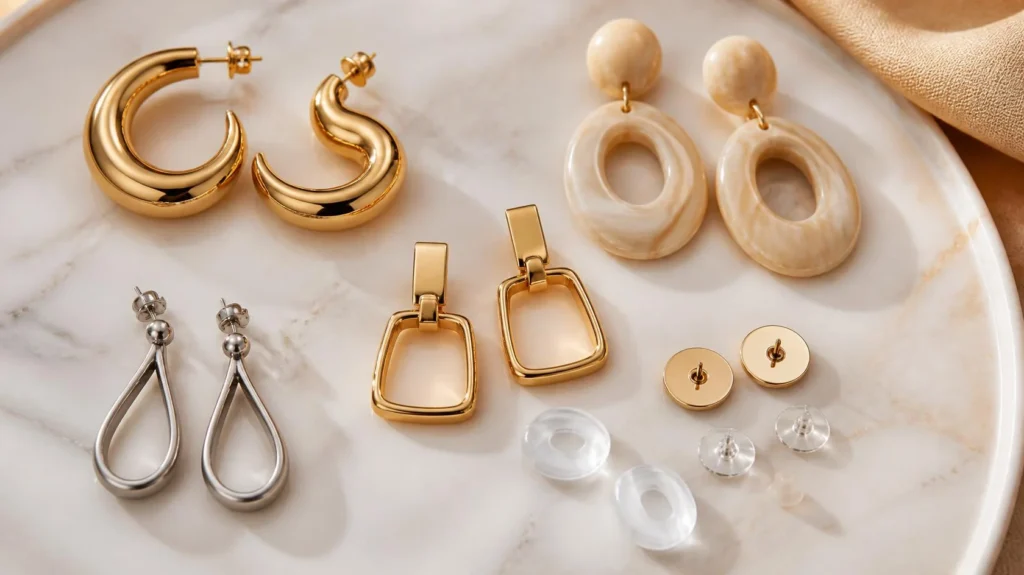
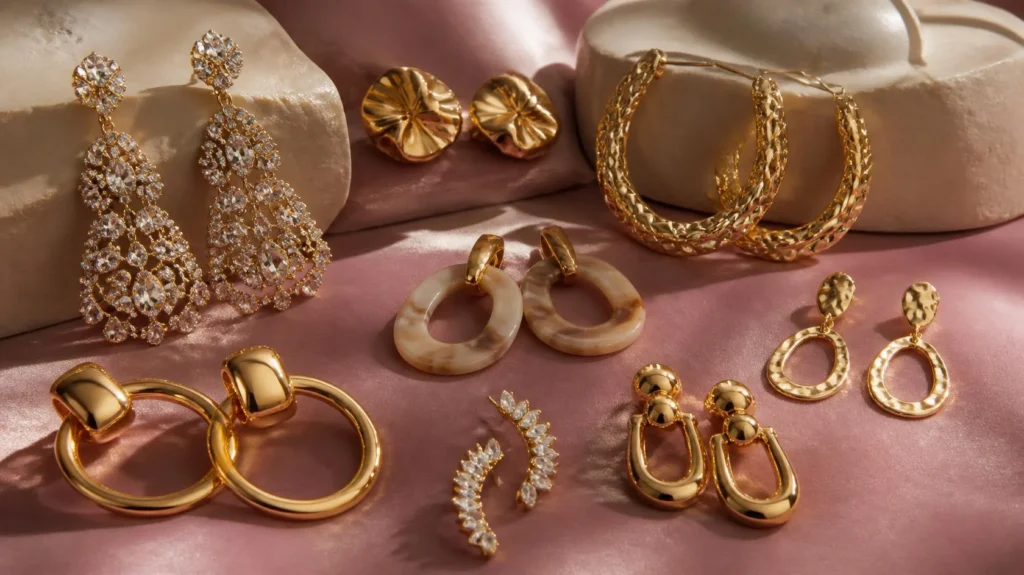
Seven shapes cover almost everything sold as a bold pair. Prices. reflect what US retailers were charging in 2026, from resin at the low end up to fine gold.
| Type | Weight each (grams) | Comfort over 4 hours | Snag risk (hair, knitwear) | Price band |
| Chandelier | 9 to 18 | Poor without support | High | $30 to $400 |
| Oversized hoop | 6 to 14 | Fair | Medium | $25 to $300 |
| Drop | 5 to 10 | Good | Medium | $28 to $250 |
| Ear cuff or climber | 1 to 4 | Excellent | Medium, catches fine hair | $20 to $180 |
| Sculptural stud | 3 to 8 | Very good | Low | $35 to $500 |
| Tassel | 4 to 9 | Good | High, threads catch wool | $18 to $160 |
| Door knocker | 8 to 20 | Poor to fair | Low | $30 to $450 |
Read that table sideways, and a pattern shows up. The shapes that photograph loudest, chandelier and door knocker, are the two that punish you. Climbers and sculptural studs give you visual scale with almost none of the mass, because the weight sits against the lobe rather than swinging off it.
Construction: Hollow Forms, Resin, And Titanium
A gold door knocker statement earring the size of a matchbook could weigh thirty grams solid. Made hollow, the same silhouette lands near nine. Good makers stamp or electroform a thin shell and seal it, so the outside reads as heavy metal, and the inside is air. It dents more easily than solid gold. That is the trade.
Resin and acrylic do the same job at a fraction of the price. A five-inch resin chandelier can come in under six grams, which is why so many oversized summer pairs are plastic under the color. Enamel over a light alloy behaves similarly. Titanium is the quiet winner for anyone with a reactive lobe, since it is strong, light, and skips the nickel problem. Beware of anything described only as “brass” with no mention of a hollow build. Solid brass is dense.
Backs, Discs, And Patches
Changing the back is the cheapest upgrade available, and it does more than most people expect. A standard butterfly back presses a few square millimeters into the skin. Swap it for a wide flat disc back and the same load spreads across a much larger footprint, so the pull stops feeling like a pinch.
- Flat disc backs: clear plastic or metal, roughly $6 to $20 a set. First thing to buy.
- Screw backs: keep a heavy post from creeping forward through the channel.
- Adhesive lobe patches: around $12 for 60 patches. They stick behind the lobe and carry the load across skin instead of the piercing.
- Clip converters: useful for a piece so heavy that no piercing should hold it.
Here is the trick experienced wearers swear by. If you have a second lobe piercing, use it. Run a fine chain or a thin support hook from the heavy piece up to that second post. Two channels then share the load instead of one, and some brands now design drops exactly this way.
Stretching And Tearing, The Long View
This is the part shopping pages leave out. Years of heavy wear from statement earrings can widen a lobe channel from a neat dot into a slot, and a very stretched channel can eventually split at the edge. It is slow. Cumulative, too. And mostly avoidable.
Practical caution, not medical advice: if a piercing looks elongated, sits lower than it used to, or stings after an hour, treat that as a signal to lighten up. Give the lobe plain days between heavy nights. Never sleep in a big pair. And if a channel has already thinned noticeably, a professional piercer or a doctor is the right person to ask, not a blog.
Styling: Necklines, Necklaces, Hair, And Glasses
Once the comfort question is settled, styling gets easy. Bold ear jewelry wants space around it, and most styling mistakes are crowding mistakes. For the full picture, read Canadian Tuxedo.
Neckline Pairing
- Strapless or bandeau: the friendliest neckline there is. Chandeliers and long drops get a clean field.
- Deep V: go vertical. A drop echoes the line, while a wide door knocker fights it.
- High neck or turtleneck: sculptural studs and hoops. Anything dangling vanishes into fabric.
- Halter and one-shoulder: the outfit is already asymmetric, so keep the ear simple.
- Boat or square neck: rounded shapes soften a hard horizontal line.
Volume matters as much as neckline. A ruffled collar and a chandelier will argue with each other. Our guides to dresses and silhouettes are worth a look before you pick a pair for a specific gown.
When To Skip The Necklace?
Skip it. That is the honest default for anything past roughly two inches of drop. If the pair does the work at eye level, a chain at the collarbone splits attention between two focal points. Two exceptions. A thin, close-fitting chain that reads as texture rather than as a piece. Or a long pendant sitting well below the neckline, so the two never compete in one glance.
Updo Versus Loose Hair
An updo is the classic partner, and for good reason. Nothing muffles the shape; the full silhouette shows in profile, and there is less pull on a heavy piece. Loose hair asks more of the design. Fine or curly hair tangles in filigree, tassels, and open hooks, so smooth closed shapes work better. A low bun or a half-up style splits the difference nicely, and our hair styling ideas pair well with this.
Glasses
Frames are a competing rectangle beside your ear. Keep the pair narrow and long rather than wide, so nothing collides at the temple. Thin wire frames tolerate more scale than thick acetate. Short drops that end above the jaw look tidiest with heavy frames, and matching metals, gold to gold, quietly ties the two together.
Buying Checklist

- Ask the seller for the gram weight. No answer means assume heavy.
- Look for hollow, resin, enamel, or titanium if the shape is large.
- Check the post thickness. Thin wire posts dig in.
- Confirm the back type, and budget $6 to $20 for disc backs regardless.
- Do a home wear test for two hours before cutting the tag.
What To Buy First?
If you own nothing bold yet, start with a sculptural stud or a climber in the $35 to $90 range. These are a good entry point into statement earrings because comfort is close to guaranteed, and they work under a coat collar in fall. Add a hollow gold-tone door knocker next, then earn the chandelier once you know how your lobes behave over a long evening. Browse more fashion styling ideas when you are ready to build the outfit around it.
FAQ
Most jewelers treat anything past seven or eight grams per side as heavy. Statement earrings above that are wearable, just not for eight hours. Plan on three to four hours, with disc backs or a lobe patch helping out.
Yes, surprisingly well. A patch sits behind the lobe and takes the downward load onto skin instead of the piercing channel. Sixty of them cost roughly $12, and one patch handles one night.
Not anymore. Marbled and translucent resin has been a designer material for years, and a good one at $40 reads far richer than thin plated metal at the same price.
You can, but pick one to lead. Keep the chain thin and close to the throat, or drop the pendant low enough that the two never register together.
Ear climbers and cuffs, at one to four grams. They hug the ear, so there is no swinging load at all.