


A textured fringe haircut is a front section cut with choppy, uneven ends so the hair falls in separate pieces rather than one solid line. Barbers build it by point-cutting into the tips. It reads relaxed instead of styled. Ask for it badly, and you walk out with a blunt shelf. Our related guide, Jean Skirt, goes further into this.
The gap between a good one and a bad one is rarely the product. It is the technique, the front length you bring in, and the words you use at the chair. This page gives you the script, the tools that matter, and a density test you can do right now. It also covers the daily routine that keeps a textured fringe haircut piecey past lunchtime.
What a textured fringe haircut actually is

A textured fringe is a front section with broken, uneven ends. The barber points the scissors into the tips and cuts vertically, so no two strands finish at the same height. That ragged edge creates the separation. Most people need roughly 4 to 5 inches of front length before the shape holds.
Everything else follows from that edge. Weight comes out of the tips, not the roots, which is why the front still moves after you dry it. Stylists sometimes call the same idea a choppy fringe or a piecey fringe. If you want the wider family of shapes and how they behave over a year, our full fringe haircut guide maps them out.
Textured, blunt, wispy or curtain: which edge do you want
The four common fringe shapes differ less in length than in the cutting tool used on the ends. That single choice decides how heavy the front looks and how often you need a trim.
| Fringe shape | How the edge is cut | Suits | Trim window |
|---|---|---|---|
| Textured/choppy | Point cut vertically into dry tips | Straight to wavy, medium density | 3 to 4 weeks |
| Blunt | One straight line, usually cut wet | Thick, dense hair with a flat hairline | 2 to 3 weeks |
| Wispy | Slide cut, ends tapered to a point | Fine to medium density | 2 to 4 weeks |
| Curtain | Split centrally, angled away on each side | Wavy or thick hair, longer front | 6 to 8 weeks |
Blunt is the strictest of the four. Curtain forgives the most. The textured version sits in between, which is why it has become the default ask in barbershops. If your hair is fine and a choppy edge feels too aggressive, read how wispy bangs are cut before you book anything.
Key takeaways
- You need about 4 to 5 inches of front length before a barber can build real texture.
- Point cutting makes the separation. Thinning shears usually ruin it.
- Pinch the front section: if the scalp shows through, go wispy instead.
- Trim every 3 to 4 weeks, and expect the shape to blur by week five.
- Hair grows about half an inch a month, so a fringe cut too short costs you roughly two months.
How much front length you need before you book
Barbers cannot cut texture into hair that has no length to lose. Pull your front section straight down and look at where it lands. Below the eyebrow means you have room to work with.
- Under 3 inches: too short. The ends will spike rather than separate.
- 4 to 5 inches: the sweet spot for a fringe that sits on or just above the brow.
- 6 inches or more: you can go for a heavier, forward-swept shape or split it into a curtain later.
What to say to your barber, word for word
Most bad fringes come from a vague request. Give the length, then the technique, then the sides, in that order. Say the words below almost verbatim.
- “Leave the front long enough to sit just above my eyebrows when I push it forward.”
- “Point cut into the ends. Please do not cut a straight line across.”
- “Low taper on the sides and back, blended, nothing shaved above the temple.”
- “I want it piecey and separated, not spiky.”
- “No thinning shears through the fringe.”
- “Cut it dry so we can both see where it falls.”
Point cutting, razors and the thinning shear problem
Point cutting means the barber holds the scissors vertically and nibbles into the ends. Each snip removes a few strands at slightly different heights. You lose weight at the tips and keep it at the roots, which is exactly what separation needs. A straight razor does something similar with a softer, feathered finish, though it can rough up hair that is already dry or bleached.
Thinning shears are the trap. Those notched blades, sometimes called chunking shears, cut a fixed fraction of every strand at one depth, so fine hair ends up see-through at the top and frizzy underneath. Ask for point cutting, and the difference lasts weeks. Accept thinning shears, and you get a fringe that looks fine on day one, then splits into two flat curtains. Coarse, dense hair survives them. Fine hair rarely does.
Who it suits, and the pinch test that tells you
Density decides this more than face shape does. Try the pinch test before you commit. Gather the front two inches of hair between your thumb and forefinger, push it forward, and look in the mirror at your hairline.
- The bundle feels solid, and no scalp shows: you have the density for a choppy edge.
- You can see scalp through the section: a textured cut will expose it further, so take a softer tapered shape instead.
- The section swirls sideways and refuses to lie forward: you have a growth pattern that will fight a short fringe every morning.
- Tight curls: ask for a dry cut, since curls spring up once they lose water weight.
Fades and tapers that sit well with it
A low taper keeps the weight up top where the fringe needs it, and it is the safest pairing by a distance. Mid fades read sharper, and suit rounder faces because the contrast adds height. High fades and disconnected undercuts look striking in photos, though they leave nothing to blend into once the front grows out. Layered cuts work too, and a shag haircut with heavy layers carries a choppy front naturally.
Styling it at home in about four minutes

Product does less than drying direction does. Get the shape into the hair first, then lock it.
- Towel dry until the hair is roughly 90 percent dry, damp but not dripping.
- Blow the front forward and slightly down, moving the nozzle side to side.
- Hit the front with the cool shot for ten seconds so the shape sets.
- Warm a pea-sized amount of matte clay, or a pinch of texture powder, between dry palms.
- Push it through from underneath. Never smooth it over the top.
- Break the ends apart with your fingertips, one small piece at a time.
Sea salt spray works on the damp stage, not the dry one. Use it before the dryer, then finish with clay. Cream and pomade both add shine and weight, which flattens the separation you paid for.
Why it collapses on day two
By the second morning, the fringe usually goes flat, and people blame the cut. It is nearly always oil. Scalp oil travels down the front section overnight, meets yesterday’s clay, and the strands clump back together into a solid sheet.
Wash frequency fixes this faster than any product swap. Most people do well washing every second day, using a clarifying shampoo once a week to strip the build-up. Between washes, rewet only the front under the tap, dry it forward, and reapply half your usual amount of product. Sleeping on a dry fringe helps. Sleeping on a damp one sets a crease you will fight until noon.
Trims, growing it out, and fixing one cut too short
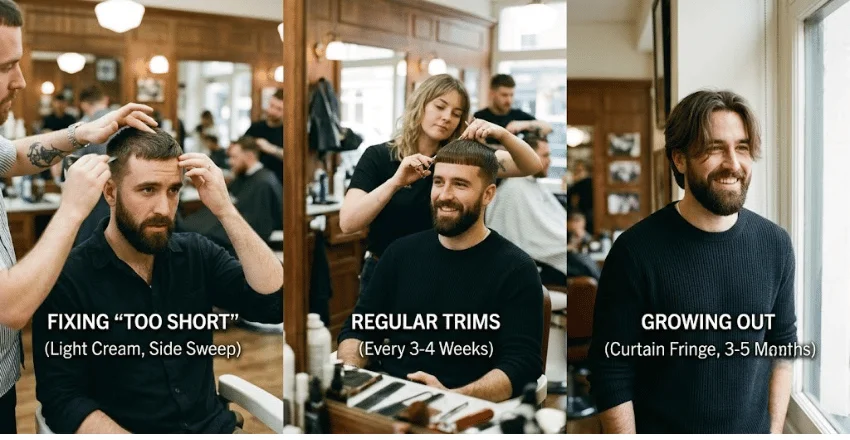
Book a trim every 3 to 4 weeks. The shape blurs around week five, and by week seven the ends have grown into your line of sight. Plenty of barbers tidy a fringe free between appointments, and shops that do charge usually ask $15 or less.
If it comes back too short, do nothing drastic. Hair grows about half an inch a month, so an inch of lost length takes roughly two months to return. Push the front sideways with a light cream while you wait, and skip the next scheduled trim entirely.
Growing it out fully takes longer. Expect three to five months before the front reaches a length you can split into a curtain shape. Ask your barber to keep blending the sides so the middle stage does not look accidental.
Frequently asked questions
Yes, with height. Keep the front slightly longer on one side and let the sides stay tight. A flat, level fringe widens a round face, while a broken angled edge lengthens it.
You can maintain one. Cutting the shape from scratch is harder than it looks. If you trim at home, cut dry, take tiny vertical snips into the ends, and never cut straight across.
It does, provided the barber cuts dry and works with the curl clumps rather than through them. Curls shrink as they dry, so a wet cut nearly always lands too short.
Messy describes the styling. Textured describes the cut. A messy finish on a blunt cut still shows a hard line underneath, which is why the two rarely look the same.
Budget four minutes each morning and one short trim a month. That is the honest floor for keeping a choppy front looking deliberate.
No sign of it. Barbers report it as their most requested front shape, and the taper pairings keep changing while the fringe itself stays.