

A jean skirt runs about $25 at Old Navy and $188 at Reformation, and that spread says less about quality than you would guess. Both are cotton. Both arrive in the same four lengths. What separates them is fabric weight, hem finish, and where the waistband was cut to sit.
Pick a denim skirt by answering four questions about yourself. How much leg do you want to show? Where do you want the waistband? How dressy does the wash need to be? What will you spend? Length and rise settle the fit. The wash decides the outfit. Price decides what fabric you get.
The spec sheet, side by side
Every number below comes off live US product pages, not off a style blog. Use it as a shopping filter before you look at a single photo.
| Style | Typical length (size 28) | Usual rise | Common washes | Price band |
| Mini | 13 to 17 in | Low to high | Stone, light, black | $25 to $190 |
| Above the knee, A-line | 18 to 21 in | Mid to high | Medium, ecru | $30 to $120 |
| Knee length, pencil | 22 to 26 in | High | Rinse, dark indigo | $35 to $150 |
| Midi, column or slit | 30 to 37 in | Mid to high | Rinse, medium, white | $40 to $190 |
| Maxi | 37 in and up | Mid | Light, medium, patchwork | $50 to $190 |
Key takeaways
- Measure, do not trust the tag. A midi and a maxi can sit less than one inch apart on the same brand’s own site.
- Length first, then rise. Those two settle the fit. Everything after that is decoration.
- Rinse and dark indigo read dressiest. Sanded, whiskered distressing reads cheapest and dates fastest.
- The heritage tier near $70 is where the money stops buying fabric and starts buying a name.
- Check the vent or the slit before you check the price.
1. How much leg do you want to show?

Start with the number, not the name. Brand labels contradict each other constantly, so the word printed on the tag tells you far less than a tape measure does.
Here are the real numbers, pulled from live product pages this week. Madewell lists a smocked-waist denim midi at 37 inches and a mid-rise maxi at 38 1/4 inches. That is less than an inch apart, between two categories most shoppers treat as opposites. The same brand’s crossover-waist mini measures 14 3/8 inches. Those measurements are on nearly every product page if you scroll past the marketing copy, and they are the only honest way to compare lengths across two sites.
Here is what each band does on the body.
- Mini, 13 to 17 in. Reads young and needs the rise to do the work. Anything under 14 inches wants a high waist unless you want a very short result.
- Above the knee, 18 to 21 in. The safest length in the whole category. Works with flats, boots, sneakers.
- Knee length, 22 to 26 in. The dressy option, especially in a pencil cut. Also the one most likely to restrict your stride.
- Midi, 30 to 37 in. The current favorite. Needs a slit or it walks like a tube.
- Maxi, 37 in and up. Heaviest and hottest. Buy it in a lighter denim or not at all.
Volume matters as much as hem height on the longer cuts, and denim behaves like any other fabric there: a fold adds width exactly where it starts. Our breakdown of how pleat types change volume applies directly, just with a heavier cloth doing the folding.
2. Where do you want the waistband?
Rise on a skirt is the distance from the top edge of the waistband down to the seat seam. Brands typically spec a high rise near 11 to 13 inches, a mid rise around 9 to 10, and a low rise at 7 to 8. The gap between the extremes is about a hand’s width, which is plenty to change your whole outline.
A high rise pulls waist definition upward and makes the leg read longer under a short hem. A low rise does the reverse. It stretches the torso and asks for a cropped top to keep the proportion honest. Mid rise is the forgiving middle, and it is what most midi and maxi denim skirts use. Go low only if you already like how low-rise jeans sit on you.
One number on the tag can change fit more than the size does: elastane content. Check the percentage. An all-cotton skirt has no stretch at all, so it gives roughly half a size across a day and springs back in the wash. Above about 3 percent elastane, the skirt keeps its shape but bags at the seat by mid-afternoon.
3. Should it read dressy or worn-in?
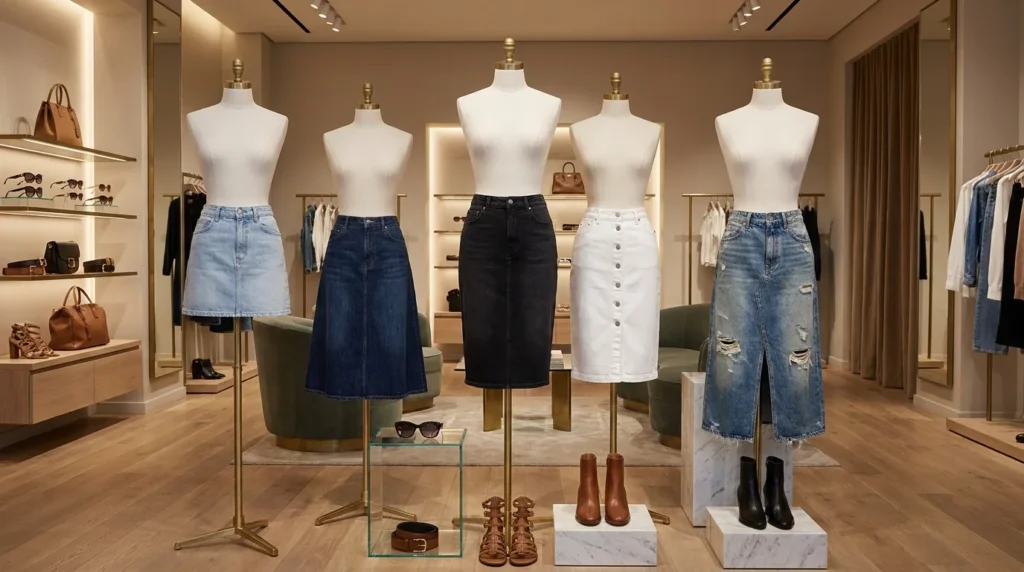
Wash does more social work than shape. Ranked from most formal down:
- Rinse and dark indigo. The only washes that pass in an office. Flat color, no fading, close to a navy skirt in effect.
- Black and ecru. Quietly dressy. Ecru in particular stops reading as denim from six feet away.
- Medium stone. The default. Goes with everything and commits to nothing.
- Light vintage. Weekend only, and it washes out further every cycle.
- Sanded, whiskered distressing. Ages fastest of anything here.
Finish counts almost as much. Raw, frayed hems read casual however dark the denim underneath. Clean turned hems with one row of topstitching read polished. Gold contrast thread pushes the whole thing Western, and tonal thread keeps it neutral.
4. What should a jean skirt cost you?
Price bands by retailer tier, from what we saw across US sites in July 2026:
| Tier | Where you find it | Typical price | What the money buys |
| Mass market | Old Navy, H&M, American Eagle, Target | $25 to $45 | Lighter denim, more elastane, hems that pucker after a few washes |
| Heritage denim | Levi’s | $64 to $99, most sit at $70 | Heavier cotton, proper hardware, a hem that holds its line |
| Contemporary | Madewell, Good American, Reformation | $98 to $190 | Rigid cotton, cleaner cut, more length options per style |
The step from mass market up to heritage buys you cloth. The step above $120 mostly buys you cut and a longer life, which is worth it on a skirt you will wear weekly and wasted on one you will not. We run the same three-tier test on other garments across our other fashion write-ups, and denim is one of the categories where the middle tier wins most often.
What to skip

Five things we would not buy again.
- Heavy factory distressing. Sanded whiskers and shredded hems date a wardrobe faster than any silhouette.
- Bandage-tight tube minis. Rigid pencil cuts in a thin stretch blend ride up on the first flight of stairs.
- Long, straight shapes with no opening. Three details decide whether you can walk properly: a back vent, a front slit, or a kick pleat. Without one of them, a long skirt locks your stride, and every staircase becomes a climb in small steps.
- Paper-bag waists in denim. The gathering piles bulk exactly where the fabric is already thickest.
- Fake pocket flaps. They add a seam line across the hip and hold nothing.
The verdict: what we would buy first
Our pick is deliberately boring. Knee length or a short midi, mid to high rise, medium stone wash, from the heritage tier near $70. It carries a tucked tee in July and a sweater in November. It survives the machine. Nothing about it pins you to one particular year.
Buy the mini second, once you know which hem you actually reach for. The maxi comes third, and only in a lighter weight, because fabric volume is the real problem with long denim.
Before you order, measure a skirt you already own and like. Write down two numbers: the length in inches and the rise. Shop to those numbers instead of to the words on the tag, and you will send far less back.
Frequently asked questions
Yes, and the category has widened rather than narrowed. Long column skirts and above-knee A-lines both sell heavily right now, and every large US retailer carries at least four lengths at once. That kind of range is the mark of a settled staple.
The one that ends where your leg is narrowest, which for most people is just above the knee or at mid-calf. Hems that land at the widest part of the calf are the ones that come back. Measure down from your natural waist, then shop to that number.
A tucked tee, a fitted knit, a striped long sleeve, or a button-down with a half tuck. Keep the top close to the body when the skirt carries volume, and let it loosen when the skirt is straight. Dark rinse plus a blazer is the one combination that reads dressy with no effort at all.
Flat sandals and white sneakers for medium and light washes. Ankle boots for knee-length. Loafers or a low block heel for a dark rinse. Suede is the easiest material to ruin here, so read our method for cleaning suede shoes before you wear a pair near wet sidewalks.
Snug at the waistband with room for two fingers, and no pull lines across the hip when you sit down. Denim gives. Anything that needs a deep breath in the fitting room will be loose by dinner. If the hip fits and the waist gapes, take in the back seam, because the reverse almost never works.