
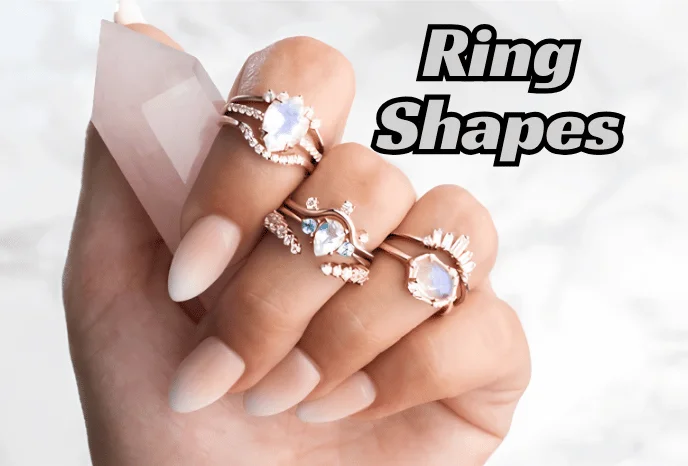
Most guides on ring shapes stop at what each cut looks like. That is the least useful part of the decision. What settles a purchase is apparent size against flaw tolerance, plus how the stone survives a decade of car doors. This guide compares ten cuts on those axes, with millimeters and dollars attached. Helix Earrings is a useful companion read here.
Ten cuts dominate the market: round brilliant, oval, emerald, princess, cushion, pear, marquise, radiant, asscher, and heart. Elongated cuts such as oval and marquise look up to 15 percent larger face-up than a round of equal weight. Step cuts reveal inclusions. Brilliant cuts hide them.
Key takeaways
- Marquise, pear, and oval give the largest face-up spread per carat. Expect about 10.5 mm of length from a one-carat marquise.
- Emerald and asscher cuts have wide open facets, so buy VS2 clarity or better and stay in the D to G color range.
- Round and cushion cuts disguise small inclusions, which makes SI1 a safe grade and a cheaper one.
- Pointed cuts chip—v-prongs or a bezel fix that.
- Round costs the most per carat. A one-carat cushion can save you roughly 40 percent.
How ring shapes change apparent size per carat
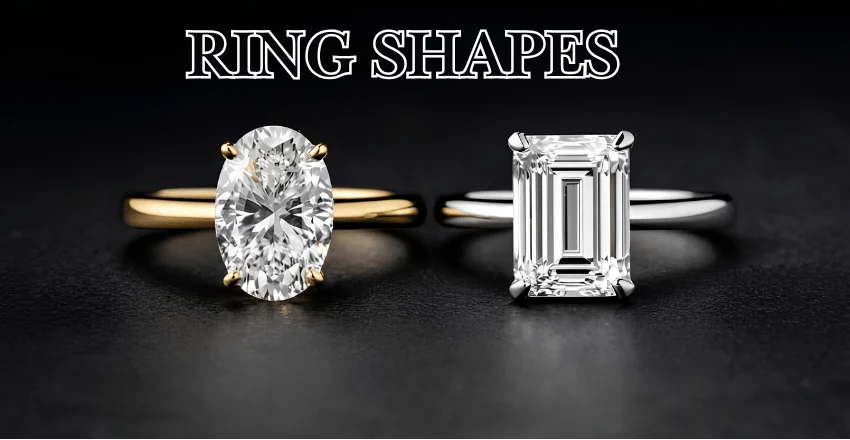
Carat is weight, not size. Two stones at exactly one carat can look nothing alike from above, because the cutter distributes that weight differently. Round brilliants carry much of their mass in the pavilion, the cone hidden below the girdle. Elongated cuts spread more of theirs across the top, where you actually see it.
| Ring Shapes / Cut | Face-up size at 1 carat | Reads against a round |
| Round brilliant | 6.5 mm across | Baseline |
| Princess | 5.5 x 5.5 mm | Smaller than it weighs |
| Asscher | 5.7 x 5.7 mm | Smaller than it weighs |
| Cushion | 6.2 x 5.9 mm | About the same |
| Heart | 6.5 x 6.5 mm | About the same |
| Radiant | 6.6 x 5.2 mm | Slightly longer |
| Emerald | 7.1 x 5.0 mm | Longer, narrower |
| Oval | 7.7 x 5.7 mm | Roughly 10 percent bigger |
| Pear | 8.9 x 5.5 mm | Noticeably longer |
| Marquise | 10.5 x 5.0 mm | Largest spread of all |
So a one-carat oval sits close to a 1.25-carat round in visual presence. Marquise pushes further still. Its long axis measures over 60 percent more than a round of identical weight, which is why it photographs so large on a finger. Princess and Asscher go the other way. Both look small for the money you paid.
Which cuts forgive a flaw and which expose one
This is where shoppers overpay. Brilliant cuts scatter light through dozens of small kite and triangle facets, and that visual chaos disguises a tiny feather or crystal. You can drop to SI1 clarity on a round or a cushion and still see nothing without a loupe.
Step cuts do the opposite. Emerald and Asscher use long parallel planes, 57 and 58 facets, arranged like a staircase. Jewelers call the result a hall of mirrors. It is gorgeous. It also leaves an inclusion nowhere to hide, so treat VS2 as your floor and move to VS1 past two carats.
Color behaves the same way. A brilliant cut breaks white light into flashes that mask a faint yellow tint, so J color often passes as white in a round. An emerald cut shows body color plainly, and most buyers stay between D and G.
What holds up to daily wear
Your ring takes more abuse than anything else you own: gym bars, grocery handles, laptop edges, car doors. Shape decides how much of that reaches the stone.
Pointed cuts carry the real risk. The two tips on a marquise and the single tip on a pear are thin, and one hard knock against a granite countertop can chip either. V-prongs wrap metal around each point and handle most of that. Bezels wrap the entire girdle and handle the rest, though you trade away some sparkle.
- Marquise and pear: V-prongs at every point, checked once a year.
- Emerald and asscher: flat tables show scratches less than domed crowns, but they film over with hand lotion fast.
- Princess: four sharp corners, so protected corner prongs are not optional.
- Round and oval: the most forgiving pair, though a thin girdle on either can nick.
Cleaning is the unglamorous half of ownership. Warm water, a drop of dish soap, a soft toothbrush under the stone once a week. That same routine keeps the rest of your fine jewelry bright.
Oval and marquise carry one extra quirk. Both can show a bow-tie, a dark band across the waist where the pavilion angles fail to bounce light back to your eye. Pear does it too. No lab report grades it. You have to watch video of the actual stone, tilted, before you pay.
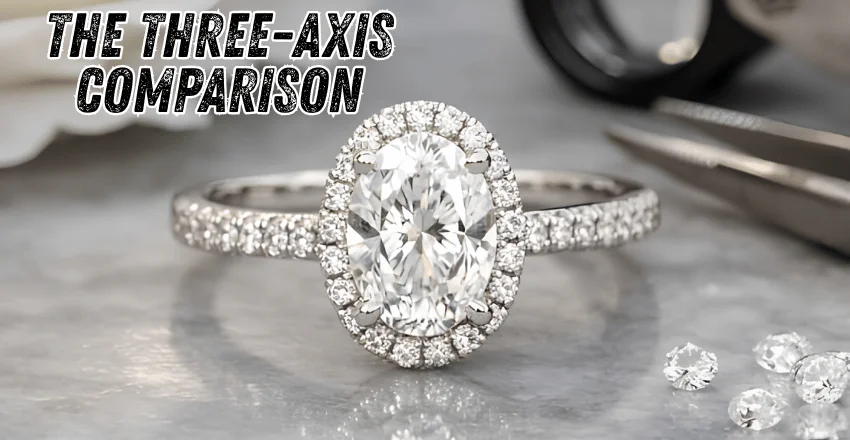
The three-axis comparison
| Cut | Apparent size per carat | Flaw and color tolerance | Daily wear risk |
| Round brilliant | Baseline | High, SI1 works | Low |
| Oval | Roughly 10 percent larger | High | Low, watch the bow-tie |
| Marquise | Largest spread | High | High, two points |
| Pear | Large | High | Moderate, one point |
| Emerald | Long and narrow | Low, VS2 minimum | Low |
| Asscher | Small for its weight | Low, VS1 preferred | Low |
| Princess | Small for its weight | Moderate | Moderate, four corners |
| Cushion | Close to round | High | Low |
| Radiant | Slightly elongated | High | Moderate |
| Heart | Similar to round | Moderate | Moderate, cleft and point |
Read across a row rather than down a column. A cut that wins on size can lose on wear, and your answer depends on which trade you accept.
Matching a cut to your finger and hand
Proportion beats carat weight here. The stone that flatters a long slim finger can swamp a petite hand.
- Short fingers: oval, pear, and marquise pull the eye lengthwise. Target a length-to-width ratio near 1.40 on an oval, 1.65 on a pear, 1.90 on a marquise.
- Long fingers: round, princess, cushion, and asscher balance the hand instead of stretching it further.
- Wide fingers: a broader stone with a slightly bolder band reads better than a narrow solitaire, which gets lost.
- Petite hands: 0.75 to 1.0 carat looks larger in proportion than the number suggests.
Band width matters nearly as much as the stone. Narrow or tapered shanks leave more finger visible and lengthen the line. Halos add perceived size without adding carat weight. If you are picking a ring to wear beside formal occasion dresses, remember that scale reads differently in photographs than in a mirror.
What each cut costs
Round brilliant costs the most per carat because of waste. Cutting a round from rough discards roughly half the crystal. Fancy shapes keep more of it, so they price lower at the same weight.
| Cut | Typical 1 carat natural price, J color and SI1 |
| Round brilliant | $3,390 to $3,450 |
| Marquise | $2,480 to $2,980 |
| Oval | $2,440 to $2,790 |
| Asscher | $2,190 to $2,790 |
| Heart | $2,280 to $2,780 |
| Emerald | $2,370 to $2,400 |
| Pear | About $2,270 |
| Princess | $2,230 to $2,370 |
| Radiant | $2,250 to $2,360 |
| Cushion | $1,990 to $2,050 |
Push quality upward, and the gap widens. In whiter color with cleaner clarity, a one-carat round runs $6,000 to $7,000, while a comparable oval lands near $4,800 to $5,800. Lab-grown stones rewrite the math completely. Set as a solitaire in 14k gold, one carat sits around $900 to $1,800, while two carats run $2,000 to $4,500.
One warning on emerald cuts. They look cheap per carat on paper, then charge you back on clarity and color, so the finished piece often lands near a round.
How to choose without second-guessing
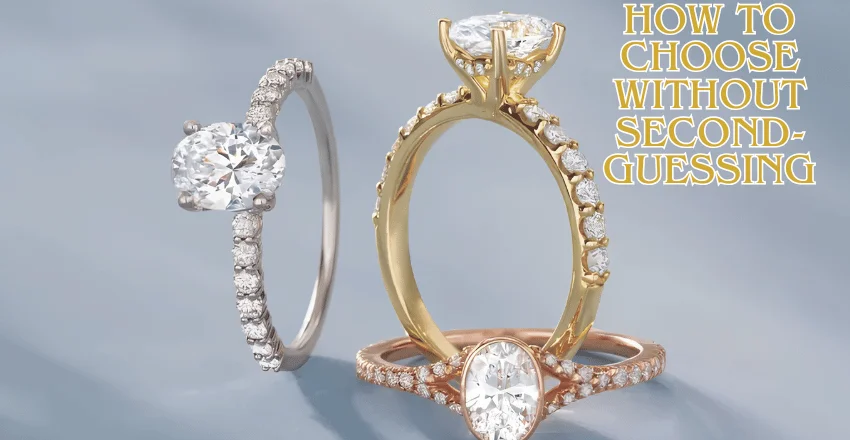
Start from the trade you care about most. Want maximum spread for the money? Oval or marquise. Want the cleanest architectural lines? Emerald, with the clarity budget behind it.
Then do one thing before you pay. Ask the seller for a 360-degree video of the exact stone. Tilt it on screen and hunt for a bow-tie or a visible inclusion. Grading reports capture neither. Two minutes of footage saves a return shipment and a lot of regret.
FAQ
Marquise, then pear, then oval. A one-carat marquise spreads about 10.5 mm long against a round measuring 6.5 mm across.
It shows film rather than scratches. Wash it weekly in warm soapy water with a soft brush, and it stays sharp.
The points do, yes. V-prongs or a bezel setting cut that risk sharply, and a yearly prong check catches loosening early.
VS2 as a floor, VS1 once you pass two carats. Brilliant cuts stay eye clean at SI1, which costs less.
Cushion. Expect roughly $1,990 to $2,050 for a one-carat natural stone in J color with SI1 clarity.