

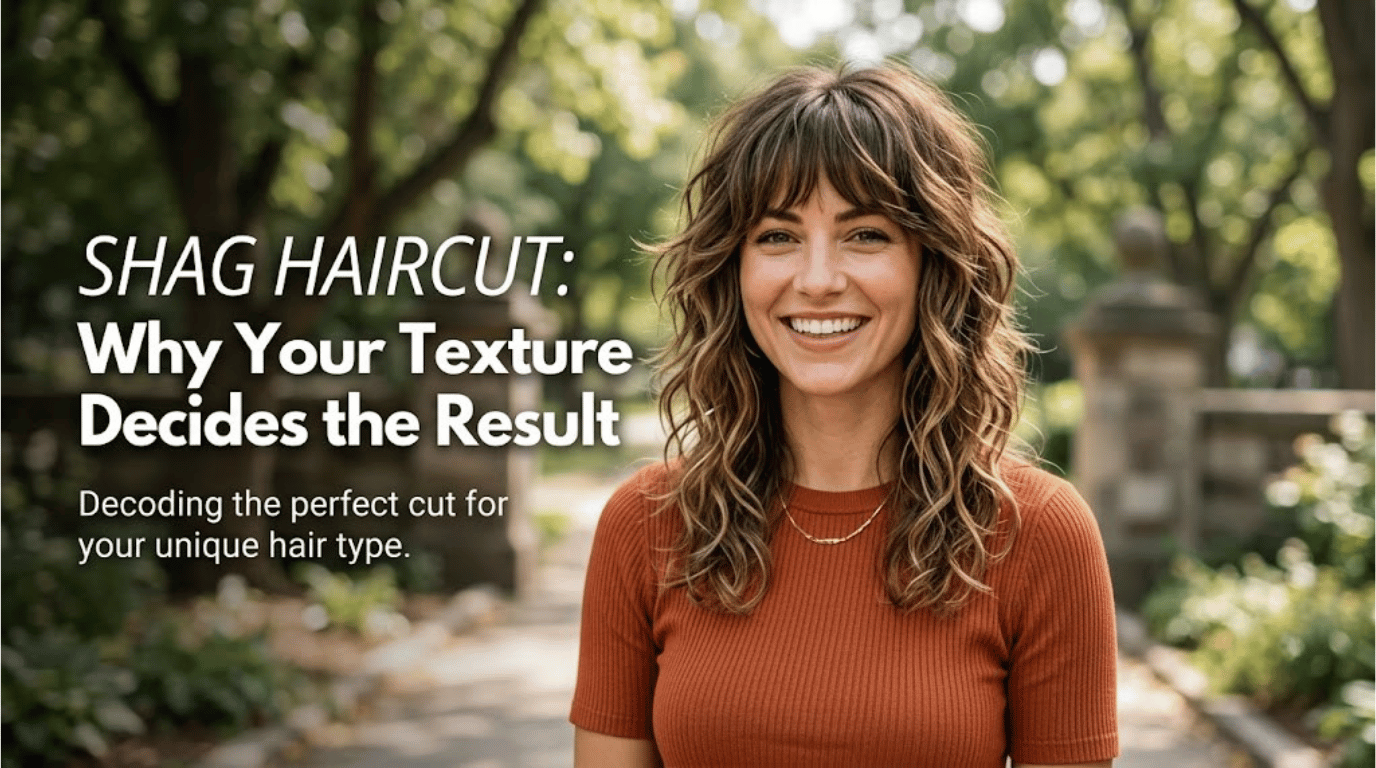
A shag haircut is not really one shape. It is a stack of layers built to separate and move, and that movement is borrowed straight from your own hair. Two people can bring in the same photo and walk out with cuts that look nothing alike. One goes flat, the other puffs into a triangle.
Here is the short version. The cut removes interior weight and stacks shorter layers around the crown so hair falls in separated pieces instead of one blunt line. Fine hair needs fewer layers, kept long. Dense hair needs weight taken from the inside. Curls need a dry cut.
Key takeaways
- The layers are designed to separate, so your natural texture does most of the styling work.
- Fine hair: fewer, longer layers, with weight left at the ends.
- Thick hair: interior weight removal, or the shape pyramids at the jaw.
- Curly and coily hair: cut dry, curl by curl, never stretched out wet.
- Budget $39 to $93 for a standard salon cut, and $80 to $250 for certified dry curly work.
- This one does not air dry to nothing. Plan on mousse and a texture spray.
Why texture matters more here than with other cuts

Think about a blunt bob. It is a line. You can cut that line on almost any head, and it still reads as a bob. Layers behave differently. They only look deliberate when the hair underneath falls away and reveals the piece above it.
That is the whole trick: separation. A cut built on separation needs hair that separates by itself, and textures do that at wildly different rates. Fine straight strands cling and read as one sheet. Coarse dense hair pushes outward instead of dropping. Curls shrink and clump. Before you commit, browsing a broad hair ideas archive helps you spot which photos share your texture rather than just your goal.
How a shag haircut behaves on five hair textures
Fine, straight hair
Fine hair gets told to avoid layers. That advice blames the cut for a bad execution. Short layers run all the way through the ends, leave a see-through perimeter, and thin hair looks thinner, never fuller.
Fix it by using fewer layers, placed high. Keep the shortest interior pieces around the crown and the top of the fringe, then leave the ends close to one length. Collarbone to shoulder is the sweet spot. Go longer and the weight drags your crown lift flat by lunchtime.
Thick, straight hair
Density is where the pyramid happens. Surface layering alone leaves a heavy shelf sitting underneath, so the hair widens at the jaw while the top perches like a mushroom.
Interior weight removal is the answer. Your stylist works inside each section, thinning bulk between the scalp and the ends without moving the outline. Roughly a fifth of the weight comes out. You will see an alarming pile on the floor. That is the job working.
Wavy hair
This is the texture the cut was built around. Waves already separate on their own, so layers simply amplify what already exists.
One caution. Cut the front too short, and a bend that sat below your cheekbone jumps above it, which widens the face. Ask for your shortest face-framing piece to land at the chin or below.
Curly hair
Curls shrink. Cut wet and stretched, a layer measured at four inches can spring back to two and a half once it dries, and nobody can eyeball that reliably.
So the cut should happen dry, curl by curl, with each spiral sitting exactly where it will live. Layers get placed inside the curl clusters instead of sliced across them. If your stylist reaches straight for a spray bottle and a wide comb, book elsewhere.
Coily hair
Coils can carry this shape beautifully. The layering has to respect shrinkage of 50 to 75 percent, which changes the goal: you are sculpting a rounded, expanding silhouette rather than pieces that fall past each other.
Most stylists build the outline on stretched or lightly blown-out hair, then refine in the natural state. Definition gets checked wash-and-go style before the final snips.
The modern version versus the 1970s original
Paul McGregor cut the original in 1971, and the shape was aggressive. Short crown layers, a heavy blunt fringe, thinned wispy ends, and volume stacked high before it dropped away to almost nothing. It looked deliberate because it was set that way every single morning.
Four things changed on the way to the current revival.
- Layer placement moved down. The shortest pieces now sit near the cheekbone rather than high on the crown.
- The fringe softened into curtain bangs or a wispy fringe instead of one blunt curtain across the brow.
- Thinning shears gave way to point cutting and razor work, so ends taper rather than string out.
- The perimeter keeps its weight, which is what lets the shape hold up without daily setting.
Why? Nobody wants to set their hair before work. Today’s build reads as lived-in on day two, and that is the whole appeal of the seventies mood running through current fashion trend coverage.
Variants matched to texture and face shape
| Variant | Texture it flatters | Face shapes | Watch out for |
| Short shag (chin to jaw) | Fine to medium straight | Oval, long, oblong | Adds width at the jaw on round faces |
| Mid-length shag (collarbone) | Almost anything | Round, square, heart | Reads as plain layers without a fringe |
| Long shag (below the bust) | Thick straight or wavy | Round, square | Layers disappear; ask for visible steps |
| Shag with curtain bangs | Wavy, fine to medium | Round, square, heart | A hairline cowlick will fight your part |
| Curly shag | Loose spirals to tight coils | Oval, long, square | Wet cutting collapses the whole shape |
Face shape is the smaller variable here. Texture decides whether the cut works at all; face shape only decides where the shortest piece should sit.
What to ask for at the salon
Bring photos, then back them with words that mean something behind the chair.
- “Soft, disconnected interior layers, with weight left at the perimeter.”
- “Point-cut my ends. No straight-across thinning shear lines.”
- “Keep my shortest face-framing piece at the chin, blended into a curtain fringe.”
- “Take interior weight out but leave my outline where it is.” Say this if your hair is dense.
- “Cut this dry, in my natural pattern.” Say this if you have curls or coils.
Ask one more question before the cape goes on. How much total length am I losing? This shape reads shorter than it measures, because separated layers pull the eye upward.
Styling, and the products that decide the outcome

This is one of the rare cuts that genuinely does not work air-dried with nothing on it. Left alone, the layers dry as flat, separate sheets, and the crown sits down on your skull.
- On damp hair, work a golf-ball-sized amount of volumizing mousse from ends up to roots. Scrunch it in. Do not comb.
- Rough dry upside down on medium heat until about 80 percent dry, scrunching with your fingers. Curls get a diffuser on low instead.
- Flip back up and shape the fringe on a round brush, rolling away from your face for ten seconds, then let it cool before you release it.
- Mist texture spray at the crown and mid-lengths from roughly 10 inches away, then pull the pieces apart with your fingers.
Two products do the heavy lifting: a root-lifting mousse and a dry texture spray. Sea salt spray is a useful third for fine to medium hair that will not hold a bend, though it turns coarse hair crunchy. On curls, skip the salt and use a leave-in cream. Short face-framing pieces also change which earrings read well, so it is worth revisiting your jewelry picks after a big chop.
How it grows out
Layered cuts fall apart in a predictable order. The fringe goes first, around four to six weeks, once it drops past your lashes and starts splitting. Crown lift fades next, near week eight, because the short interior pieces finally get long enough to lie down. Your outline is the last thing standing.
Trimming just the fringe, usually $15 to $25 and sometimes free where you already get cut, buys back a month. Two of those between full appointments is normal. Once the shape reads as ordinary long layers, you are overdue.
Cost and trim cadence
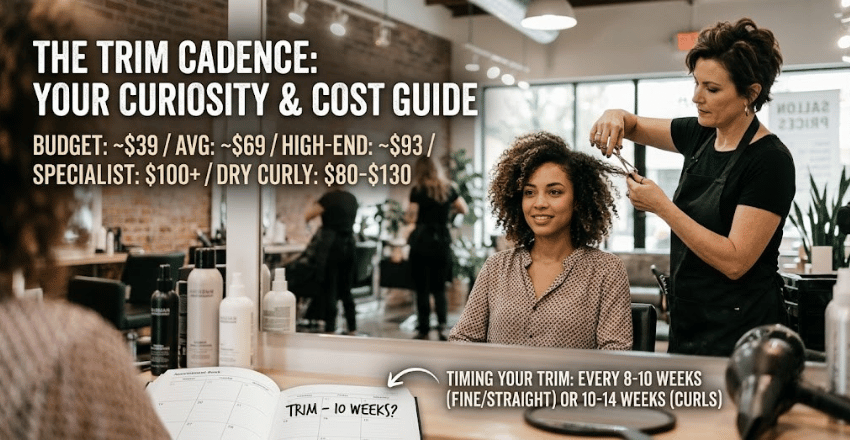
- Standard salon cut: roughly $39 at budget salons, $69 on average, and $93 at high-end salons.
- Specialist or heavily textured work: $100 and up, because it eats chair time.
- Dry curly cut: $80 to $130, with certified curl-by-curl methods running $120 to $250.
- Trim every 8 to 10 weeks on fine or straight hair, and every 10 to 14 weeks on curls.
Prices climb in major metros and drop in suburbs. Chain salons sit well below these numbers, though a texture-heavy cut is rarely the place to economize.
Your next step
Pull three reference photos of people who share your texture, not just your target length. Take them to a consultation before you book the cut itself. Fifteen minutes of talking now saves six months of growing something out.
Conclusion
A shag haircut is less about following a trend and more about working with the hair you already have. The same layers can create soft movement on fine hair, remove bulk from thick hair, or define natural curls, which is why texture matters more than the reference photo you bring to the salon. When the layering, length, and styling are matched to your hair type, the result looks effortless instead of high maintenance.
Before committing, choose inspiration photos from people with a similar texture, discuss your goals during a consultation, and ask for a cutting technique that suits your hair. A well-planned shag haircut grows out gracefully, styles faster, and keeps its signature movement long after you leave the salon.
If you want to read more interesting articles, then visit our Hair category.
Shag haircut FAQs
Yes, if the layers stay long and concentrated near the crown. Over-layering is the failure mode: the ends, which thin out your perimeter and expose scalp.
Only if the shortest face-framing piece sits at or above your cheekbone. Drop that piece to the chin and the same cut lengthens the face instead.
Only if the shortest face-framing piece sits at or above your cheekbone. Drop that piece to the chin and the same cut lengthens the face instead.
No. Most people rough-dry on day one and refresh with texture spray and dry shampoo afterward. Curls get a water mist and a scrunch.
Yes, provided you have at least three inches to work with at the crown. Below that, the layers have nowhere to stack, and the shape flattens.