
Americans say bangs. Salons and fashion magazines often say fringe. The same cut, two words, and a fringe haircut ask more of you than any other change you can make to your hair. He asks the honest version, shape by shape.
The short answer: pick a shape that works with your growth pattern, not against it, then budget for a trim every two to four weeks. Blunt shapes demand the most upkeep. Curtain and side-swept shapes demand the least. Everything else is detail on that trade.
Key takeaways
- Bangs are the highest-upkeep thing you can do to your hair. Trims land every 2 to 4 weeks, not every 8.
- Blunt and micro shapes are the strictest. A curtain and side-swept buy-ya details of slack.
- Plan on $170 to $425 a year in salon trims, plus roughly 40 hours of morning styling you were not spending before.
- A cowlick at your hairline overrules every face shape rule about bangs you have read.
- Growing the front out takes 9 to 12 months to blend fully, and months 2 through 5 are the ugly ones.
The type map: 8 shapes and who they suit
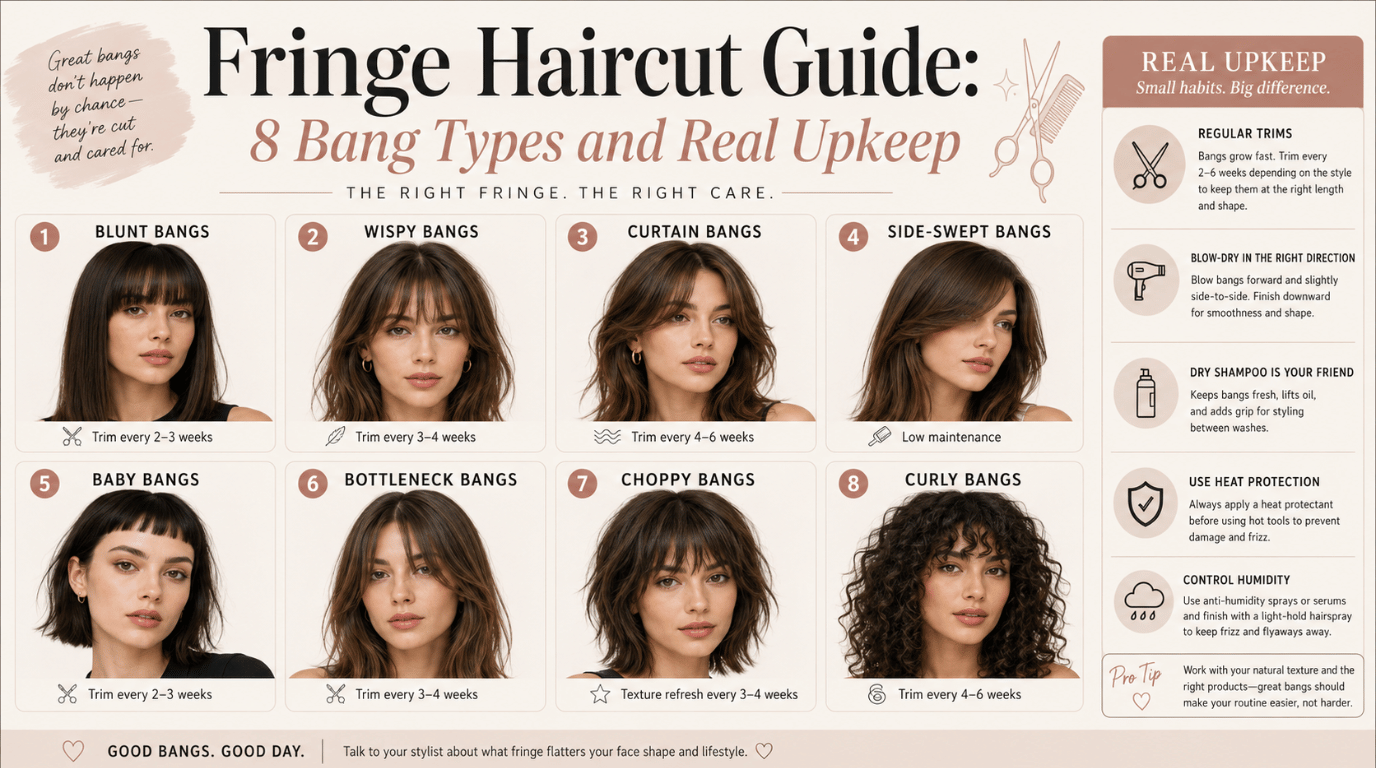
Face shape matters less than stylists once claimed. Texture and growth pattern matter more. Some pairings are simply easier to live with, and this table is where I would start a consultation.
| Fringe Haircut Shape | Face shapes it flatters | Texture that cooperates | Trim window |
| Blunt | Oval, long, heart | Thick and straight | 2 to 3 weeks |
| Curtain | Round, square, heart | Wavy to medium | 5 to 6 weeks |
| Side-swept | Round, square | Fine to medium | 4 to 6 weeks |
| Choppy or textured | Long, oval | Thick, wavy | 3 to 4 weeks |
| Micro or baby | Oval, long | Straight, low density | 2 weeks |
| Curly | Heart, oval, long | Curly to coily, cut dry | 4 to 6 weeks |
| Birkin | Long, oval, square | Fine to medium, straight | 2 to 3 weeks |
| Wispy | Round, square, diamond | Fine | 3 to 4 weeks |
| Grown-out | Nearly all | Nearly all | 8 to 10 weeks |
Read that last column twice. It is the part most guides leave out, and it is the part you will actually feel. If you want more hair styling ideas before committing, browse a few grown-out and curtain shapes first, because those two forgive a missed appointment.
The commitment math behind a fringe haircut

Hair grows roughly half an inch per month. On the back of your head, nobody notices. Across your eyes, half an inch decides whether you look sharp or you spend the afternoon blinking.
| Line item | How often | Cost per year |
| Salon trim at $10 to $25 | Every 3 weeks, 17 visits | $170 to $425 |
| Salon trim, longer cycle | Every 6 weeks, 9 visits | $90 to $225 |
| Cutting shears for home touch-ups | One time | $15 to $30 |
| Dry shampoo for oily roots | About 10 cans | $60 to $100 |
| Small round brush and mini flat iron | One time | $30 to $70 |
| Morning styling, 5 to 10 minutes | Daily | 30 to 60 hours |
First year, most people land somewhere between $275 and $625. That sits on top of a full women’s cut, which runs $30 to $90 in most US salons. Ask one question at the desk before you book: does this salon trim bangs free between paid appointments? Plenty do, and that single answer can wipe out the biggest line above.
Nobody quotes you that number in the chair.
The time cost is the one nobody warns you about. You lose the ability to skip a wash day because the front of your hairline collects dirt more than the rest of your head. Washing and drying just the front takes four minutes. Doing it 300 mornings a year adds up to a working week.
Your cowlick decides more than your face shape
Stand at a mirror and push your hair straight forward off your hairline. Does a section swirl, kick sideways, or refuse to lie flat? That is a cowlick. A heavy blunt cut sitting on top of one will part itself in a place you did not choose.
The fix is length and weight. Longer, heavier fringes hold a cowlick down through sheer mass, so curtain or grown-out bangs are the safer order. Micro and baby lengths are the worst possible pairing. Blow-dry damp hair against the growth direction first, then flip it back the way you want it, and you buy yourself most of a day.
Check your hairline before you book, not after.
Fine hair and curly hair need different rules
Very fine hair
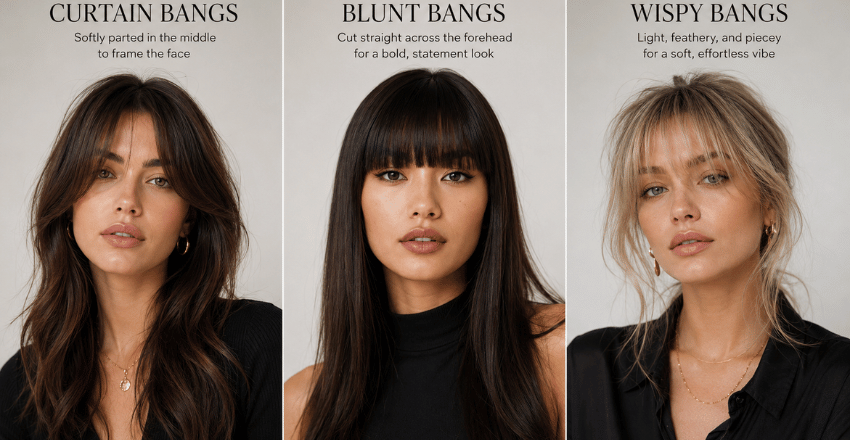
Fine hair can absolutely carry bangs. The catch is arithmetic: whatever you move to the front comes out of the density everywhere else. A stylist who takes too little leaves you with a see-through curtain you can read a menu through.
Ask for a soft, feathered, or side-swept shape at eye-grazing length. Anything longer goes limp by noon. Skip a hard center part in the front, which splits thin hair into two thinner halves and shows scalp.
Curly and coily hair
Curly bangs work beautifully and fail loudly, with very little in between. Almost every disaster traces back to one of three things.
Cut them dry.
- Getting wet. Curls shrink 2 to 4 inches as they dry, so a wet cut at eyebrow level lands at mid-forehead.
- Thinning shears. They shred the curl pattern and create frizz that no product can settle.
- Straightening the front to match a photo. That leaves you with one flat piece and a head of texture behind it.
Glasses change the length, not the style
Frames and bangs compete for the same two inches of your face. Length has to clear the top rim or sit clearly below your brows. Never let it rest on the frame itself. Deep, chunky frames want a shorter or softly parted front. The same balance applies to accessories. A heavy fringe, big frames, and chandelier earrings are three loud things at once, so pick jewelry that balances a heavy fringe instead.
Sweat, gym days, and humid weather
Sweat ruins a blowout faster than rain does, and your forehead sweats first. Here is what actually holds up.
- Pin the front back before the workout, not after. A single clip beats fixing it later.
- Keep a soft terry headband in your bag. It absorbs; a nylon one just slides.
- Rinse and re-dry only the front when you get home. Two minutes with a round brush resets the shape.
- In August humidity, stop fighting it. Curtain and side-swept shapes ride out a wet week; blunt ones do not.
Growing them out: a 6- to 12-month path

Month three is when most people quit and go back.
Nobody warns you about this part before the scissors come out. Expect 3 to 6 months before the front clears your eyes and 9 to 12 months before it disappears into the rest of your hair.
- Months 1 to 2. Past the brow, still behaving. Ask for a slight taper at the outer corners so the shape softens instead of squaring off.
- Months 2 to 3. The eye-poker stage, and the worst of it. Bobby pins, a deep side part, and headbands carry you through.
- Months 4 to 5. Long enough to split down the middle and wear as a curtain shape. A lot of people stop here on purpose.
- Months 6 to 12. Face-framing layers connect the front to your length. Around month 9, it stops reading as a grow-out.
Two things speed up the pinned-back months. Book a real trim every 8 to 10 weeks, taking ends only, so the rest of your hair stays healthy while the front catches up. And lean on headbands, which have gone from gym gear to a genuine fashion piece worth owning in the last few seasons.
How to decide this week
Test-drive the bangs tonight with a clip. Pull a section forward, hold it flat at brow level, and pin it. Live with it for a day, through a workout and a full face of makeup, and you will learn more than any photo can tell you.
Then book a consultation rather than a cut. Ask your stylist for the longest version of the shape you want, because bangs can always come up and never go back down. Bring two photos of the same length on hair that matches your texture, not just your face.
If the trim math bothers you more than the styling time does, start with a grown-out or curtain shape and move to shorter later. That order costs you nothing. The reverse order costs you nine months.
Conclusion
A fringe haircut can completely change your look, but the best bangs are not simply the ones that photograph well. They are the ones that suit your hair texture, growth pattern, daily routine, and willingness to keep up with trims and styling.
Blunt and micro bangs give the strongest shape but demand the most maintenance, while curtain, side-swept, and grown-out styles offer more flexibility when appointments or morning styling slips. Before committing, check your hairline for cowlicks, think realistically about your trim schedule, and start slightly longer if you are unsure.
The right fringe should make your haircut feel more intentional, not turn every morning into a styling project. Choose the shape you can comfortably maintain, and you are far more likely to enjoy your bangs long after the first cut.
Apart from that, if you want to know about shag haircut guide, then please visit our Hair category.
Fringe haircut FAQ
Most US salons charge $10 to $25 for a trim on its own, and many waive it entirely for clients who book regular cuts. Independent stylists in big cities sit at the top of that range.
No, but the shape matters more than usual for bangs. Feathered and side-swept versions read as full; heavy blunt versions borrow density from the full and can leave the back looking sparse.
You can maintain one. Cutting a fresh shape yourself rarely ends well. Trim dry, never wet, cut vertically into the ends rather than straight across, and take off less than you think you need.
Bangs need roughly 6 to 8 months from a standard length and longer from a microcut. A 2-inch fringe has to reach roughly 7 inches before it sits inside a ponytail without escaping.