

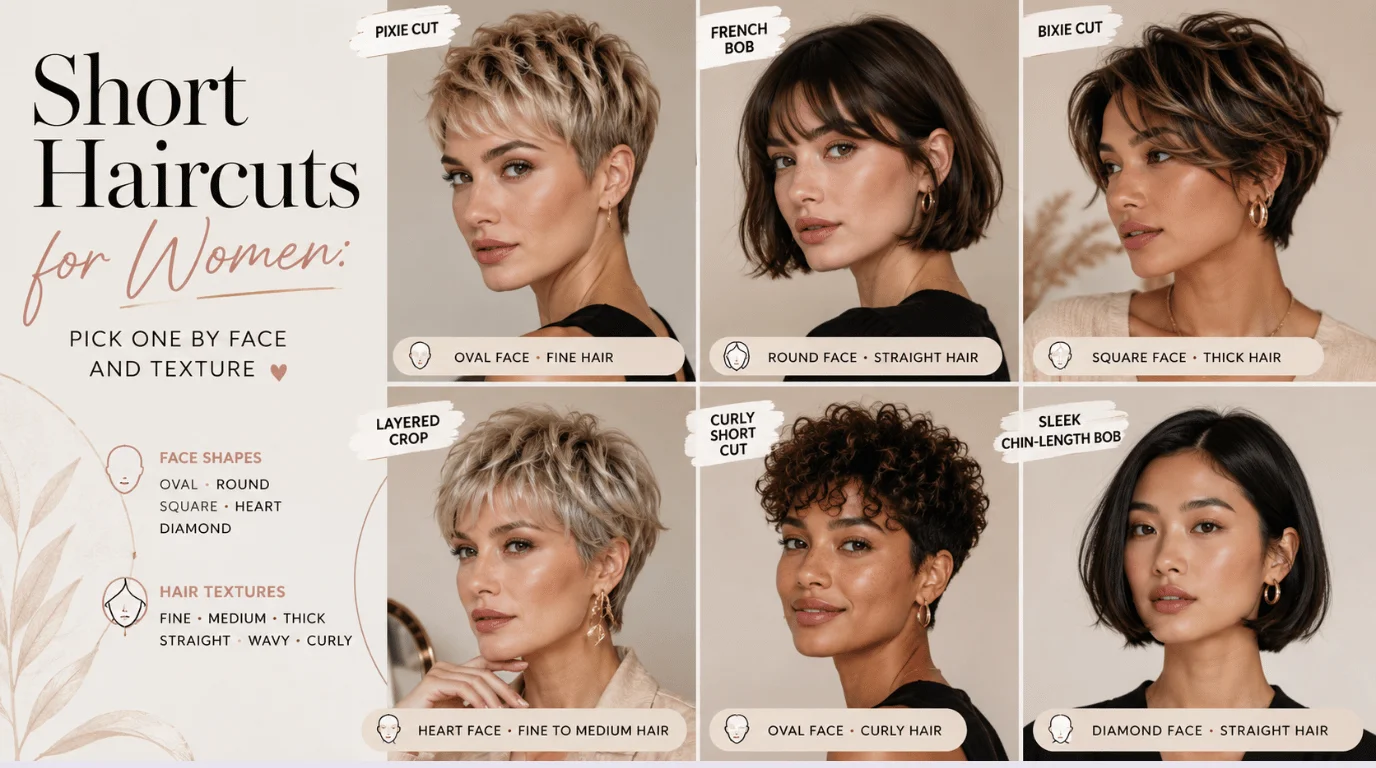
Most women bring a photo to the salon. The photo is the problem. It shows a cut that already worked on someone else’s face shape, density, and hairline, and none of those three transfer.
The short version: Pick a length that breaks above or below your widest facial feature, never level with it. Then let your texture decide how much weight comes out of the interior. Fine hair keeps a blunt perimeter. Thick hair gets hollowed from inside. Curls get cut dry. Short haircuts for women succeed or fail on those three calls.
What to look for, what to avoid
| What to look for | What to avoid |
| A perimeter that ends above or below your widest feature | A blunt edge stopping level with it, which repeats the width |
| Interior weight removal on dense hair | Surface-only layers, which leave a shelf and a triangle at the jaw |
| A blunt or near-blunt edge on fine hair | Layering cut into the ends, which makes thin hair read see-through |
| A dry cut on curls and coils | Cutting wet and stretched, where four inches springs back to two |
| A shape that works with your cowlick | A short fringe fighting a front cowlick every morning |
| A shape you can reset every five to eight weeks | A precision crop you can only afford to trim twice a year |
TL;DR
- Short haircuts for women work when the length misses your widest feature, and the weight suits your texture.
- Fine hair wants a solid edge. Dense hair wants weight taken from the inside. These are opposite instructions for the same cut.
- Budget $34 to $93 a visit in 2026, but count on seven to ten visits a year, not two.
- A pixie takes ten to fourteen months to reach a chin-length bob.
Start with your face shape, not the photo
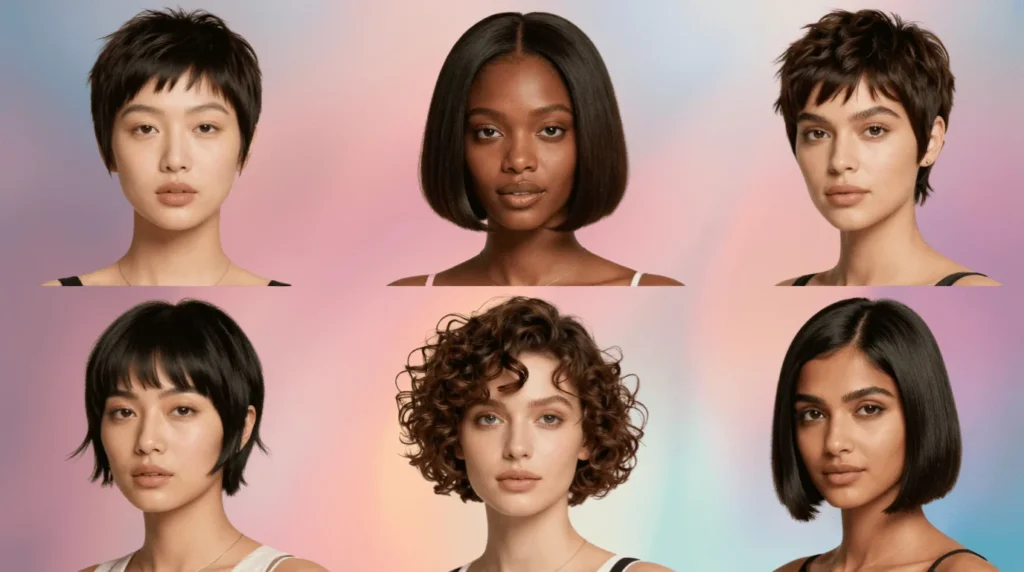
Face shape decides where the cut should stop. Hard edges land the eye on whatever sits behind them, so a blunt line level with your widest point announces that point to the room.
Round
Keep the ends off the cheek. Finishing above the cheekbone works, and so does falling below the jaw. Cheek level does not. Height at the crown and a side part both pull the eye upward instead of across.
Square or angular
Soft ends do the work. Ask for a broken perimeter rather than a blunt one, with length falling just past the jaw so the corner sits inside the hair rather than being framed by it.
Heart
Weight belongs low. Choose a chin-length bob that thickens toward the ends, which balances a narrow chin against a wider forehead. Keep any fringe wispy.
Oval
Most lengths sit well, which is genuinely the advantage. Choose one texture and upkeep instead.
Long or oblong
Width is the goal. Chin length or shorter, with volume at the sides, stops the face from reading as longer. A blunt fringe shortens the forehead and helps.
Why the same cut lands differently on two heads
Two people can ask for the same crop and walk out with different results. The cut is not the variable. Weight is. Hair falls because of load. Sections dense enough push outward before they drop, so the shape widens at its heaviest point instead of hanging. Think of that interior, and the same section collapses inward.
This is why a stylist working on dense hair spends most of the appointment inside the hair rather than on its outline. That same technique on fine hair leaves the ends looking sparse. Separation is the other half of it. A layered shag cut only reads as layered when the piece underneath falls away and reveals the one above it.
Hair that clings, as fine, straight hair does, reads as one sheet no matter how many layers went into it. So the photo you brought is not a plan. It is a result produced by hair that may behave nothing like yours.
Then match the cut to your hair texture

Fine or thinning
Keep the perimeter blunt or close to it. A solid edge is what creates the impression of density, and layering into the ends removes exactly that. Chin length carries more visible weight than shoulder length on fine hair, which surprises people who have spent years growing it out.
Thick or coarse
Triangles are the risk here. Surface layers alone leave a shelf of untouched bulk underneath, so the hair widens at the jaw while the top sits flat. Point cutting inside each section removes that bulk without moving the outline.
Wavy
Waves separate by themselves, so layers amplify what already exists. One warning. Cut the front too short, and a bend that used to sit below your cheekbone jumps above it, widening the face.
Curly and coily
Cut dry, curl by curl. Wet and stretched, a layer measured at four inches can spring back to two and a half once it dries. Coils shrink further, often by half or more, so the goal shifts from pieces falling past each other to a rounded shape that expands evenly.
Want short without giving up all your length? The two-tier jellyfish cut crops only the top layer and leaves the hair underneath long.
Your hairline decides more than your face shape
Nobody photographs a cowlick. It still runs the cut.
Run a hand back through dry, unstyled hair and watch where it refuses to lie down. Front cowlicks lift a fringe off the forehead within an hour of styling, which is why some women fight their bangs every morning and blame the weather. Whorls at the nape push hair at the back of the neck sideways, so a tapered crop that should sit flat kicks out instead.
Neither one is a reason to stay long. Both are a reason to speak up at the consultation. A stylist who knows about the whorl at your nape will leave an extra half inch there and cut the taper to follow the growth rather than against it. One who finds it halfway through the appointment is improvising.
What Short Haircuts for Women Really Cost in a Year
Per visit, going short is cheap. Per year, it is not, and the gallery pages never mention this.
Women’s cuts in the United States average around $69 in 2026. Budget chains sit near $34 to $39. Upscale salons reach $93, and in New York the top end passes $160. Next to a color appointment, those prices look easy.
Frequency is the catch. Long hair tolerates a trim twice a year because its shape lives at the ends. A crop is a shape, and a shape drifts as soon as it grows.
| Length | Visits a year | Annual cost at $69 |
| Pixie or cropped cut | 8 to 10 | $550 to $690 |
| Chin-length bob | 6 to 8 | $415 to $550 |
| Long, trimmed only | 2 to 3 | $140 to $205 |
A pixie can cost three times what long hair costs to maintain, at the same salon, in the same chair. That is worth knowing before you commit rather than after.
Upkeep and the grow-out
Short hair asks for more of your money and less of your morning. Crops dry in a few minutes and take a piece of product, and that trade is the real reason people keep coming back. Growing it out is the part worth planning. Hair grows roughly half an inch a month, so the calendar looks like this:
- Months 1 to 3: the shape holds. Keep the perimeter trimmed and leave the interior alone.
- Months 4 to 7: the awkward stretch. Sides reach your ears and stick out. Trim the sides only and let the back catch up.
- Months 8 to 14: a pixie reaches chin length and turns into a bob you can wear.
Ten to fourteen months from a pixie to a chin-length bob is the honest number. Anyone promising four is selling you something.
What to ask for at the salon

- Name your widest feature and ask for a length that misses it.
- Ask for interior weight removal if your hair is dense and a blunt perimeter if it is fine.
- Say the word “dry” if you have curls, and book someone who cuts curls dry.
- Point out your cowlick and your nape whorl before the cape goes on.
- Ask how often the shape needs resetting, then decide whether that fits your calendar.
Where to start
Pick your shape from the table, then read the texture section that matches your hair. Those two calls narrow a wall of photos down to two or three cuts that will be on your head. Bring that to the consultation instead of a picture. Our hair guides cover the individual cuts in more detail if you want to read up before you book.
Apart from that, if you want to know about fringe haircuts, then please visit our hair category.
FAQ
Usually the opposite. Crops dry fast and need one product. What it does need is a reset every five to eight weeks, because you are maintaining a shape rather than a length.
Only if it gets layered to the ends. Blunt chin-length edges look thicker than the same hair at shoulder length because the weight concentrates into one visible line.
A chin-length bob with a soft, slightly broken edge. It suits round, square, and heart shapes; handles most textures; and grows out without a hard, awkward stage.
Yes, as long as it gets cut dry. Shrinkage is the whole problem, and a dry cut is the only way to see where each curl will actually sit.
About seven months for a low ponytail from a pixie, though the front pieces still need pins for a while after that.