

Some haircuts grow out. The jellyfish haircut does not, at least not on any timeline you would call convenient. It puts a rounded, bob-length bell on top of long hair underneath, with no blending at all between the two lengths. That gap is the entire point of the style, and it is also the thing you are signing up for.
A jellyfish cut is a two-tier, disconnected style. Your stylist cuts the top section into a rounded bob that stops near the chin or jaw. The hair underneath stays long, often past the shoulder blades. Nothing connects the two lengths, so the outline reads as a bell over trailing tentacles.
Key takeaways
- The cut is disconnected on purpose. No stylist can blend it back later.
- Growing it out takes 16 to 24 months for most people at half an inch of growth a month.
- It suits medium to thick, straight or lightly wavy hair. Fine hair reads as sparse underneath.
- Budget $45 to $125 for a cut and style, more with a specialist.
- Trims every 4 to 6 weeks keep the contrast sharp.
What a jellyfish haircut actually is
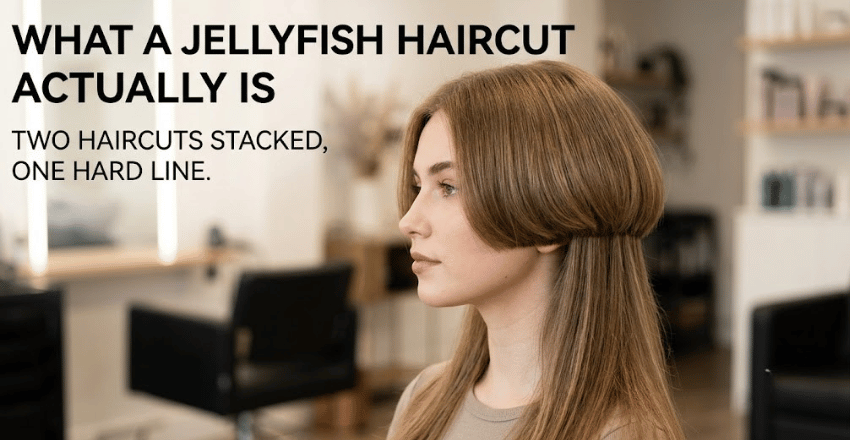
Picture two haircuts stacked on one head. A stylist shapes the upper section into a rounded, one-length bob, landing between the earlobe and the jaw. Everything below that parting stays long and mostly untouched, sometimes with light face framing near the front.
Those two sections never meet.
- That refusal to blend separates this shape from every soft layered cut you have seen. A butterfly cut fades one length into the next. This one draws a hard line and leaves it. From behind, the short crown flares over the long hair like a bell over tentacles.
- Most stylists build it with a horizontal parting that runs ear to ear, or a slightly curved one that dips at the back. Where they place that parting changes everything. High and the bell looks small and severe; low and you get a heavier, softer dome. Ask to see the parting drawn on your own head before a single cut happens. If you follow hair trend coverage closely, this is the detail that separates the versions you liked online from the one you get.
Where the cut came from
The shape has roots in Japanese hime styling, the blunt, straight-sided princess cut with cheek-length side panels over long back hair. Korean and Japanese street style reworked that idea through the 2010s, pushing the short section around the whole head instead of just the sides. Salons in Seoul and Tokyo were cutting versions of it years before Western feeds noticed.
Then TikTok arrived. K-pop idols wore it, e-girl and alt creators adopted it, and the tag exploded across 2023 and 2024. It has stayed in rotation since, which is longer than most viral cuts manage.
The part nobody warns you about: growing it out
Here is the honest math. Hair grows roughly half an inch a month, so about six inches a year. To lose the disconnection, the short top layer has to travel all the way down to meet the long bottom layer.
Say your bell sits at the jaw and your long hair hits mid-back. That gap is often 10 to 14 inches.
| Gap between the two lengths | Time to close it | What the middle looks like |
| 4 inches | About 8 months | Shortest exit, only from a subtle version |
| 8 inches | About 16 months | Top layer sits awkwardly on the shoulders |
| 12 inches | About 24 months | Two full years of visible steps |
| 16 inches | About 32 months | Common with waist-length bottom hair |
You have two ways out and no third option. Wait it out, tucking and pinning the top layer while it catches up. Or cut the long hair off to match the bell, which turns your jellyfish cut into a plain bob in one appointment.
Nobody can blend a disconnection away without removing length. The hair to blend with does not exist yet. Anyone who promises otherwise is planning to cut the bottom, whether they say so or not.
Jellyfish vs. wolf, hime, mullet, and shag
Plenty of people want the drama of this shape without the trap. One of these four is probably the cut you actually want.
| Cut | Layer structure | Disconnected? | Grow out | Choose it if |
| Jellyfish | Rounded bob over untouched long hair | Fully | Hardest, 16 to 32 months | You want maximum contrast and will commit |
| Hime | Blunt cheek length side panels, long back | Partly, sides only | Moderate, 8 to 14 months | You want the drama near your face only |
| Wolf | Blended graduation, short crown to long ends | No | Easy, grows out gracefully | You want volume and shag texture, not a hard line |
| Mullet | Short sides and top, long back | Somewhat | Moderate | You want length at the back and nowhere else |
| Shag | Soft choppy layers throughout | No | Easiest | You want movement with almost no risk |
Read that table twice. The wolf cut gives most people the feeling they were chasing, at a fraction of the commitment.
Hair textures that work, and the ones that fight it
Density matters more than texture here. The long bottom layer carries no support from above, so thin hair simply looks thin.
- Medium to thick straight hair: ideal. The bell holds its round shape and the ends hang clean.
- Loose waves: excellent. Enough movement to soften the line without losing it.
- Fine or low density hair: difficult. The bottom layer goes see-through and stringy fast.
- Tight curls and coils: possible with a dry cutting specialist, risky with anyone else. Shrinkage can erase the gap entirely.
- Very long, heavy hair: the weight drags the bell flat by lunchtime.
Variants, from subtle to severe
This cut runs on a dial, not a switch. Ask for a point on that dial rather than showing a photo and hoping.
A soft jellyfish keeps the top section at collarbone length with slightly textured ends, so the step reads as a bold layer rather than a separate haircut. A classic version puts the bell at chin or jaw with a blunt perimeter, which is the shape most people picture. The severe take sits at ear length, sometimes with the underneath dyed a contrasting shade so the tiers separate further.
Color is the volume knob. Match the tiers and the cut whispers. Split them, black on top and bleached underneath, and it shouts from across a parking lot. Pairing it with the right jewelry for short layered styles matters more than usual, since the bell puts your ears and neckline on permanent display.
Styling two lengths that behave differently

Nobody mentions this part, and it is the daily reality. Your bell and your lengths dry at different rates, hold different amounts of product, and want different tools.
Up top, the bell dries in minutes and needs a round brush to keep its curve. Underneath, the long hair takes far longer and flattens if you rush it. Air drying both at once gives you a puffy top and limp ends, the exact opposite of the shape you paid for.
Here is a routine that works:
- Rough-dry the long section first on medium heat, pulling down.
- Clip that section away completely.
- Round brush the bell, drying under and over to build the dome.
- Release, then run a flat iron through the perimeter of the bell only.
- Finish with a light paste on the ends, never at the roots.
Expect 20 to 30 minutes on wash days. Between washes, dry shampoo at the crown does most of the work.
What you will pay, and finding the right stylist
Expect $20 to $125 for a women’s cut and style across the US, depending on your city and the salon tier. Precision disconnected work sits at the top of that band. In practice, expect $45 to $125 at a mid-range salon and $150 to $250 with a specialist in New York, Los Angeles, or Chicago. Korean and Japanese salons often price it lower, since they cut the shape constantly.
Vetting matters more than price. Ask one question before you book: have you cut this shape on a client, and can I see the photo?
Any stylist who says yes and shows you a real head is worth traveling for. One who says “I can figure it out” is practicing on your two-year commitment. Bring three reference photos, including one from the back, plus one version you do not want.
Work, school, and being looked at

This cut is loud. That is not a warning, just a fact worth planning around.
Most workplace dress codes say nothing about haircuts, and the shape is neat rather than messy. Conservative fields are the exception. Client-facing finance and law still read hard disconnection as unpolished.
One low bun or a half-up twist hides the step almost completely. Test it before your first day back. Schools with uniform policies rarely ban the cut itself, though contrasting dyed underlayers do get flagged. If your everyday fashion choices already lean bold, this fits right in. If they do not, the cut will do a lot of talking for you.
So, should you book it?
Book it if you have medium to thick hair, a stylist with proof, and genuine patience for a two-year exit. Skip it and take a wolf cut if any one of those three is missing. Nobody regrets the wolf cut.
Your next step is free. Part your hair at ear level, pin the top up in a rough bob shape, and live with that silhouette for a day. If you still want it tomorrow, book the consultation.
Conclusion
A jellyfish haircut is one of the boldest styles you can choose because its dramatic, disconnected shape is meant to stand out, not blend in. It works best on medium to thick hair, rewards precise styling, and demands regular trims to keep the contrast sharp. The biggest consideration is commitment—growing out the cut can take years, and there is no quick way to erase the separation without sacrificing length.
If you love fashion-forward looks and have a stylist experienced with disconnected cuts, the jellyfish haircut can be a striking statement. If you’re unsure, try a softer version first or spend a day pinning your hair into the shape before booking your appointment to make sure the look fits both your style and your routine.
Jellyfish haircut FAQ
Yes, harder than nearly any other cut. Closing a 12-inch gap takes roughly two years at normal growth rates. Most people either wait or cut the long hair off.
Every 4 to 6 weeks. Half an inch of growth on the bell starts softening the contrast, and the shape loses its edge quickly.
It can, with a stylist who cuts curls dry. Shrinkage means the bell must be cut longer than it looks, or the two tiers collapse into each other.
Sort of. A soft version with the top at collarbone length reads as a heavy layer and closes in about eight months. That is the low-risk entry point.
It can, since a chin-length bell adds width right at the cheeks. Dropping the bell to the jaw or lower keeps the line longer and reduces that effect.