
Most lists of low-maintenance short haircuts skip the math. They show a photo, call it easy, and move on. A cut can be quick to style and still drag you back to the salon every four weeks. That is a subscription, not a saving.
Maintenance runs on three separate axes: daily styling minutes, how often the shape needs a professional trim, and how it behaves while growing out. Few cuts win all three. A sharp pixie styles in three minutes but needs cutting every four to six weeks. The textured lob reverses both numbers.
Key takeaways
- Fast to style and cheap to keep are two different things, and the sharpest cuts trade one for the other.
- Salon frequency drives the annual bill far more than the price of any single cut.
- Blunt, precise shapes announce regrowth. Textured and layered shapes hide it.
- Your texture decides the winner. A wash-and-go crop on curls beats a bob that needs a round brush.
- Yearly upkeep on short hair runs roughly $290 to $950 depending on the shape you pick.
The three axes nobody separates
Ask ten people what low maintenance means and you get three different answers wearing the same phrase. One never picks up a hair dryer. Another sees her stylist twice a year. A third can ignore the whole thing for two months and still look deliberate.
Those are genuinely different goals, and they pull against each other.
- Daily styling time. Minutes between shower and door, product included.
- Salon frequency. How many weeks before the shape stops reading as intentional.
- Grow-out grace. Whether week ten looks softer or just messier.
A precise shape earns its speed by being precise. Grow a half inch and the geometry breaks. Softer cuts need more coaxing at first, then coast for months. Pick the axis that annoys you, then choose against the other two.
Low-maintenance short haircuts scored on all three axes

Annual figures below assume a mid-range American salon at $60 to $80 per cut, before tip. Adjust up or down using the cost table further along.
| Cut | Daily styling | Salon visit | Grow-out grade | Annual upkeep |
| Sharp pixie | 2 to 4 min | Every 4 to 6 weeks | Poor | $600 to $950 |
| Long pixie | 4 to 6 min | Every 6 to 8 weeks | Good | $420 to $700 |
| Blunt bob | 5 to 10 min | Every 6 to 8 weeks | Fair | $480 to $780 |
| French bob | 6 to 10 min | 6 weeks, plus fringe trims | Fair | $520 to $850 |
| Textured lob | 5 to 8 min | Every 10 to 12 weeks | Excellent | $290 to $460 |
| Shaggy bob | 3 to 6 min | Every 8 to 12 weeks | Excellent | $340 to $560 |
| Textured crop | 3 to 5 min | Every 4 to 6 weeks | Poor | $580 to $900 |
| Buzz | Under 1 min | Every 3 to 4 weeks | Fair | $340 to $680, or $40 at home |
| Grown-out crop | 4 to 8 min | Every 8 to 10 weeks | Excellent | $380 to $600 |
The nine cuts, honestly
Pixie, long pixie and textured crop
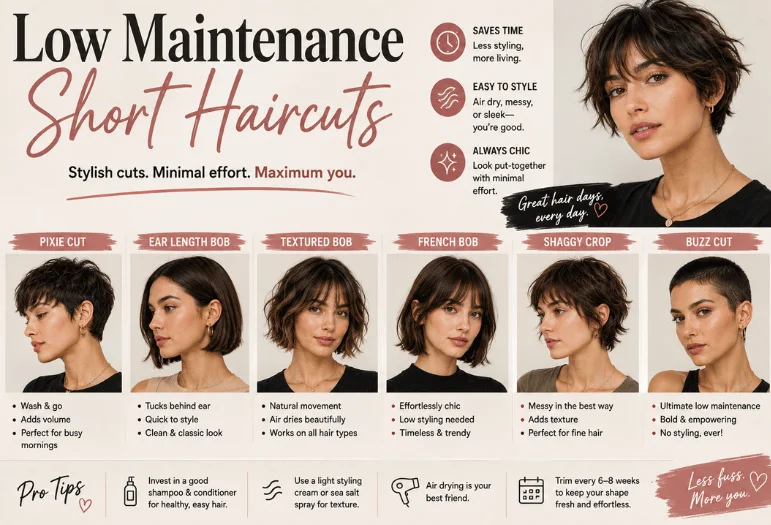
The pixie is the fastest morning of the nine. Towel, a pea of paste, fingers through the front, done. It is also the most expensive shape on this page, because the whole effect lives in a nape and a sideburn that outgrow themselves in a month.
A long pixie softens that. Weight through the crown and a longer perimeter buys two extra weeks per cycle and a far kinder grow-out. The textured crop sits between them: choppy on top, tight at the sides, brilliant for four weeks and shapeless at eight. Budget for it honestly rather than calling it thrifty.
Blunt bob and French bob
A one-length bob is the cleanest low-effort shape for straight hair that has no strong opinion of its own. Blow it out for six minutes with a round brush, and it holds all day. The catch is the line. A blunt hem is a ruler laid against your growth rate, and by week eight it reads soft rather than sharp.
The French bob adds a fringe, which adds a second maintenance clock. Fringe trims run every three to four weeks, and while many salons do them free between cuts, you still make the trip. Charming cut. Not a hands-off one. For more shape and styling ideas, browse our hair guides and cut inspiration.
Textured lob and shaggy bob
Here is where the money actually lives. A collarbone lob cut with soft internal layers can go ten to twelve weeks without looking neglected, because there is no hard line to lose. Four visits a year instead of nine roughly halves your spend.
The shaggy bob does the same trick with more attitude. Piecey ends, a bit of movement around the jaw, and a shape that genuinely improves as it drops. Both want a texture spray and about four minutes. Neither wants a blow-dry.
Buzz and grown-out crop
A buzz is the only cut here with a styling time of zero. That is the whole appeal. The trade is frequency, since a quarter inch of regrowth shows within three weeks.
Clippers change the math completely. A decent home set runs $30 to $60 once, and after that the annual cost is close to nothing. The grown-out crop, meaning a crop deliberately allowed to sit at ear length, is the quiet winner of the whole category. Low styling, long cycles, and it never looks like an accident.
What a year of upkeep really costs

The national average for a women’s haircut in the United States sits near $69, with men’s cuts around $43. Chain salons start closer to $27 to $39. High-end city salons run $90 to $250, and in Manhattan, a women’s cut of $163 to $171 is normal. Tipping adds another 15 to 25 percent on top.
Multiply by visits and the gap becomes serious.
| Salon tier | Price per cut | 4-week cycle (13 visits) | 12-week cycle (4 visits) |
| Chain or budget | $27 to $39 | $351 to $507 | $108 to $156 |
| Mid-range independent | $60 to $80 | $780 to $1,040 | $240 to $320 |
| High-end city salon | $110 to $170 | $1,430 to $2,210 | $440 to $680 |
Cycle length matters more than price per cut. A $150 lob trimmed four times a year costs less than a $50 pixie kept sharp, and the pixie owner spends nine extra hours in a chair getting there.
Your texture rewrites the whole answer
Fine straight hair rewards precision. Blunt edges create the illusion of density, and a chin-length bob on fine hair looks thicker than the same hair at shoulder length. The downside is that every millimeter of growth shows on a clean line, so plan on trims every six to eight weeks.
Wavy hair is the easiest texture to keep short and cheap. Waves blur outlines, which means grow-out is forgiving and a shaggy bob or lob can stretch past twelve weeks. Air dry, scrunch, walk away.
Curly and coily hair follows different rules entirely. Shrinkage means a cut that looks short wet may sit two to four inches higher dry, so a good curl-specialist cut is shaped dry, curl by curl. Done right, a curly pixie or crop is a genuine wash-and-go. Done wrong on straight-hair principles, it is a triangle you fight every morning.
Thick straight hair needs internal weight removed, or a bob turns into a bell. Ask for hidden layers.
The awkward stage, and who skips it
Hair grows roughly half an inch a month. From a pixie, ear-length arrives around month five, a chin-length bob around month twelve, and shoulder length takes two to three years. The rough patch lands between months three and six, when the hair is too long to spike and too short to tuck.
Some shapes sail through it. Others fall apart.
- Grows out gracefully: long pixie, textured lob, shaggy bob, grown-out crop.
- Grows out badly: sharp pixie, tight crop, blunt one-length bob, anything with an undercut.
The fix is cheap, and most people never ask for it. During grow-out, book trims that touch only the nape and the ears, leaving the crown alone. That is a $30 to $45 cleanup, not a full cut, and it prevents the mullet shape that sends people back to the clippers. A wide headband and bolder earrings carry the rest. Our jewelry edit has pieces that balance a chin-grazing length.
How to choose in four questions

- What annoys you more, mornings or appointments? Mornings mean pixie or crop. Appointments mean lob or shag.
- What is your real annual budget? Under $400 rules out anything on a four-week cycle unless you own clippers.
- Do you plan to grow it back? If yes, start long rather than sharp.
- Will you use heat? If the answer is no, skip the blunt bob and let texture do the work.
Bring a photo of the grow-out you want, not just day one. Stylists find that request refreshing, and it changes how they cut the perimeter. Pair the finished shape with the rest of your look through our fashion inspiration archive, since a shorter neckline shifts how collars and necklines sit.
Your next step
Pick your axis before you pick your photo. Decide whether you are buying back mornings or buying back salon trips, then choose the cut that matches, and tell your stylist which one you optimized for. That single sentence at the start of the appointment does more for your upkeep than any product on the shelf.
FAQ: low maintenance short haircuts
The textured lob, at ten to twelve weeks between trims. A shaggy bob is close behind. Both hide regrowth because they have no single hard line to lose.
Daily, yes. Annually, no. A pixie takes two to four minutes each morning but needs cutting every four to six weeks, which puts it among the priciest low-maintenance short haircuts to keep.
Between roughly $290 and $950 at a mid-range salon, driven almost entirely by how often you go. Add 15 to 25 percent for tips.
A buzz, at under a minute. Next fastest is a sharp pixie with paste, then a shaggy bob air-dried with texture spray.
They work beautifully, on one condition. The cut must be shaped dry by someone who understands shrinkage; otherwise, the length you asked for is not the length you get.
Which short cut needs the fewest salon visits?
The textured lob, at ten to twelve weeks between trims. A shaggy bob is close behind. Both hide regrowth because they have no single hard line to lose.
Is a pixie really less work than a bob?
Daily, yes. Annually, no. A pixie takes two to four minutes each morning but needs cutting every four to six weeks, which puts it among the priciest low-maintenance short haircuts to keep.
How much does a short cut cost per year?
Between roughly $290 and $950 at a mid-range salon, driven almost entirely by how often you go. Add 15 to 25 percent for tips.
What is the fastest cut to style in the morning?
A buzz, at under a minute. Next fastest is a sharp pixie with paste, then a shaggy bob air-dried with texture spray.
Do short cuts work on curly hair?
They work beautifully, on one condition. The cut must be shaped dry by someone who understands shrinkage; otherwise, the length you asked for is not the length you get.