
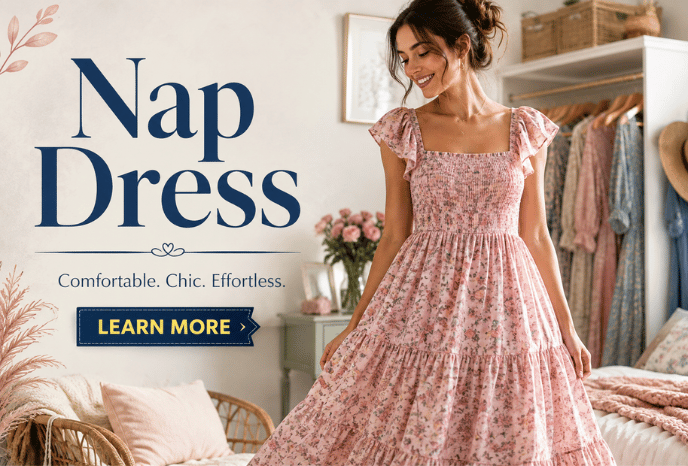
$150 is the cheapest way to get the original. That is what Hill House Home charges for its Ellie style in cotton poplin, and most of the brand’s current styles sit between $178 and $228. A copy in the same silhouette costs $25 to $120.
That gap is real, though it is rarely the one shopping roundups describe. At the top of the market, you pay for smocking density, cotton weight, and a size run from XXXS to XXXXL. At the bottom, you give up opacity and elastic life. Whether a nap dress at $178 earns its price comes down to four questions about you, not about the fabric.
The spec sheet: the original against three copy tiers
Prices below are what these pieces cost in the US in July 2026, taken from current listings rather than from old roundups. Sale numbers move; the specs do not.
| Nap Dress Tier | Typical 2026 price | Fabric | Smocking | Lining | Sizes |
| Hill House original | $150 to $228, roughly $119 to $151 in the semi-annual sale | 100% cotton, usually poplin, plus linen and Swiss dot seasonally | Full elasticated shirring across the whole bodice, branded Nap Smocking | Mostly unlined | XXXS to XXXXL |
| Mid tier | $70 to $120 (Quince around $70 to $74, Abercrombie $96 to $120) | 100% European linen, organic cotton poplin, or a 60/40 cotton and polyester blend | Shirred bodice with fewer rows, still stretches two sizes | Cotton upper lining on the blended styles, a skirt lining on a couple of colorways | XS to XL, some petite and tall runs |
| Budget tier | $25 to $45 (Old Navy around $25) | 100% cotton or a mid-weight rayon | Shallow shirred panel, roughly half the rows of the original | Unlined | XS to 4X |
| Marketplace tier | $15 to $40 | Thin rayon or polyester, occasionally cotton | One elastic casing at the top, sometimes stretch only across the back | Unlined | S to XL, sizing inconsistent between sellers |
Key takeaways
- The original costs $150 to $228 in 2026, and the twice-yearly sale is the only reliable way under $150.
- Smocking rows, not the print, are the things you are paying for. More rows mean more stretching and better recovery.
- Nearly every version is unlined, so a pale colorway needs a slip for whatever you spend.
- The $70 to $120 tier is where the real value sits for most buyers.
- Below $25, the fabric is too thin to survive a season of real wear.
Where the Nap Dress Style Came From, and Who Owns the Name “Nap Dress”

Hill House Home launched in 2016, and founder Nell Diamond introduced the Nap Dress in 2019. Named for its sleep-worthy comfort, the Nap Dress became a pandemic-era fashion favorite, with the New York Times describing it as an elevated nightgown.
The name is not generic, whatever the internet does with it. Hill House Home holds a US trademark registration for it, granted on September 14, 2021, under registration number 6481495, covering dresses, loungewear and nightgowns. Hill House trademarked its smocking method too.
That single legal fact explains the entire shopping experience. Every rival brand has to sell you a “smocked tiered midi” instead. Search the look by name, and you get one brand, then a wall of dupes with no shared vocabulary.
Question 1: How many times a year will you wear it?
Cost per wear settles this faster than any review does. At $178, thirty wears a year puts you under $6 a wear in the first year and under $3 by the second. That is a reasonable buy. At six wears a year, the same piece costs $30 a wear, and a $74 linen version does the identical job for $12.
Be honest about which of these you are:
- Daily wearer. You work from home, you have small kids, you reach for one thing. Buy the original, on sale if you can wait.
- Summer-only wearer. Four months of use, then it hangs. Mid-tier.
- Trial buyer. You are not sure if the silhouette suits you. Spend $25 and find out before you spend $178.
Question 2: How much does construction actually matter to you?
Smocking rows. The original runs shirring across the full bodice, often twelve or more rows of elastic thread. Cheap copies run four or five rows or use a single elastic casing at the neckline. Fewer rows mean the fabric gathers unevenly, and the elastic loses its snap faster, usually inside a season.
Fabric weight. Cotton poplin at a decent weight hangs away from the body and holds a pressed edge. Thin rayon clings, especially in humidity, and shows every seam underneath.
Tiers and hem width. Three tiers move differently from the two. That extra seam adds fabric to the hem, which gives the skirt swing instead of drooping. Folds in a skirt do the same job, and our guide to pleated skirt volume and care covers how added width behaves at the hip.
Lining. Most originals are unlined. So is most of the budget tier. The blended mid-tier styles often carry a cotton lining through the upper body, which is genuinely useful and something the expensive version does not give you. That last point is worth sitting with. You can spend $228 and still need a slip.
Question 3: Is your body changing this year?
A very large share of this category of buyers is pregnant, newly postpartum, or somewhere in between. The silhouette earns its reputation here, and it also has limits nobody prints on the label.
What works: the smocked bodice stretches roughly two sizes, so one piece can cover a second trimester, a third trimester, and the first few months after. Tiered skirts clear a bump without a maternity panel. Cotton washes at home, which matters more than it sounds.
What does not work: nursing access. A high square neckline with no buttons and no wrap must come down over your shoulders or up from the hem, and neither is discreet. If you plan to feed it, buy a style with adjustable ribbon straps or a low, loose neckline and check the strap drop before you commit.
One more thing worth knowing. Smocking that has been stretched over a bump for six months recovers, but not perfectly, so keep the pre-pregnancy version separate if you own two.
Sizing, honestly
- Between sizes: size down. Reviewers agree that smoking runs generously.
- Larger bust: the bodice stretches, but the strap length does not. Check the shoulder-to-bust measurement, not the chest number.
- Petite: midi styles land at the ankle around 5’2″. That reads intentionally, so flat sandals work.
- Tall: 46-inch length is standard across the mid-tier. Above 5’9″, it becomes a midi, not a maxi.
Question 4: Where are you wearing it?

Around the house, nothing works. Once it leaves the house, two specs start to matter. Opacity comes first. White, butter, pale blue, and any small print on a white ground go sheer in direct sun. No price tier fixes it, because almost nothing here carries a lining. A nude slip solves the problem for about $20.
Heat behavior comes second. Linen wrinkles hard but breathes; poplin holds its shape but traps warmth, and polyester blends do neither well. For an outdoor summer wedding, that is the whole decision. The same fabric logic that governs lightweight beach wedding fabrics applies to a guest outfit in August.
For an office, look at the strap. Thin spaghetti straps read like sleepwear under fluorescent light. Ruffled shoulders, flutter sleeves or a wide ribbon strap read like clothing.
What to skip when you buy a nap dress

Blunt list, no hedging.
- Anything under $20. The fabric is too thin, the shirring is one casing, and the seam allowance will fail before the print fades.
- Marketplace listings with a center-front seam. It shows up in the photos, and it is a giveaway that the pattern was cut down to save yardage.
- Full-price special fabric styles for $228. Eyelet and Swiss dot are lovely, and they go on sale twice a year. Wait.
- Polyester at any price. Sleeping in comfort is the whole appeal, and polyester cannot deliver it.
- Buy three at once. Buy one, wear it ten times, then decide. This silhouette suits fewer bodies than marketing implies.
- Pay extra for a name on a copy. A $120 blended version is not better than a $74 linen one. It is a bigger logo.
The verdict
Our recommendation splits cleanly by budget. Weekly wearers should buy the original cotton poplin during the semi-annual sale. At $119 to $151, you get the deepest smocking and a size range nobody else offers. A dozen wears in summer? Then the $70 to $74 linen mid-tier is the smarter buy, and the fabric is arguably nicer. Skip everything for under $25.
Whatever you choose, order one size down, budget $20 for a slip, and wash it cold. For more on fabric, fit, and care across the rest of your closet, browse our fashion coverage.
Nap dress FAQ
Because you can sleep in it. Hill House Home built the first version to sit between a nightgown and daywear and named it for the nap you could take without changing.
At 25 or more wears a year, yes. Under ten wears a year, no, and the $70 linen tier gives you 80% of the result for a third of the money.
Yes, and it is one of the few non-maternity styles that genuinely works through a third trimester. Feeding in it afterwards is the hard part, so check the neckline first.
Cold water, full load, lay flat to dry. Heat is what kills shirring, so keep it out of a hot dryer and use a cool iron on the skirt only.