

Across the pairs we specced out, the hem opening on barrel jeans runs from 14.75 inches to 20.25 inches, with prices between roughly $35 and $240. That hem number, not the size on the label, decides whether a pair reads sculpted or sloppy on you. Four questions about your own frame, closet, and budget will narrow the rack faster than any shopping roundup.
Barrel Jeans: The Numbers That Decide the Fit
A barrel cut sits roomy through the hip and thigh, then curves back below the knee, so the hem finishes narrower than the widest point. That taper is the entire difference between barrel jeans and a wide leg. Hem openings usually land between 15 and 20 inches and rise from 9.5 to 12.5 inches.
Leg opening is measured flat across the hem. Double it, and you get the circumference your foot has to pass through, which is the figure some size charts quote instead. Size charts mix the two up constantly, so here are both, with straight- and wide-leg measurements from the same brands for scale.
| Cut | Rise | Leg opening (flat) | Hem circumference | Inseam |
| Cropped, darted barrel | 10.75 in | 14.75 in | 29.5 in | 26.5 in |
| Full-length pieced barrel | 11.4 in | 16.5 in | 33 in | 29 to 32 in |
| Mid-rise mall-brand barrel | 9.5 in | about 16 in | about 32 in | 26.25 to 30.25 in |
| Relaxed or ultra barrel | 12.5 in | 20.25 in | 40.5 in | 27 in |
| Straight leg, for reference | 11.25 in | 15 in | 30 in | 29 in |
| Wide leg, for reference | 11.5 in | 24.5 in | 49 in | 32 in |
Read down the table and the pattern jumps out. A soft barrel and a straight leg can share almost the same hem, around 15 inches. Their real difference lives above the knee: the barrel adds three or four inches of room at the thigh, then pulls it back in. Wide leg never pulls back, which is why a 24.5-inch opening swallows a shoe and a barrel hem does not.
Key Takeaways
- A hem under 16 inches reads tailored. Past 19 inches it reads fashion-forward.
- Rise does the balancing work: 11 inches or more keeps the volume off your middle.
- Cropped inseams of 26 to 27 inches suit frames under5’44”. Full length starts around 29 inches.
- Budget $35 to $60 at mass market, $120 to $170 at contemporary brands.
- Slim shoes only. Chunky soles fight the taper the pattern was built for.
Question 1: How Much Curve Do You Want in Barrel Jeans?
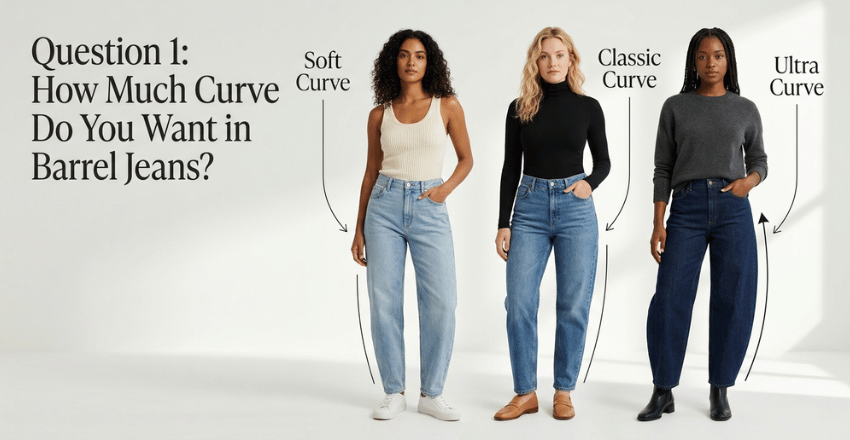
Nobody labels the curve on a pair of barrel jeans, yet it varies more than any other measurement. Three common tiers cover nearly every style you will find on the rack.
- Soft barrel, 15-to-16-inch hem. Reads as a relaxed straight leg with a gentle bend—the safest first pair.
- Classic barrel, 16-to-17-inch hem. Curve is visible standing still, and the taper shows clearly from the side.
- Horseshoe or ultra, 19-to-21-inch hem. It balloons at the thigh, then snaps hard at the ankle.
Brands build that bend two ways. Knee darts pinch fabric at the front of the knee, which throws a sharp fold line and gives the leg its shape cheaply. Pieced construction uses curved side panels instead, so the sweep is smoother and holds better in rigid cotton.
Want the effect without the fold? Take the pieced version. The engineering is the same idea behind how pleated skirts handle volume: fabric has to be cut and joined to hold a shape, not just cut wider and hoped over.
Question 2: Where Do You Carry Your Width?
Taper is a balancing tool, so where you need it depends on where your own width already sits.
- Wider hips and thighs. The ankle taper counterweights the top of the leg. Go high rise so the waist stays defined.
- Fuller through the middle. Take a rise of 11 inches or more and a soft curve. Skip the ultra-shapes.
- Straight or athletic frame. This is the cut that hands you a shape you do not otherwise have, so the bigger curves earn their keep here.
- Petite. Cropped inseam, high rise, and shaping repositioned for a shorter leg.
- Tall. Full length at 32 inches, or the hem rides up, and the taper lands mid-calf.
One rule holds across all five. Your waistband has to sit where your waist is narrowest, because it is the only thing anchoring all that fabric below it.
Question 3: Where Should the Hem Land, and Over What Shoe?
Ankle bone, or an inch above it.
Pooling fabric kills the silhouette, and it is the most common reason a decent pair photographs badly. Rough inseam targets by height:
- Under 5’5’3 25 to 26.5 inches
- 5’3″ to 5’6″: 27 to 29 inches 5’7”
- 5’7″ and up: 30 to 32 inches
Shoes follow the hem number. Under 16 inches, a slim ankle boot slides cleanly under the opening. Between 16 and 19 inches, ballet flats, pointed flats, and low-profile sneakers keep enough of the foot visible. Past 19 inches, wear the slimmest thing you own, since the hem covers most of the shoe anyway.
Suede boots are the popular pick in that first band, and suede marks the moment the weather turns. Learn how to clean suede shoes without damaging the nap before the first wet week of fall, not after.
Question 4: What Should You Spend on Barrel Jeans?
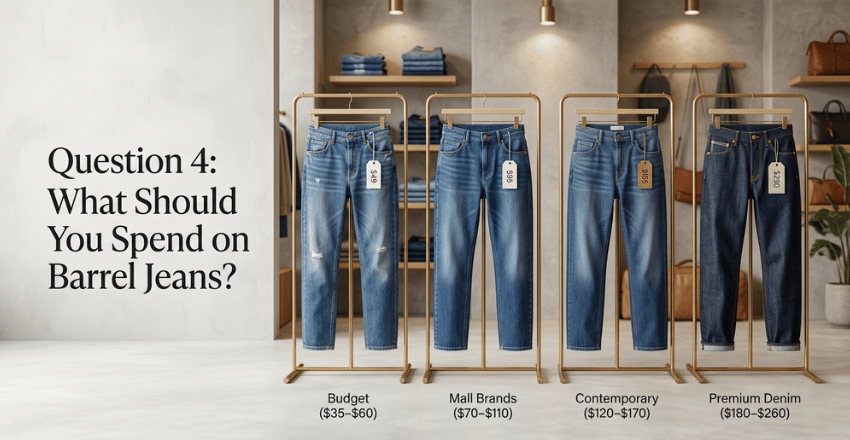
Expect to pay for fabric weight and construction rather than the logo. Rigid cotton has been holding a curve for years. Thin stretch denim relaxes into a shapeless tube by about the third wear.
| Retailer tier | Price band | What you get |
| Mass market | $35 to $60 | Stretch denim, mild curve, one or two inseams |
| Mall brands | $70 to $110 | Short, regular and long inseams, curvy fits |
| Contemporary | $120 to $170 | Rigid cotton, darted or pieced shaping, petite and tall lines |
| Premium denim | $180 to $260 | Heavier mills, sharper taper, rises up to 12.5 inches |
A high-rise mall-brand pair we priced sat at $90. The darted contemporary version was $148, and a premium ultra-high rise hit $239. Testing the shape for the first time? That $70 to $110 band tells you whether you like it without much regret.
What to Skip
Here is the blunt version, because most guides stop at what to buy.
- Lug-sole boots and platform sneakers. Chunky soles double the visual weight at the exact point the leg is trying to narrow.
- Long tunics and oversized shirts that cover the hip. Covering the hip reads as width with no waist anywhere.
- Full-length pairs you plan to shorten. Cutting a pooling hem removes the taper the pattern was drafted around.
- Horseshoe curves as your opening bid. Start soft, then go bigger once you know the shape works on you.
- Knee darts on an inseam under 27 inches unless the pair is cut into petite. A dart drafted for a 5’8″ leg lands on your calf and looks like a crease.
Making the Rest of the Outfit Work

Tuck something in. A fitted tee, a bodysuit, a slim knit, half a button-down: anything that shows where your waist actually is. A belt does the same job in five seconds.
Keep the top half quiet after that. Solid colors, clean lines, and one structured layer such as a cropped jacket or a blazer. The pants are the loud part of this outfit, and two loud parts cancel each other out.
Ready to build the rest of it? Our fashion styling archive covers the tops, shoes, and layers that pair with a curved leg.
FAQ
Yes. The shape has moved from novelty to a standard cut, and most major denim labels now carry one alongside their straight and wide-leg blocks. Exaggerated horseshoe versions will date first, so buy those on a smaller budget.
Barrel curves gradually from hip to hem. Balloon gathers volume high on the thigh and drops it in sharply, often with elastic or a drawstring at the ankle. Horseshoe sits between the two, with a harder snap-in below the knee.
Down, usually, on rigid cotton. Several brands cut this shape generously and say so in their own fit notes. Stretch versions run truer, so take your normal size and check the hip measurement.
Slim ankle boots, yes, under a hem of 16 inches or less. Wide-shaft and knee-high boots bunch under the taper and gap at the calf, which is why they look awkward in every fitting room mirror.
Yes, with a cropped inseam and a high rise. Buy the petite line rather than hemming the regular one, because the knee shaping is repositioned in a petite draft, not simply shortened.