

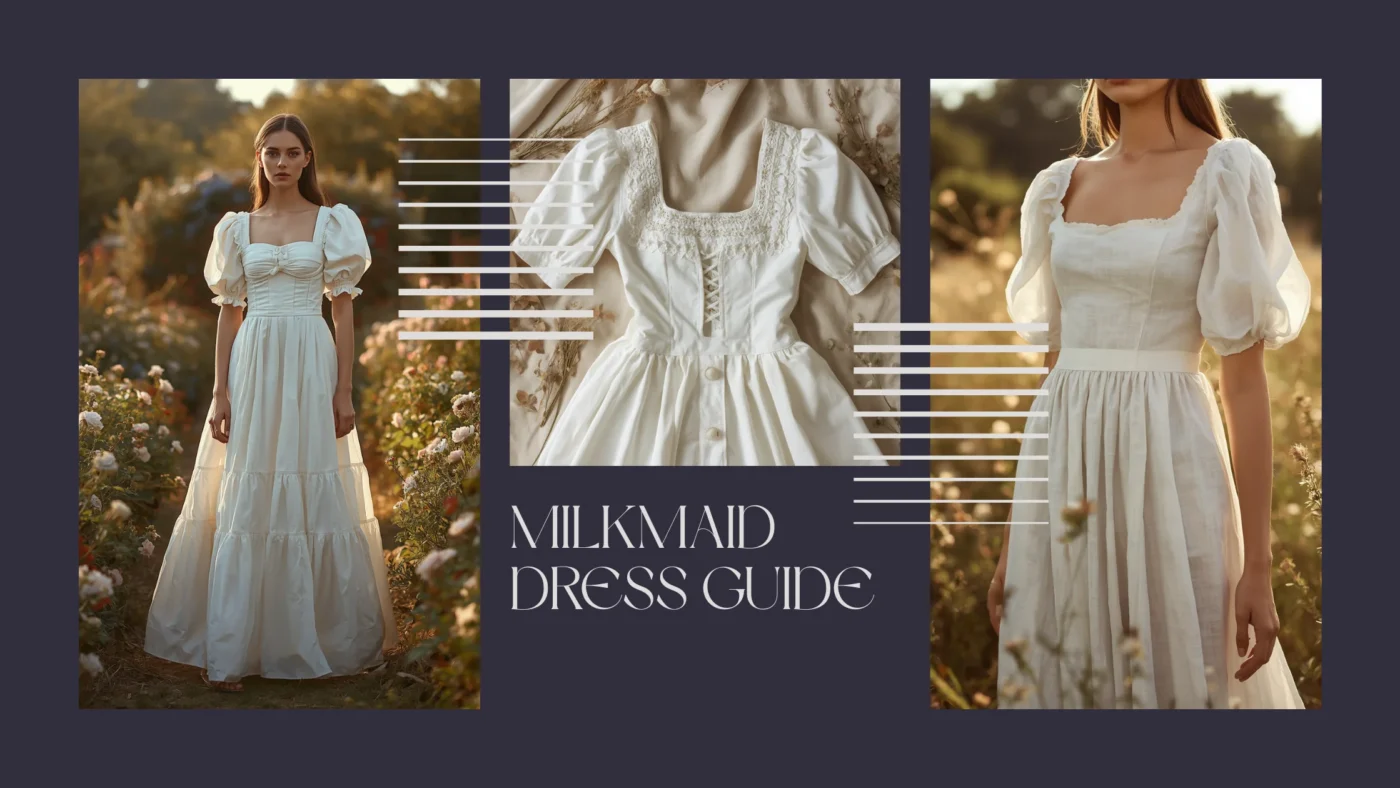
A milkmaid dress has a square or sweetheart neckline, a corset or shirred bodice, puff sleeves or tie straps, and a full skirt. Four details, and all four have to show up. Drop one,ne and you own a sundress, a smock, or a prairie dress instead.
Every shopping guide on page one skips the harder question. Does that fitted top hold you up on its own, or do you need something underneath? The answer depends on which bodice you bought, and you can settle it in the fitting room before you pay.
The Four Defining Details At A Glance
| Detail | Standard version | Variations you will see | What it changes for you |
| Neckline | Square, cut straight across the chest | Sweetheart, scooped, off-shoulder | A square neck shows collarbone and wants a straight-cut cup under it; sweetheart curves down and hides more. |
| Bodice | Fitted, either boned or shirred | Smocked panel, laced front, plain lined panel with a back zip | This is the detail that decides whether the top stays up on its own |
| Sleeves | Short puff, gathered at the shoulder | Long balloon, flutter, tie straps, no strap at all | Puff sleeves sit off the shoulder seam, so they carry no weight |
| Skirt | A-line or full, gathered at the waist | Tiered, paneled, mini, midi, maxi | Volume balances the fitted top, and tiers add the most of it |
| Fabric | Cotton poplin or a linen blend | Eyelet, gingham, chiffon, broderie | Stiffer cotton holds a puff; soft chiffon lets it collapse |
| Length | Midi | Mini, maxi | Midi reads day to night, mini leans young, maxi leans cottagecore |
TL;DR
- Four details define the style: square or sweetheart neck, fitted bodice, puff sleeves or tie straps, full skirt.
- A boned bodice with a back zip holds you. A fully shirred back compresses; it does not lift.
- Tie straps on a shirred bodice are decorative. They carry no weight at all.
- Real US price bands run about $25 to $60 at mass market, $70 to $150 mid-tier, and $150 up at contemporary brands.
- A balconette works under a square neckline. A wide-set strapless works under a sweetheart neckline.
What Actually Makes A Dress A Milkmaid Dress?
The name points to eighteenth-century farm workwear, but nobody is checking your historical accuracy. What people are reading is the signature shape of a milkmaid dress: narrow and structured on top, with a wide and soft silhouette below.
Does The Neckline Have To Be Square?
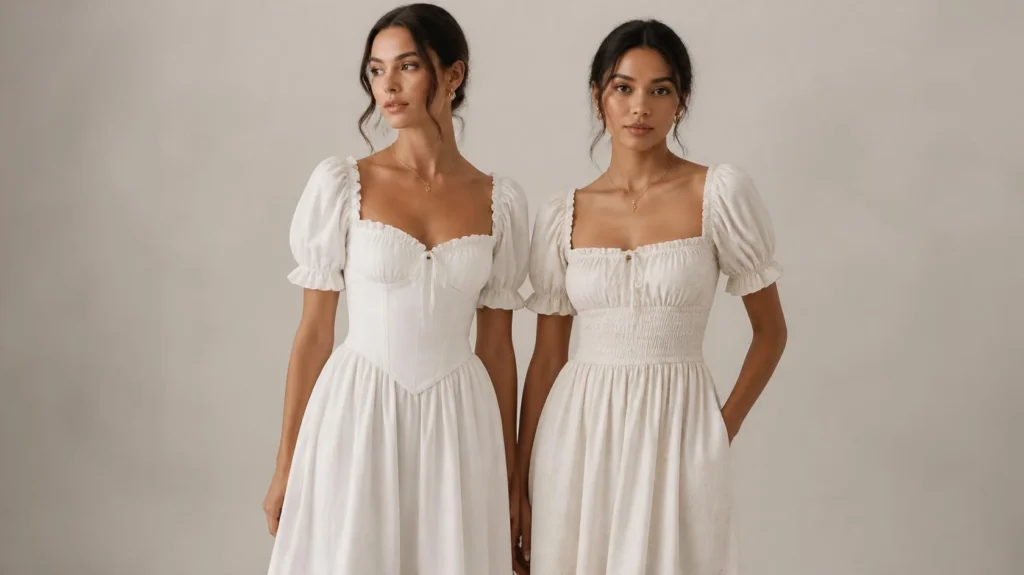
No, though square is the default. A square neck cuts straight across the chest and sits wide, which is what makes the shoulders look broader and the waist look smaller. Sweetheart is the other common shape, dipping into two soft curves at the center.
Scooped and off-shoulder versions get sold under the same label. They read close enough, but the shape you pick changes what you can wear under it, which matters more than the label does.
Corset Bodice Or Shirred Bodice: How To Tell Them Apart
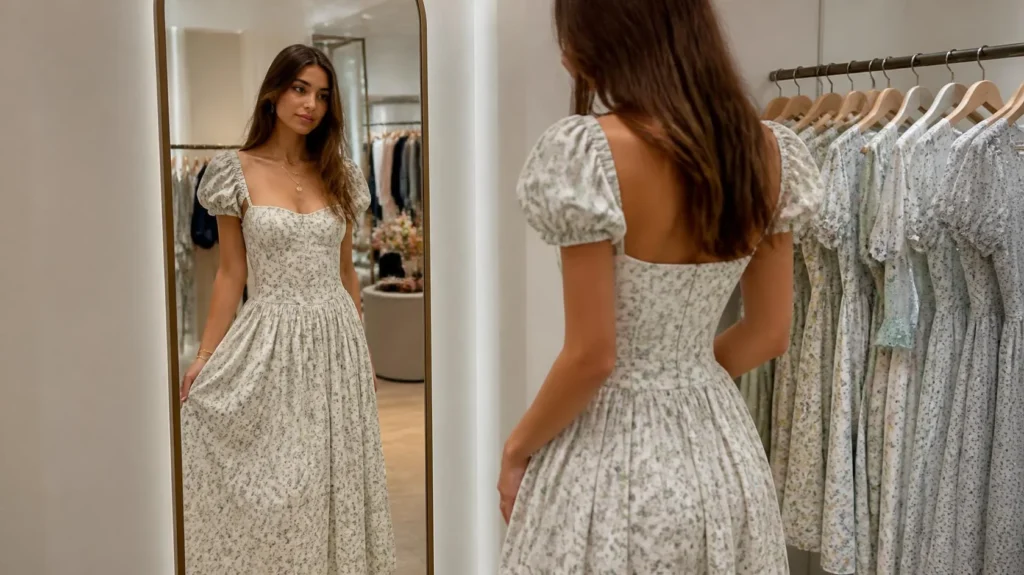
Turn the dress inside out. Corset bodices have a lining, vertical channels at the side seams, and thin plastic or spiral steel bones running through them. A shirred bodice has rows of elastic thread stitched across the fabric, usually across the whole back panel.
Both look fitted on the hanger. They behave nothing alike on a body, and this single difference decides almost everything about support.
Do The Sleeves Have To Puff?
They do not, but something has to happen at the shoulder. Short puff sleeves are the signature. Tie straps, flutter sleeves and long balloon sleeves all pass, because each one keeps the eye at the shoulder line and away from the middle.
Fabric decides whether the puff survives. Cotton poplin, eyelet and stiffer linen blends hold their shape through a wash. Rayon and thin chiffon go flat by the second wear.
How The Skirt Should Behave?
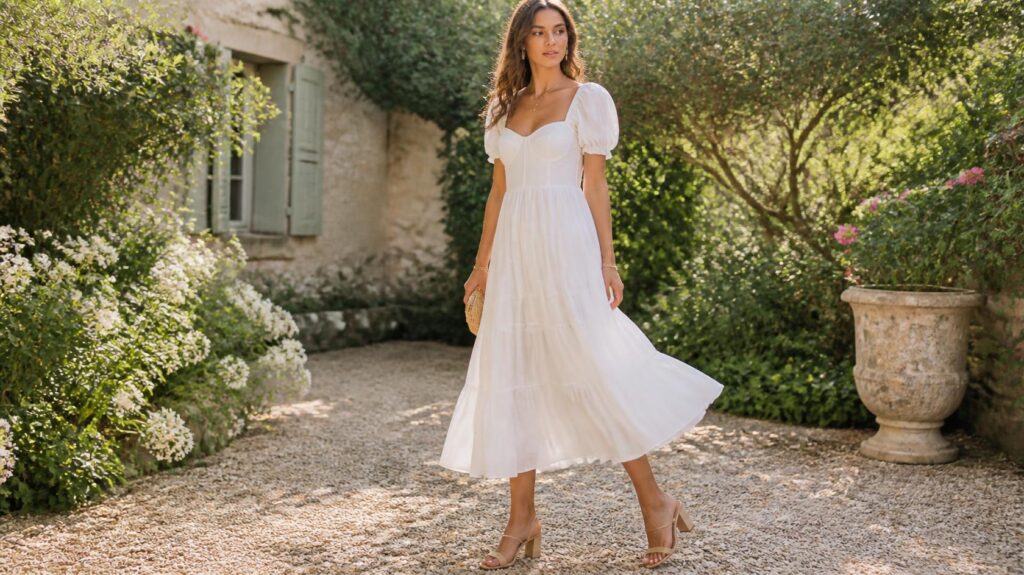
Volume is the whole point below the waist. A gathered A-line or a tiered skirt gives the fitted bodice something to work against. That is the same trick a pressed pleat skirt uses to add width at the hip, without adding bulk at the waist. Cheap versions gather a flat rectangle and call it a skirt. Better ones use real yardage, and you can feel the weight in your hand.
How It Differs From A Prairie Dress Or A Smock Dress?
Prairie dresses cover more: high neck, long sleeves, ruffled collar, often a yoke. Smock dresses skip the fitted waist entirely and fall straight from the shoulders. This style sits between them, fitted through the ribs and loose everywhere else.
Will The Bodice Stay Up Without A Bra?
Sometimes. It depends on construction, not on price, and the answer is easier to test than to guess.
What Shirring Actually Does?
Shirring is elastic thread. It pulls fabric in against your ribs and grips by tension, which feels secure standing still and stops feeling secure the moment you raise your arms. Elastic compresses. It does not lift.
So a fully shirred back holds a smaller bust fine and slides down on a fuller one. If you wear a C cup or above and the entire back panel is elastic, plan on wearing something under it.
When A Corset Bodice Really Holds?
A boned and lined bodice with a back zip is a different garment. The bones stop the fabric from folding, the lining takes the load, and the zip means the fit is fixed rather than stretchy. Four to eight bones is typical at this price level.
That construction will genuinely hold you braless up to about a C or D, assuming the ribcage measurement is snug. Snug is the operative word. Any bodice that gaps at the top is doing nothing.
Tie Straps Are Decoration, Not Support
This is one detail that catches people out when wearing a milkmaid dress. The shirred bodice features tie straps stitched to a stretch panel, meaning that tightening them only gathers the fabric rather than providing support or lift. They are decorative and carry no weight. Tighten them all you like—the bodice still sits wherever the elastic decides.
The Fitting Room Test That Takes Thirty Seconds

Do this in the fitting room, every time. It takes about thirty seconds, and it settles the question that no guide answers for you.
- Stand square and let the bodice sit where it wants to.
- Raise both arms straight overhead and hold for a count of three.
- Drop them and look down. If the neckline moved more than an inch, the bodice is not holding you.
- Bend forward at the waist. Anything that shifts here will shift on a dance floor.
- Walk five steps. Loose bodices announce themselves as soon as you move.
Outdoors, keeping a neckline where you put it gets harder. Our guide to picking a beach wedding gown for wind and heat works through the same problem in detail. Wind pulls at anything unanchored.
Which Bra To Wear Underneath?
Match the bra to the neckline shape, not to the dress category. Nobody on page one does this, and it is the difference between a clean line and straps you spend the evening hiding. We cover this in more depth in How a Shift Dress Should Fit.
| What you are wearing | Best bra | Why it works | Bust range |
| Square neckline, shirred back | Balconette with removable straps | Straight-cut cups sit below a straight neckline instead of peeking over it | Any |
| Square neckline, boned bodice and zip | Nothing, or nipple covers | The bodice already does the lifting, so a bra only adds bulk | Up to a C or D |
| Sweetheart neckline | Strapless with wide-set underwire | Curved cups follow the curve of the neckline | Any, if the band is snug |
| Off-shoulder or tie straps | Adhesive bra or body tape | No strap has anywhere to hide on an open shoulder | Sticky to a DD, tape above that |
Skip plunge styles. The center panel sits too low and shows through a square opening every time.
What You Will Pay, And What Changes At Each Price?
Retailer tier tells you more than the label does. Here is what a milkmaid dress really costs across mass market, mid-tier, and contemporary US stores this summer.
| Price band | Where you find it | What the money buys | The tell |
| $25 to $60 | Old Navy, Target, Walmart, boohoo, Amazon | Fully shirred back, thin unlined cotton or poly, a skirt gathered from a flat panel | The sleeve puff goes flat after one wash |
| $70 to $150 | Free People, Petal & Pup, Abercrombie, Madewell | Lined bodice, back zip, sometimes light boning, cotton poplin or a linen blend | The skirt has enough yardage to swing when you turn |
| $150 and up | Anthropologie, Reformation, Everlane, small labels | Boned and lined bodice, covered zip or hooks, eyelet or European linen | The bodice stands up by itself on the hanger |
Most of what we saw at the mid-tier sat between $88 and $168, with $109 showing up again and again. The jump from mass market to mid-tier buys structure. The jump from mid-tier to contemporary mostly buys fabric.
How To Wear It?
What Shoes Go With It?
Flat sandals and white sneakers keep a midi casual. Block heels or raffia wedges lift the same dress into wedding-guest territory. Knee boots work in fall, and they stop a maxi from reading like a nightgown.
Avoid a pointed stiletto. The proportions fight.
Which Fabric Works Best In Summer Heat?
Cotton poplin, eyelet, and linen blends breathe and hold their shape. Poly chiffon does neither, though it drapes beautifully in photos. For a July wedding outdoors, take the cotton and accept the wrinkles.
Does It Suit A Bigger Bust Or A Petite Frame?
For a milkmaid dress, a fuller bust often works best with a boned bodice and back zip. Shirred styles need to stretch further across the bust, which can reduce the level of support they provide. Choose the size that fits your ribcage measurement and adjust the waist afterward for a better fit.
Petite frames should watch the skirt length and the sleeve volume together. Mid-calf length with a modest puff keeps the proportions honest. A huge balloon sleeve on a small frame swallows the shoulder line.
More styling breakdowns like this one live in our fashion guides, which cover fit and fabric across the rest of the wardrobe.
Where To Start?
Pick the bodice first and the print second. Decide whether you want the dress to do the supporting or your bra to do it, then buy the construction that matches. Run the arms-overhead test before the receipt prints.
Get that one call right, and the rest is just color.
FAQ
Yes, for daytime and outdoor ceremonies. Choose a midi or maxi in a print, add block heels, and skip white or ivory. Boned bodices photograph cleaner than shirred ones because they hold a line.
It is, though the shape has narrowed. Extreme balloon sleeves have faded, and corset seaming has grown. What sells now looks closer to a fitted sundress with a square neck than to full cottagecore.
Size to your ribcage on a boned bodice and size down on a fully shirred one. Shirring stretches roughly two inches, so the smaller size usually fits and grips better.
Wash cold, hang dry, and steam rather than press. Hot irons flatten the gather permanently. Storing the dress on a padded hanger keeps the shoulder full between wears.
Look at three things: the neckline, the bodice construction, and the waist seam. Plain sundresses hang from the shoulders with no structure through the middle. This style is fitted and seamed, and that is what separates one from the other.