
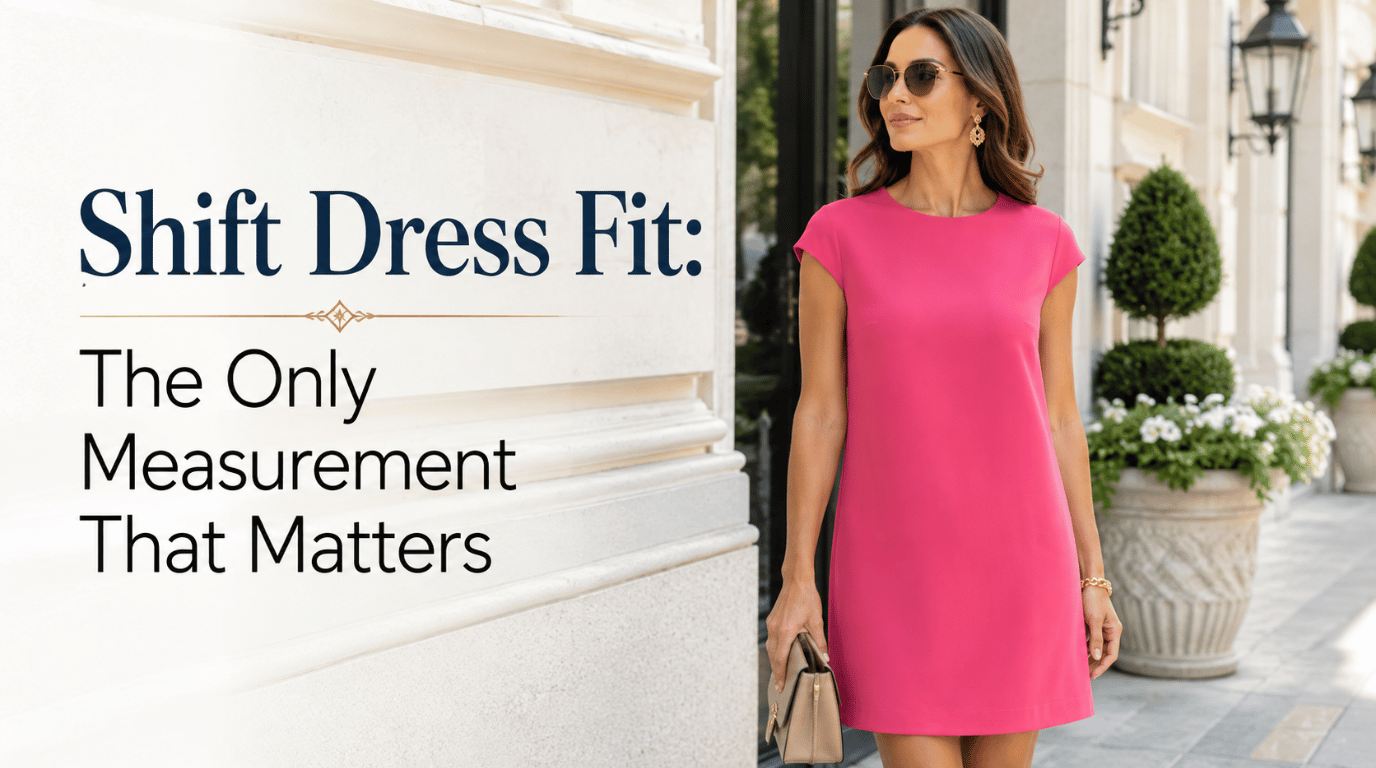
A shift dress fits at the shoulders, or it doesn’t fit anywhere. There’s no waist seam to catch the body further down, so the shoulders and the bust carry the whole garment on their own. That one structural fact explains why two women in the same size can look sharp or swamped.
Five fit checks, ranked by how much they matter
Work down this list in order. The first two are pass or fail in the fitting room. The rest you can negotiate later with a belt or a tailor.
- The shoulder seam sits on the outer edge of your shoulder bone. Half an inch too wide and the armhole drops, the side seams pull forward, and everything below it reads sloppy.
- The armhole doesn’t gape at the front. A gaping armhole is the detail shoppers blame on the silhouette when the real fault belongs to that one badly graded dress.
- The bust holds the fabric clear of your stomach. With enough clearance, the fabric falls in a straight vertical line. Without it, the fabric lands on you.
- The side seams hang straight down. If they swing forward, the front is riding up over the bust, and you need a roomier size or an added dart.
- The hem lands where you want it. Most US brands cut the classic version to hit an inch or two above the knee on a 5-foot-6 frame.
Notice what isn’t on that list. Your waist measurement doesn’t appear, and neither does your hip, because nothing in this dress is built to sit on either one.
Shift dress vs.. sheathvs.s. A-linvs.vs. tent.
The definition here is subtractive. Take a dress, remove the waist seam, remove the shaping darts, and remove the gathering, and what’s left is this silhouette. It hangs from the shoulders, skims past the waist without touching it, and stops.
Shoppers mix these four names up constantly, and retailers make it worse. The same dress gets tagged “shift” on one site and “sheath” on the next. Three attributes separate them cleanly.
| Silhouette | Waist seam | Where it skims | Who it suits |
| Shift | None, and no waist darts either | Shoulders and bust, then falls straight past the waist | Straight and column frames, long-waisted builds, anyone who wants no contact at the middle |
| Sheath | Usually none, but darts and curved side seams do the same job | Bust, waist and hip in sequence | Hourglass frames and anyone who wants the waist marked |
| A-line | Often yes, at or just above the natural waist | Bust and waist, then flares out from the hip | Pear frames and anyone who wants room through the hip |
| Tent | None, and the flare starts at the bust rather than the hip | The bust only, then swings free | Pregnancy, broad hips, or a deliberate volume look |
Sheath is the confusion that costs money. It has no waist seam either, which is why the two names get swapped so often, but its darts grip the body all the way down. Wedding listings blur the terms further, and our guide to beach wedding dress silhouettes works through the same four names in a bridal context.
Key takeaways
- A shift dress has no waist seam. The loose feel is a side effect of that, not the rule itself.
- Buy for your shoulders. Narrowing them afterwards costs more than any other alteration.
- Sheath grips through darts, A-line flares from the hip, and tent flares from the bust.
- Fabric weight decides whether the dress reads boxy or fluid.
- Expect $30 to $60 at mass market and $70 to $150 for a properly finished armhole.
Shoulder width is the measurement you can’t cheat.
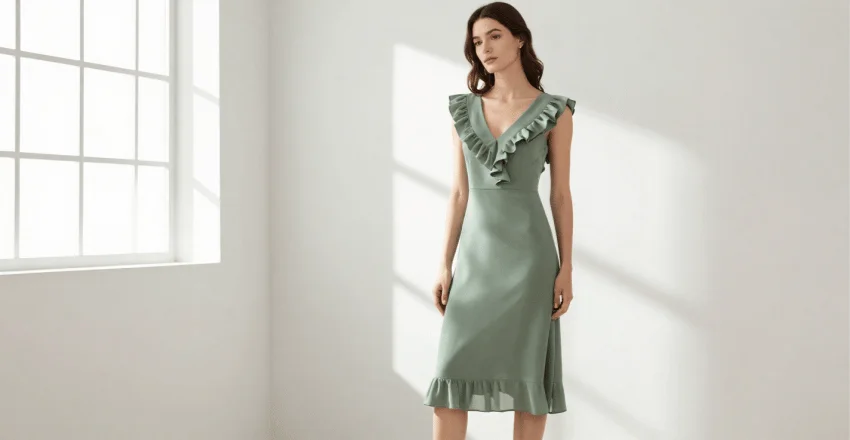
Every other dress gives you a second anchor point. A waist seam catches the body in the middle, so a bodice that runs slightly wide still sits correctly once the waist takes over. Strip that seam out, and the shoulders hold the entire garment alone.
Too wide, and the armhole seam slides onto your upper arm. The dress now hangs from a point that isn’t a shoulder, the neckline creeps backward, and the hem tilts. Too narrow is less obvious and worse to wear. The armhole binds, the fabric rides up when you lift your arms, and it never settles back down.
Cost is why this outranks a waist that runs an inch loose. Taking in a side seam runs roughly $20 to $40 at most US tailors. Narrowing a shoulder means unpicking and resetting the armhole. Quotes we’ve seen sit closer to $35 to $70 on an unlined dress and higher once there’s a lining to reattach. Size to your shoulders, then bring the rest in.
What the bust does with the rest
After the shoulders, the bust is the only other thing holding fabric off your body. Get that clearance, and the dress falls in an unbroken vertical line from chest to hem. Lose it and the fabric drapes onto your stomach, which is the exact shape people mean when they call this cut unflattering.
Fabric decides whether it reads boxy or fluid.
Two dresses cut from one pattern can look nothing alike. Weight and drape do that, and most listings bury the detail in the fiber content line.
- Linen and cotton poplin: hold their own shape. Crisp and architectural and the most likely to read as boxy on a small frame.
- Ponte and heavier knits: structured but forgiving. They keep a clean line without standing away from the body.
- Crepe: the safest office pick. Enough weight to hang straight, enough softness to move with you.
- Silk and viscose: pure drape. These follow you rather than skim you, so they show more than the pattern suggests.
- Tweed and brocade: maximum structure. Classic for the sixties look, but punishing in July.
Structure is a tool, not a flaw. A stiff cloth that stands away from the hip creates width on purpose, the same trick a pleated skirt uses to build volume. Use it when you want the straight line broken up.
Where the shape came from

The 1920s dropped the waistline out of women’s clothing entirely. Coco Chanel built a career on the straight, corset-free line that replaced it. The 1960s brought it back in bright wool and bold prints, cut short and worn by Jackie Kennedy and half of Mod London. Both eras wanted the same thing: a dress you could move in.
Three ways to put shape back in
The straight line isn’t compulsory. Each of these fixes works, and they cost different amounts.
Belt it, but find the waist first. There’s no seam to guide you here. Bend sideways and feel for the crease that forms. That fold is your natural waist, usually about an inch above the navel and higher than most people guess. A narrow belt of one to one and a half inches sits there cleanly, while a wide belt pools the spare fabric into a roll above it.
Tailor it. A side-seam taper from underarm to hem buys you a soft column for roughly $20 to $40. Two added bust darts cost a little more and give you real shaping through the front. Ask for the taper to stop at the hip if you still want walking room.
Let the fabric do it. A ponte or crepe version in your true size reads more shaped than a linen one two sizes up. Sizing up is the common mistake because the shoulders go up with everything else.
What you’ll pay in 2026
US prices we tracked this spring sorted into four bands, and the fabric quality tracked the number closely.
- $30 to $60: Old Navy, Target, and Amazon own-labels. Thin jersey or polyester, unlined, unfinished armholes.
- $70 to $150: J.Crew, Madewell, Quince, Boden. Linen, ponte, and crepe-bound armholes and better shoulder grading across sizes.
- $160 to $300: Anthropologie, Reformation, Theory. Structured cloth, a real lining, and a hem you won’t need to shorten.
- $350 and up: contemporary and designer labels, where the money goes into pattern cutting rather than the cloth.
That second jump is the one worth paying for. It’s where the armhole gets finished properly, and the armhole is check number two.
Styling it by occasion
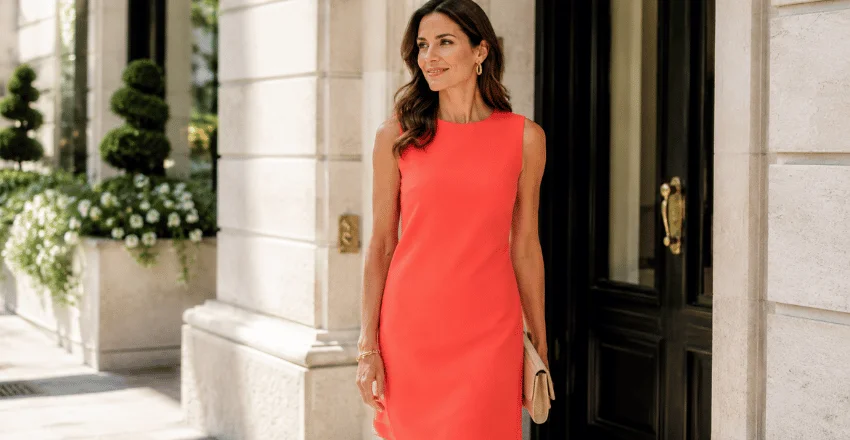
Office. Crepe or ponte, knee-length, and a structured jacket left open so the vertical line stays unbroken. Pointed flats or a low block heel finishes it. Skip the belt, because the jacket already breaks the shape for you.
Wedding guest. Move up a fabric tier and let accessories carry the rest. A plain surface is the ideal frame for one strong piece. That’s why a Cartier Love bracelet or a single wide cuff beats a necklace competing with the neckline.
Weekend. Linen, unbelted sneakers, or flat sandals. This is the one context where “boxy” is the whole point.
Evening. Silk or satin, a narrow belt at the true waist, and heels. Keep the shoe plain. The dress carries no detail to compete with, so a busy shoe wins the outfit.
Cold weather. Opaque tights, ankle boots, and a fine knit underneath rather than over the top. Layering on top adds bulk exactly where this silhouette has none to spare.
Before your next order, measure shoulder point to shoulder point across your back and check that number against the brand’s size chart. It takes a minute, and it’s the one figure that decides whether the dress works on you.
Frequently asked questions
No. Neither carries a waist seam, which is why the names get swapped, but a sheath uses darts and curved side seams to follow the body. The straight version skims past the waist without narrowing at all.
Yes, with one condition. The fabric has to clear the bust and the fullest part of the hip without resting on either. Buy the size that manages that, then take the side seams in. A stiffer cloth holds the line better than a soft one here.
Neither by default. Size it to your shoulders or your bust, whichever needs more room, and alter it down from there. Sizing up to gain hip room drags the armhole onto your arm and undoes the fit you were buying.
An inch or two above the knee is the classic length and the easiest to wear to work. Anything shorter gets awkward to sit in, since no waist seam holds the skirt in place when you cross your legs.
Yes, if the fabric earns it. A crepe, silk, or textured cotton with real jewelry reads dressed up. A cotton jersey one reads like a T-shirt, no matter what shoes you add.