
Most shoe listings give you one number. Heel height. That figure tells you little about how platform sandals will feel after four hours on your feet. What matters more is the gap between the back of the shoe and the sole under your toes.
Effective pitch is heel height minus front platform height. A 5-inch heel built on a 2-inch platform gives a 3-inch pitch, so your foot sits at the angle of a 3-inch shoe. Height comes from the whole sole. Strain comes from the pitch alone.
Key takeaways
- Pitch, not total height, decides how a shoe feels. Subtract the front sole from the heel.
- A flatform has a pitch of zero. Your foot stays level, whatever the sole measures.
- Wide soles and a secure strap cut ankle roll. Narrow bases on tall stacks invite it.
- EVA is the lightest sole material and wood is the heaviest, often by a full pound per pair.
- Expect $25 to $150 for most US pairs, with cork wedges landing near the middle.
The one measurement brands leave out
Brands measure heel height at the back, floor to heel seat. Almost none publish the front sole thickness, and almost every shopper needs it. So measure it yourself once the box arrives. Stand the shoe on a table, hold a ruler against the sole under the ball of the foot, and read it off. Subtract that from the heel number.
What is left is your pitch. Your calves, your arch, and the ball of your foot all answer to that figure and ignore the rest. Two inches feels like a low block heel. Past three inches, weight slides forward and the front of the foot carries it. Past four, most people start counting the minutes until they can sit down.
Run the math on a few real pairs and the pattern gets obvious fast.
| Heel height | Front sole | Effective pitch | Feels like |
| 2 in | 2 in | 0 in | A flat sandal with extra height |
| 4 in | 2.5 in | 1.5 in | A low heel you can wear all day |
| 3.5 in | 0.5 in | 3 in | A mid block heel |
| 5 in | 2 in | 3 in | A mid block heel, but taller on you |
| 6 in | 2 in | 4 in | A steep evening shoe |
How platform sandals compare, style by style
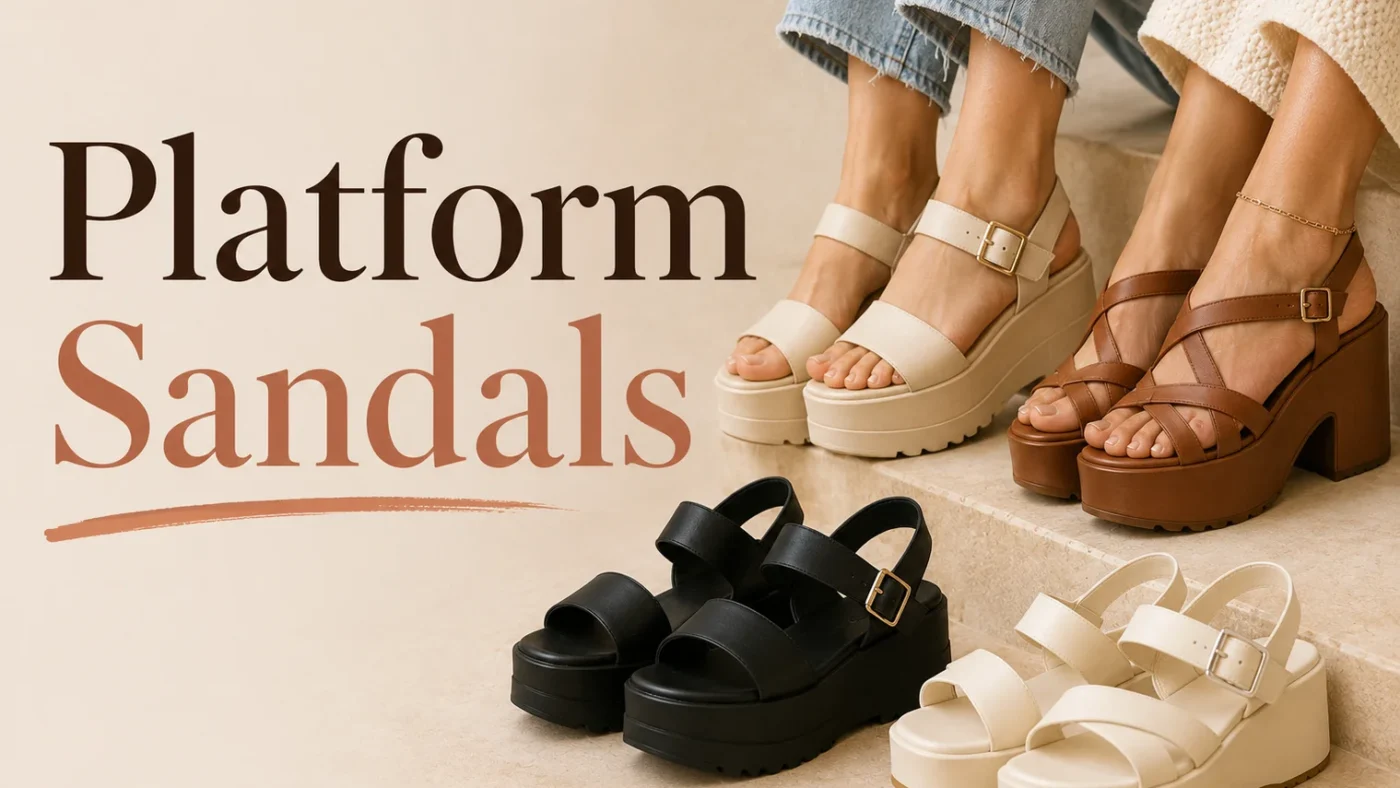
Five constructions fill most racks, and they do not walk alike. The numbers below are typical, so measure your own pair against them. For the wider footwear picture, browse our shoes archive.
| Style | Heel | Front sole | Pitch | Usual sole | Stability | Price |
| Flatform | 1.5 to 3 in | Same as heel | 0 in | EVA or rubber | High | $25 to $70 |
| Cork wedge | 2.5 to 4 in | 0.75 to 1.5 in | 1.75 to 2.5 in | Cork or covered foam | High | $50 to $120 |
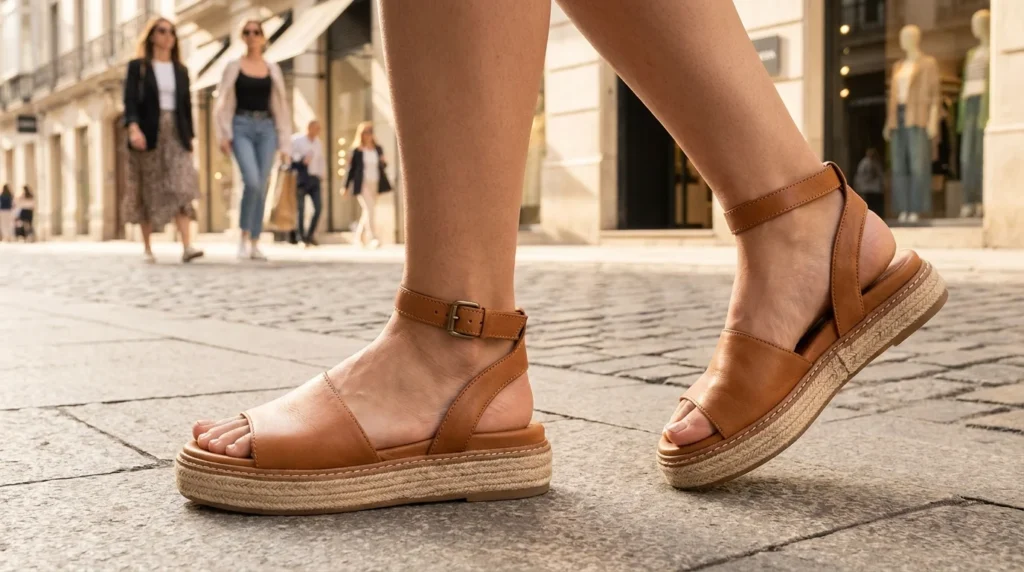
| Espadrille platform | 3 to 4.5 in | 1 to 1.75 in | 2 to 2.75 in | Jute rope over rubber | Good | $50 to $130 |
| Chunky block platform | 3 to 5 in | 1 to 2 in | 2 to 3 in | Rubber over a foam core | Fair | $60 to $140 |
| Platform heeled sandal | 4 to 6 in | 1 to 2 in | 3 to 4 in | Wood or resin core | Low | $70 to $150 |
Stability and the ankle roll question

Height raises your center of gravity. Simple physics, and no strap design gets around it. A rigid sole makes that worse in one specific way. The block cannot flex, so when its outer edge catches a curb or a cobblestone, the whole slab levers over and takes your ankle with it.
A thin 3-inch heel does the same thing on a smaller scale. A 2-inch flatform with a broad base barely budges. Sole width matters more here than sole height.
Watch for a sole that tapers inward under the footbed, a trick designers use to make a thick base look lighter. That taper is where rolls start.
- Choose a sole at least as wide as your footbed, edge to edge.
- An ankle strap or a slingback keeps your foot from sliding forward on the drop.
- Rounded front edges let the shoe roll through a step instead of slapping down.
- Grass, gravel and metal grates punish tall stiff soles. Save those pairs for sidewalks.
Sole materials and what they weigh
Weight is the quiet reason one pair tires you out, and another does not. You lift each shoe hundreds of times per mile, so an ounce compounds.
- EVA foam: lightest by a wide margin. A 2-inch EVA flatform pair often lands near 12 oz. It compresses across a season, so the bounce fades.
- Cork: light, warm underfoot, and it molds to your arch as you wear it. A cork wedge pair runs roughly 16 to 22 oz. Keep it out of the rain.
- Rubber: grippiest and most durable. Heavy too, around 20 to 28 oz for a lugged platform pair.
- Wood: handsome, loud on tile, and close to 2 lbs a pair. It never flexes, which is the trade you accept for the look.
Fit details that decide comfort
Pitch sets the ceiling on comfort. Fit decides whether you ever reach it. Straps belong across the widest part of your foot, not at the base of your toes. Look for a footbed with a shallow cup under the heel, which stops you sliding forward. Check the front lip too, because a hard edge on a stiff sole will bite if your toes sit right at it. Half a finger of footbed ahead of your longest toe is about right.
What a thick sole does to your pants

Hems are measured to the floor, not to your ankle. Add a 2-inch sole and every pair of pants you own suddenly sits 2 inches higher.
Classic straight pants want to break about half an inch off the floor. Wide leg and flares read better closer to a quarter inch, with only a peek of toe showing. Both numbers assume a shoe on your foot. So hem standing up, on a hard floor, wearing the pair you will actually pull on.
Switching between flats and a 2-inch base every week? Crop the leg above the ankle bone and stop fighting the math. Skirts and dresses are simpler, since the added height just reads as leg, and a midi that grazed mid-calf in flats will land a touch higher. Our dresses section goes deeper on those lengths.
What platforms cost right now
Mass market foam flatforms start around $25. Steve Madden covers roughly $30 to $130 across its platform range, which captures most of the chunky and heeled styles people actually buy. Cork wedges from contemporary labels cluster at $50 to $120. Leather uppers on a molded rubber base push toward $150.
Under $30, you are buying injection-molded foam with a printed strap. Light, cheerful, and it will crease. Above $120 you should get a leather footbed, stitched sole edges, and a base a cobbler can re-glue. Prices soften in late August, and our seasonal outfits coverage tracks what carries from summer into fall.
Your next step
Do this before you order anything. Measure the pitch of the shoe you already walk best in, save that number in your phone, and shop to it. Then hold the new pair’s sole against your own footbed and check the width. That one habit prevents more returns than any size chart.
FAQs
Usually, because the front sole cancels part of the heel. Take a 4-inch shoe on a 1.5-inch base: it holds your foot at 2.5 inches. The catch is weight and rigidity, so a tall stiff block still asks more of your balance than a soft flat.
No. A flatform keeps one thickness front to back, so its pitch is zero. A wedge fills the space between heel and toe with a solid ramp, and it still leaves a drop of roughly 1.75 to 2.5 inches.
Judge the pitch, never the total stack. Above 3.5 inches of pitch, most wearers shorten their stride and load the ball of the foot. Under 2 inches, you can cover a city block without thinking about it.
They add visual mass, yes. A beveled edge, a sole dyed to match the strap, and a little toe showing at the front all trim that back.
Rubber and leather bases, often yes. Any cobbler can fit a fresh top lift or re-glue a lifting edge for about $20 to $40. Molded foam is another story, since a split in EVA has nowhere to go.