
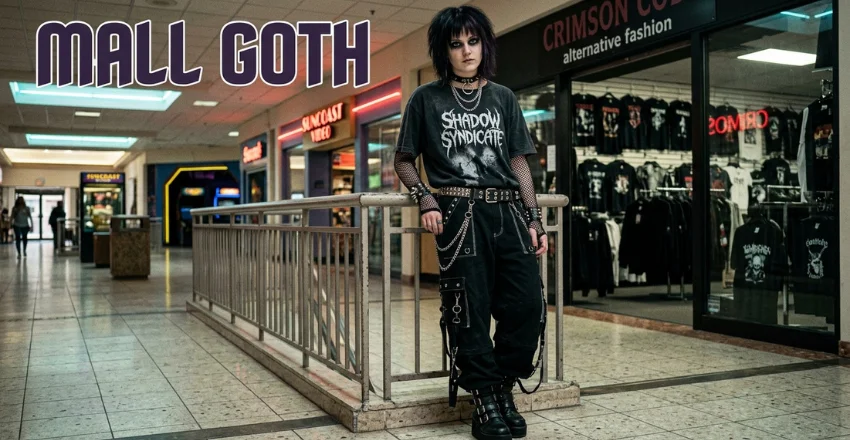
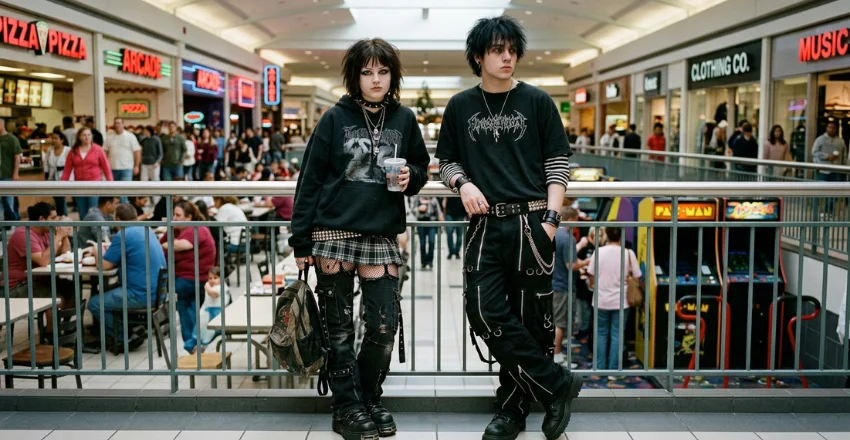
Mall goth grew out of late-1990s and early-2000s American mall culture, mixing dark alternative fashion with band merch, oversized pants, platforms, chains, and heavy makeup. Today, the easiest way to wear mall goth is to borrow its silhouette and attitude instead of copying an old Hot Topic display piece for piece.
The short answer: start with one oversized or fitted black top, add wide or hardware-heavy bottoms, choose chunky black footwear, then finish with one or two textured accessories. Keep the palette controlled and let the silhouette do most of the work. That gives you the early-2000s reference without turning the outfit into a costume.
| Style element | What to look for | Easy modern option |
|---|---|---|
| Tops | Band tees, mesh, fitted tanks, striped layers | Oversized graphic tee over a fitted long sleeve |
| Bottoms | Wide pants, cargo details, plaid, chains | Black cargos or wide-leg denim |
| Shoes | Platforms, combat boots, chunky soles | Everyday black platform or lug-sole boots |
| Accessories | Studs, chokers, chains, grommets | One metal belt plus a simple necklace |
| Colors | Black with red, purple, gray, or acid accents | Mostly black with one saturated color |
| Beauty | Dark liner, dark lips, colored hair accents | Smudged eyeliner or deep berry lipstick |
What Is Mall Goth, and Where Did the Look Come From?
The term originally carried a mocking edge. It was used for young people who saw buying an alternative identity from mainstream mall stores as an alternative to participating in established underground scenes. Over time, the label developed a recognizable culture and visual language of its own.
The American shopping mall was central to that story. Hot Topic made band shirts, chains, alternative accessories, dark makeup, and statement pants easy for suburban teenagers to find in one place. Brands strongly associated with the era include Tripp NYC, JNCO, Lip Service, Demonia, and Manic Panic.
Music shaped the look too. Nu metal, industrial sounds, emo, and alternative rock all fed into the style. That explains why a concert tee often feels more authentic than a highly ornate black dress.
The Pieces That Make the Style Recognizable
You don’t need a closet full of specialty clothing. The strongest outfits usually combine one exaggerated proportion, one dark base, and one piece of visible hardware.
Wide-leg pants are an easy starting point. Look for black denim, cargos, contrast stitching, straps, zip details, or removable chains. If you prefer denim over cargo styling, Styleblor’s flare-jeans guide explains how wider hems interact with shoes and proportions.
For tops, try a worn graphic tee, a fitted ribbed tank, a mesh layer, a striped long-sleeve, or a simple black camisole. The original look often played with extreme proportions, so a tiny fitted top can work well with huge pants. An oversized tee also works with a short skirt and tights.
Shoes should carry some visual weight. Combat boots, platform boots, creepers, and chunky sneakers all fit. You can also use an ordinary lug-sole pair rather than buying something highly theatrical. Styleblor’s black-boots guide has useful ideas for matching boot height and shape to the rest of an outfit.
9 Outfit Formulas You Can Wear Now
You can build the aesthetic from clothes that already make sense in a modern U.S. wardrobe.
- Graphic tee + black cargos + combat boots. Add a chain belt and stop there. This is the easiest everyday formula.
- Fitted black tank + extra-wide pants + platform sneakers. The contrast between a close top and oversized bottom gives the outfit its shape.
- Band tee + plaid mini + opaque tights + boots. Keep the accessories small if the plaid is loud.
- Striped long sleeve + black tee + dark denim. Let the striped cuffs and neckline show beneath the shirt.
- Mesh top + black camisole + cargo skirt + lug soles. This gives you texture without relying on novelty graphics.
- Oversized hoodie + loose black pants + heavy sneakers. Add silver hardware through a belt, bag, or wallet chain.
- Black slip dress + boots + cropped cardigan. Choose a matte or casual fabric to keep it grounded. Styleblor’s long black dress guide covers how fabric affects the mood of a black dress.
- Dark baby tee + baggy denim + studded belt. A faded red or purple graphic can break up the black.
- Black skirt + fishnets + oversized graphic top + tall boots. Keep the skirt simple so the texture of the tights remains visible.
How to Keep It From Looking Like a Halloween Costume
The biggest mistake is stacking every recognizable detail into one outfit.
Chains, striped arm warmers, a choker, fishnets, dramatic makeup, giant platforms, plaid, and a graphic tee may all fit the aesthetic. Wearing them at once can make each piece compete for attention.
Use a three-part rule instead:
- Pick one silhouette statement, such as wide-leg pants or a miniskirt with tall boots.
- Pick one texture statement, such as mesh, fishnet, distressed denim, or plaid.
- Pick one hardware statement, such as a chain, grommet belt, or studded collar.
Everything else can stay simple.
This approach also makes the clothing easier to repeat. A pair of black cargos can work with a fitted tank one day and an oversized concert tee the next.
How It Differs From Trad Goth, Emo, and Y2K
These styles overlap, but they don’t have the same center.
| Style | Main visual cue | Typical influence | Silhouette |
|---|---|---|---|
| Mall goth | Mall-bought alt pieces, hardware, band merch | Nu metal, industrial, early-2000s youth culture | Baggy mixed with fitted |
| Trad goth | Dramatic black styling, teased hair, post-punk references | Goth music and 1980s club culture | Slim, theatrical, layered |
| Emo | Band tees, skinny silhouettes, side-swept hair | Emo and pop-punk scenes | Narrower, casual |
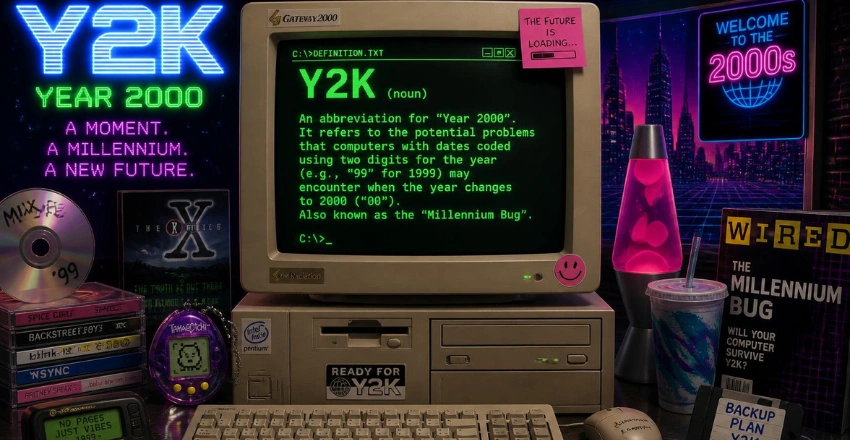
| Y2K | Gloss, color, tiny tops, low rises | Mainstream turn-of-the-century fashion | Body-conscious or playful |
Current guides often place the mall-based look between traditional dark styling and Y2K casualwear, rather than treating it as a strict uniform.
That flexibility is useful. You can lean darker, more punk, more romantic, or more colorful while keeping the same basic proportions.
Where to Shop Without Rebuilding Your Closet From Scratch
Start secondhand. Wide black pants, old band shirts, plaid skirts, leather belts, oversized hoodies, and worn-in boots don’t need to come from a specialty retailer.
Then fill only the gaps. If your closet already has black jeans and boots, you may need nothing more than a graphic tee and a metal belt. If you own several fitted black tops, spend your budget on one strong pair of wide pants.
Vintage and resale listings can also help you find older Tripp-style pieces, old alternative merchandise, and discontinued silhouettes. Modern retailers can supply the basics, but mixing sources usually looks more personal than buying a complete matching set.
Build the Outfit Around One Strong Piece
You don’t need to recreate 2002 down to the last wristband. Choose the element you like most, whether that’s enormous pants, platform boots, a faded band shirt, or heavy silver hardware. Build the rest of the outfit around it.
That approach keeps the history visible while making the clothes work for your life now. Start with one piece, wear it several ways, and add more only when you know what your wardrobe is missing.
FAQs
Yes. Reduce the number of statement details. Black cargos, a graphic tee, a metal belt, and ordinary chunky boots can read alternative without feeling like event clothing.
No. They are among the most recognizable references, but any wide black pants with straps, pockets, contrast stitching, or hardware can create a similar silhouette.
No. Black usually forms the base, but red, purple, gray, pink, and bright accent colors can work. Colored hair, contrast stitching, and striped layers also fit the period-inspired look.
It describes an alternative style and youth culture closely tied to U.S. shopping malls, especially in the late 1990s and early 2000s. Its visual cues include dark clothing, band merchandise, wide pants, platforms, chains, fishnets, and bold makeup. The term began as an insult but later gained a more distinct identity.