
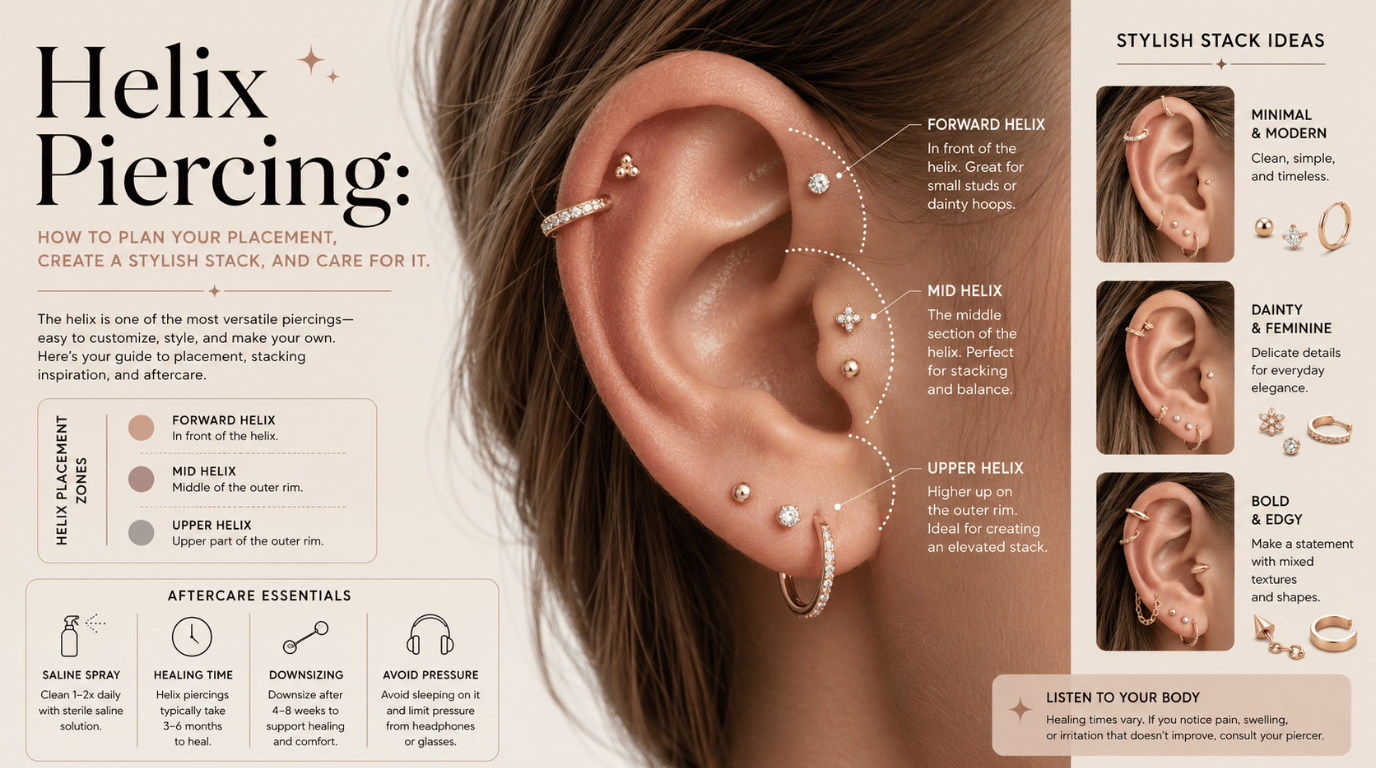
The curved outer rim of your ear is the most pierced cartilage on the body. Most guides treat a helix piercing as one small decision, made once. It is closer to a floor plan. Where the first hole lands decides what the rest of that ear can hold for years.
The rim runs from just above the lobe, up around the top, and down into the side of your head. Piercers split it into forward, mid, and upper zones. Each zone takes different jewelry, sits at a different angle, and changes how many holes will fit beside it later. Anatomy decides more than taste does.
Key takeaways
- The rim is one long piece of cartilage, and piercers divide it into a forward, mid, and upper section.
- The flat and the scapha are separate placements, not variations of the rim.
- Two cartilage holes per sitting is the common studio ceiling, usually one per ear.
- Expect $40 to $80 for the piercing, plus $30 to $150 for the jewelry.
- Glasses arms, headphone cups, and hair ties cause most of the trouble people blame on aftercare.
- Take the individual questions to a licensed piercer and anything red or painful to a doctor.
The helix family, mapped
People use the word loosely. Piercers do not. Here is what each name actually points at on the ear and what it costs you in flexibility later.
| Helix Piercing Placement | Where it sits | Typical starting jewelry | Planning note |
| Forward helix | The short ridge above the tragus, facing the front of your head | 18 gauge or 16 gauge flatback stud, 1/4 inch post | Very little room. Stacks of two or three are common, but only on a deep enough ridge. |
| Mid helix | The middle of the outer rim, roughly level with the ear canal | A flatback stud first, then a small hoop after downsizing | The narrowest zone. It snags on hair and sits right under headphone cups. |
| Upper helix | The top third of the rim, tucked slightly into the fold | Flatback stud, or a 5/16-inch hoop later | Fits the widest range of ears and the widest range of jewelry. The default choice. |
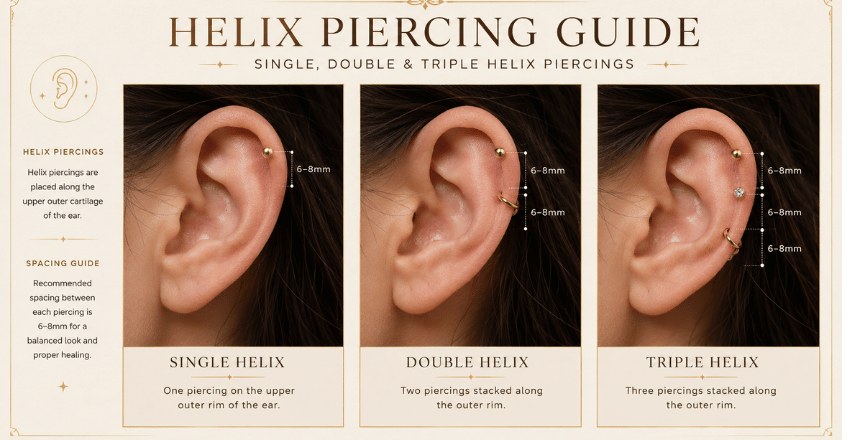
| Double or triple helix | Two or three holes in a line along the same rim | Matched studs, sometimes one hoop at the end | Even spacing matters more than placement. Usually staged across two or three visits. |
| Flat | The broad plate of cartilage inside the rim, not on it | Flatback stud only | A different placement with its own angle. Not a rim piercing. |
| Scapha | The groove between the rim and the flat | Flatback stud | Sometimes used when a fused rim leaves no room. Carries its own risks. |
Read that as a shopping list for your own ear, not a menu of trends. A stack looks deliberate only when the pieces relate, the same way a curated jewelry stack reads as one set.
Where the ridge ends and the flat begins
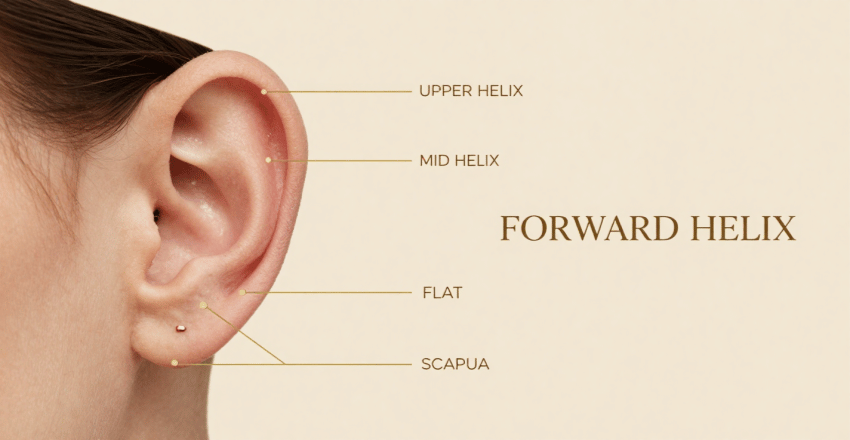
Pinch the outer edge of your ear between two fingers. That raised lip is the rim. Move inward about a quarter inch, and the tissue flattens into a wide plate; that is the flat. Between them sits a shallow trough called the scapha. Three placements, three angles, three different jewelry lengths.
The distinction is not academic. A 2015 systematic review in The Laryngoscope analyzed 66 documented infections after cartilage ear piercings. Piercings through the scapha caused visible ear deformity in 100% of those cases, against 43% for the rim itself. Pseudomonas aeruginosa was behind 87.2% of the infections.
That is one review of severe cases, not the odds for an average person. It does explain why a good piercer argues about millimeters.
How to space a stack so it looks planned
Spacing is the whole job. Two holes a quarter inch apart read as a pair. The same two holes at uneven gaps read as an accident. Order matters just as much, because each hole you add is measured against the ones already there.
- Start high. Get the upper placement first. It heals most reliably and sets the angle for everything below it.
- Measure in quarters. Roughly 1/4 inch (6 millimeters) between holes suits most ears. Tighter than 3/16 inch, swelling from one hole irritates the next.
- Leave the end open. Keep the lowest spot free if you might want a hoop there. Hoops need clearance; the studs do not.
- Wait, then add. Most studios want 8 to 12 weeks between cartilage sessions so the first hole has settled before the next one goes in.
- Photograph it. Bring a picture of your own ear to the appointment. Reference photos of somebody else’s ear are useless.
Your piercer will mark the dots and hand you a mirror. Take that moment seriously. Marks are free to move, and a healed hole in the wrong spot is not. The planning instinct behind a repeatable fashion routine applies to a whole ear too.
How many can you get in one sitting
Fewer than you want. Most reputable studios cap a session at two to four piercings total, and for cartilage the practical limit is two, ideally one per ear. The reason is boring and physical. Cartilage has poor blood supply, so it heals slowly and swells hard. Two fresh holes on the same rim swell into each other, and neither settles properly. Then there is sleep.
You cannot lie on either side if both ears are healing, and a side sleeper who ignores that ends up with pressure bumps on both. If a shop agrees to five cartilage holes in one visit without asking about your sleeping position, walk out.
What a helix piercing costs in 2026
US studios usually quote the service and the jewelry separately, which catches people out at the register.
| Line item | Typical US range |
| Helix piercing service fee | $40 to $80 |
| Implant-grade titanium flatback | $30 to $50 |
| Solid 14k gold end | $100 to $150 |
| All in, one hole, titanium | $75 to $130 |
| Staged stack of three, titanium | $225 to $390 |
| Sterile saline spray | $10 to $15 |
| Downsizing appointment | $0 to $25 plus the shorter post |
Tip 15% to 20% on the service, as you would at a salon. Budget for the downsize too. It is a second visit around week six to eight, and skipping it is why cartilage holes go crooked.
Glasses, headphones, masks and hair
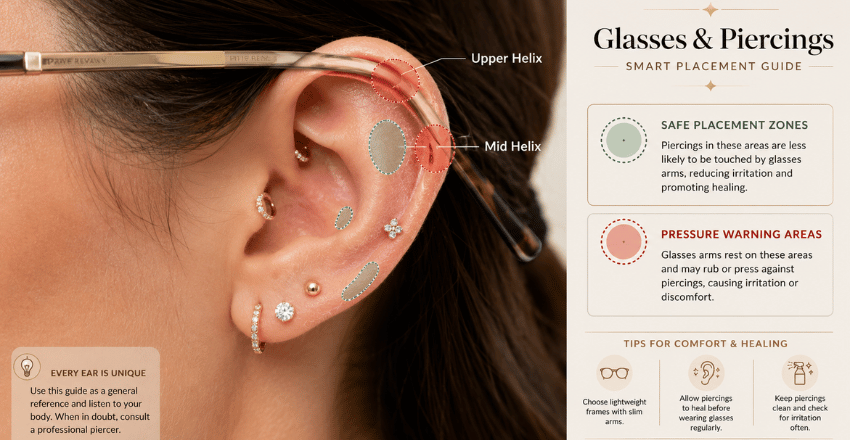
This is where the rim differs from every other ear placement and where most guides go quiet. The arm of a pair of glasses runs along the exact line of the upper and mid zones. Over-ear headphone cups clamp the whole outer edge. Elastic face mask loops hook around the same real estate.
A hair tie pulls across it every time you put your hair up. None of that is a healing problem in theory. In practice, it is the reason a well-placed hole develops a stubborn bump three months in. Bring your actual glasses and your actual headphones to the consultation.
A piercer can shift a placement a few millimeters to sit behind the arm instead of under it, but only if they can see the frames on your face. Switch to on-ear or open-ear headphones during healing. Loop your mask over your head rather than your ears where you can.
Long hair needs its own plan, and low-pull styles help. If you tie yours back daily, look at hairstyles that keep tension off the ear for the first few months.
The mall gun question, answered straight
No. Not on cartilage.
The rim is the placement most often shot with a spring-loaded gun at a mall kiosk, and it is the placement least suited to one. A needle cuts a clean channel and removes a core of tissue. A gun forces a blunt stud through by pressure, which crushes and splinters cartilage rather than parting it. Cartilage has no meaningful blood supply of its own, so that damage is slow to resolve.
The handheld units are also plastic, so they cannot go in an autoclave. Studs supplied with them tend to be too short for the swelling that follows. Find a studio where a licensed piercer uses single-use needles and implant-grade titanium. Ask to see the autoclave spore test log. Any decent shop will show you without being asked twice.
When your ear says no
Not every ear can take every placement. A rim that is fused flat to the side of the head has no lip to pierce through. Narrow ridges cannot hold a stud at a stable angle. Then there is the rolled edge, which curls tightly inward and leaves the jewelry pointing at the sky.
A good piercer will tell you this in thirty seconds and offer an alternative: a flat, a conch, or a shifted spot half an inch along the rim. That is not a sales tactic. Forcing a placement onto tissue that cannot support it is how people end up with migration, pressure, and scarring.
Conclusion
A helix piercing looks simple, but good results start long before the needle does. Placement, spacing, anatomy, jewelry, glasses, headphones, sleeping habits, and future stacking plans all affect how well the piercing heals and how balanced the finished ear looks.
Start with the placement your ear can actually support, leave enough room for future jewelry, and build a stack gradually instead of trying to create the entire look in one sitting. Choose an experienced piercer who uses appropriate needles and high-quality jewelry, follow the recommended downsizing and aftercare schedule, and do not ignore persistent redness, heat, swelling, or pain.
A well-planned helix stack should look intentional today while still leaving you options for the next piercing you may want years from now.
Apart from that, if you want to know about the Cartier Love Bracelet Guide, then please visit our jewelry category.
FAQ
Yes, though most people rate it around a 4 or 5 out of 10. Cartilage is dense, so the pressure lasts a second or two longer than a lobe. The soreness that follows is the part people underestimate.
Rarely on one ear. Two adjacent cartilage holes swell into each other, so most piercers stage them across separate visits.
Start with the side you do not sleep on. If you sleep on both, pick the ear that your glasses arm sits lowest on, and give yourself a travel pillow for the first month.
Plan on six months at minimum, and only after a downsize and a check with your piercer. Hoops move more, and movement is what a fresh channel cannot handle.
Redness, heat, throbbing pain, or discharge is not something to research online. Cartilage infections escalate fast, so see a doctor the same week.
Your next step
Take twenty minutes and look at your own ear in a mirror, both sides, with your glasses on. Note where the rim is deep enough to take a stud and where the frames sit. Then book a consultation, not a piercing, and bring that information with you. A piercer who is willing to talk you out of a placement is the one worth paying.
Nothing here replaces professional advice for your specific ear or your specific skin. Ask a licensed piercer about placement and a doctor about anything that hurts.