


Two dresses can share a pattern and hang nothing alike. One falls in a soft column that moves when you walk. The other stands off the hip like a lampshade. Only the cloth changed, which is why flowy dresses are a fabric outcome rather than a shape you order by name.
Flow comes from four things, in this order: fiber, weave, weight, and cut. Fluid fibers such as rayon, viscose, lyocell, and silk bend under their own load. Light plain or crepe weaves under roughly 150 GSM fall close to the body. A bias cut adds swing. Stiff cloth at any weight stands away instead.
A Two-Column Filter You Can Shop With
Most shopping advice hands you a list of dress names. Names lie. A tiered maxi in rayon challis and a tiered maxi in cotton poplin are the same garment on paper and two different objects on a hanger. So filter on the cloth instead.
| What to look for | What to avoid |
| Rayon, viscose, lyocell, modal, silk, or a poly crepe on the fiber content label | 100% cotton poplin, cotton twill, taffeta, or anything described as crisp |
| Weights around 60 to 150 GSM | Anything over 220 GSM unless you want structure |
| Words like crepe, challis, georgette, chiffon, satin-back, or bias | Words like poplin, canvas, ponte, scuba, or fully interfaced |
| Product photos with a movement shot, not just a flat front view | Ghost-mannequin images only, where the cloth is propped from inside |
| A hem that ripples in soft, uneven folds | A hem that holds one wide circle by itself |
| Gathers, godets, or bias panels releasing the fullness | Stiff pleats pressed flat from a rigid waistband |
Key Takeaways
- Fiber content is the fastest filter on any product page. Read it before you look at the picture.
- Roughly 60 to 150 GSM is the band where cloth falls instead of standing.
- Weight alone will fool you. Cotton poplin is light and stiff at the same time.
- Hem sweep runs about 40 inches on a straight slip and 150 inches on a three-tier prairie maxi.
- A bias cut turns a flat panel into something that spirals and swings.
- Where the volume is released, at the shoulder, bust, waist, or hip, decides who the dress suits.
What Makes Cloth Flow, And What Makes It Balloon?

The fabric choice is what defines how flowy dresses move and fall. Rayon, viscose, modal, lyocell, and silk contain long, smooth fibers that slide past each other, creating a soft drape that allows the fabric to flow naturally. Cotton and linen fibers are shorter and stiffer, giving flowy dresses a lighter structure until the material is woven thin, softened through wear, or mixed with softer fibers.
Weave comes second, and it does more work than shoppers expect. A tight plain weave locks the yarns at right angles and holds a flat plane. A crepe weave uses hard-twisted yarns that pucker slightly, so the surface never sets into a plane and the fabric folds in small, irregular waves. Satin weaves float long yarns over the surface, which is why satin slides and pools rather than creasing.
Weight comes third. Fiber memory is real, and the same logic runs through how pleat types build volume. A fold set into heat-treated polyester survives a wash. The same fold in wool has softened by lunchtime. Cloth that remembers a shape will hold it against you. Cloth that forgets will hang.
Cut is last, and the bias is the big lever. Cut a panel along the straight grain and it behaves like a plank, because neither the warp nor the weft has any give. Turn that same panel 45 degrees and the diagonal can stretch. That give is why a bias panel swings on a body, wraps around a hip instead of tenting over it, and settles back after every step.
It also eats fabric, which is why bias cutting costs more.
The Numbers Nobody Prints On The Tag
GSM means grams per square meter, and it is the key measurement that determines whether fabric creates the soft movement expected from flowy dresses or keeps a more structured shape. Most dress listings rarely mention it, but fabric suppliers do. Once you understand how different fabrics weigh, you can use a product label to predict the drape and movement of a flowy dress before buying.
| Fabric | Typical weight | How it hangs |
| Silk or polyester chiffon | 30 to 50 GSM | Floats and lifts in air, sheer, needs a lining |
| Georgette | 60 to 90 GSM | Soft ripple with more opacity than chiffon |
| Rayon challis, crepe de chine | 90 to 140 GSM | The sweet spot: a column that moves and still skims |
| Cotton poplin | 110 to 140 GSM | Light but crisp, stands away from the hip |
| Mid-weight linen | 150 to 190 GSM | Falls in soft folds once it has been washed a few times |
| Ponte or scuba knit | 280 GSM and up | Holds a shape on its own, does not flow |
Look at rows three and four. Rayon challis and cotton poplin sit within 20 GSM of each other and behave like different materials, because poplin’s rigid fiber and tight plain weave beat its low weight. That single comparison explains most disappointing online orders.
The second number is sweep, the circumference of the hem measured all the way around. A straight slip maxi runs about 40 to 50 inches. An A-line midi lands nearer 60 to 80 inches. A three-tier prairie maxi can reach 110 to 150 inches, and a full-circle skirt goes past 200.
Bridal makers work this out constantly, which is why the shortlist of fabric choices for beach wedding gowns keeps landing on chiffon, georgette, organza and crepe.
Here is the trap. Sweep and weight interact. A 130-inch hem in georgette reads as movement, while a 130-inch hem in poplin reads as a tent, and no amount of belting fixes it.
Where The Volume Is Released?

Every dress with fullness releases that fullness at one point on the torso. Above that point the garment follows you. Below it, the cloth is on its own.
Find your release point and the dress-name problem disappears.
Released At The Shoulder
Many flowy dresses use trapeze, tent, smock, or caftan silhouettes that fall from a yoke at the shoulder line. This creates the longest uninterrupted drape with no shaping or pressure around the waist. The downside is added width through the bust because the upper body measurement controls the starting shape. When made from fluid fabrics, these flowy dresses look effortless and airy; when made from stiff cotton, the silhouette can appear bulky rather than relaxed.”
Released Under The Bust
An empire seam sits an inch or two below the bust and lets everything below it fall as one line. This is the friendliest option if you are short in the leg, because the eye starts the leg line high. Full busts should check the seam sits flat against the ribcage. If it perches on the bust instead, the skirt swings forward and the dress looks like it fits someone else.
Released At The Waist
Fit-and-flare styles, wrap dresses and gathered-waist shirt dresses keep a defined middle and release below it. The catch is placement. Brands cut to a standard back-waist length. So a long-waisted body gets a seam riding above the natural waist, and a short-waisted body gets one sitting low on the hip. Try it on and look at the seam, not the hem.
Released At The Hip
Dropped-waist dresses, bias columns and slips hold the release point lowest. That gives the cleanest vertical line of the four, since nothing interrupts the torso at all. It also shows your hip line honestly, so this group leans hardest on the cloth. A bias slip in silk crepe skims. The same slip in a clingy jersey does not.
Matching Flowy Dresses To Your Proportions

Proportion beats size here. Two people wearing the same size can need opposite release points, and the difference is usually the torso, not the waist measurement.
- Short torso: release at the hip or the waist. An empire seam stacks a second horizontal line into a short space and shortens you further.
- Long torso: shoulder or empire release gives the vertical run something to do. A standard waist seam will sit high on you.
- Petite frames: keep sweep moderate, near 60 to 80 inches, and pick lighter cloth. A 150-inch hem carries a small frame instead of the other way around.
- Broad shoulders: avoid shoulder release, which starts the widest circle at your widest point. Drop it to the waist or hip.
- Full bust: release under the bust or at the waist, and choose a fabric with some surface texture. Flat satin catches light across the chest.
One caution about sizing up. Extra size adds circumference everywhere, including the shoulders and armholes, and a garment that hangs off the shoulder point loses its release line completely. Size for the shoulder and bust, then let the cloth do the rest.
How To Read A Product Page Before You Buy?
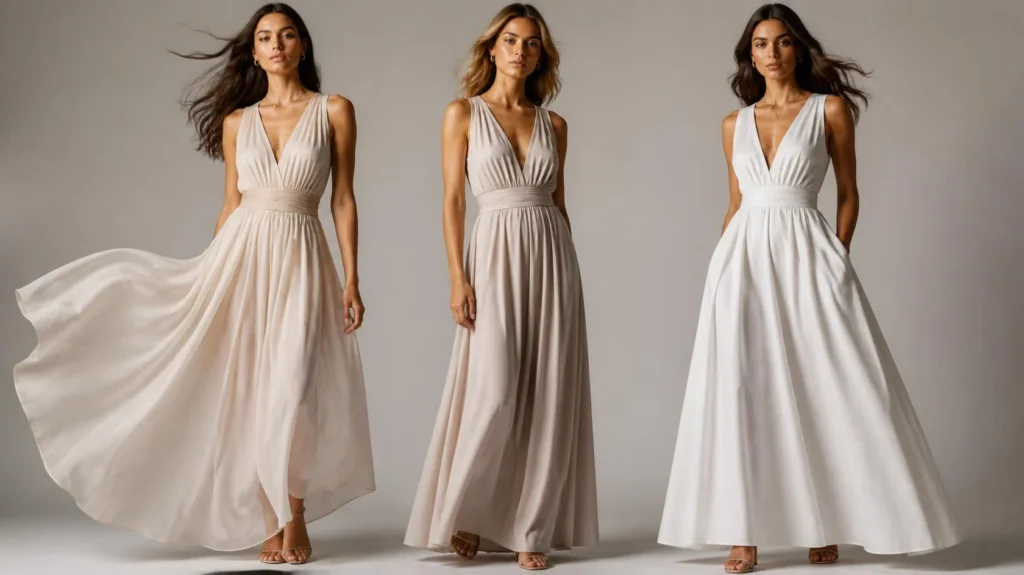
Start with the fiber content, usually buried under a Details tab. Anything listing viscose, rayon, lyocell, modal, cupro, silk, or polyester crepe is a candidate. Anything listing cotton on its own is a gamble unless the copy says washed, sandwashed, or voile, which all signal a softened hand.
Then read the photography like evidence. A movement shot with the model mid-stride tells you what the cloth does under load, and a single flat front view tells you nothing at all. Ghost-mannequin images are the least useful of the lot, because the garment is propped from inside and holds a shape it will never hold on a person.
Model height matters too. A hem photographed on a 5 foot 10 model lands somewhere else on you.
Price gives you a weak but real signal. Mass-market pieces in this category mostly land between $40 and $90. At that level the fabric is usually a light polyester or a viscose blend, which hangs well and creases little. Contemporary labels run roughly $120 to $250, where you start seeing real bias construction, cupro linings and silk blends. Above that you are paying for the cutting, not the fiber.
Where To Start?
Pick your release point first, then shop by fiber content and stay inside the 60 to 150 GSM band. That two-step filter removes most of the guesswork before you open a single product photo. For more on how cloth, cut, and care decide what a garment does on a body, browse our fashion and garment care guides.
Frequently Asked Questions
Rayon challis, crepe de chine, georgette and cupro give the most reliable balance of movement and opacity for everyday wear. Chiffon flows more but needs a lining. If you want washability over drama, look for a viscose or polyester crepe around 100 to 130 GSM.
Not if the shoulder fits and the fabric has weight. Pick a waist or hip release, keep sweep under about 80 inches, and choose a matte crepe over a shiny satin. A defined shoulder seam does more for a polished look than any belt.
Usually not. These shapes already carry ease through the body, so sizing up mostly adds width at the shoulder and armhole, where you least want it. Size to your shoulder and bust, then check the hip measurement against the flat spec.
Static is the cause, not the cut. Add a slip in a natural fiber, skip the dryer sheet, and dampen the lining lightly with a fabric spray before wearing. A slightly heavier cloth, nearer 130 GSM than 60, also clings less because gravity wins over static.
Yes, once it is broken in. New linen at 150 to 190 GSM feels board-like and holds creases. The fiber softens with every wash, then starts falling in loose folds after a month. Look for linen blended with viscose if you want that hand from day one.