

Three things shifted about fall dressing this year, and every one of them is a layering decision. Tights turned into a styled choice rather than a warmth tax, with polka dots, argyle, and flat cobalt showing up on the runways. Capes and ponchos took over the outer-layer slot a quilted jacket used to hold. Decorative belts came back to hold it all down at the hip. Grammy Dresses is a useful companion read here.
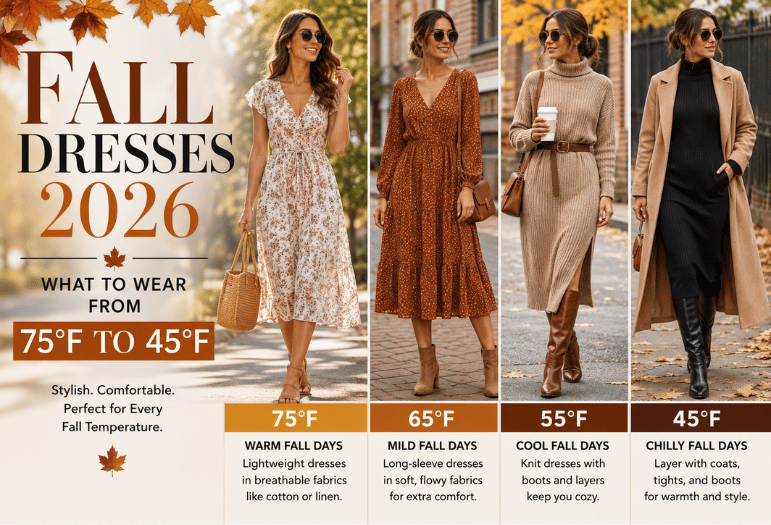
None of that helps at 4 p.m. on a Tuesday in October, when it hit 76 degrees at lunch, and it is 52 now. That is the actual problem with fall dresses, and the shopping pages ranking for the term never touch it. So what follows is a temperature map: five temperature bands, real Fahrenheit ranges, from 75 degrees down to 45 degrees and below.
The short answer: pick the dress by fabric weight, then set the legwear by temperature and the outer layer by wind. Above 70 degrees, go bare-legged with no jacket. From 55 to 65 degrees, wear 30- to 60-denier tights under a trench. Below 45, switch to opaque tights, brushed wool, and a tall boot.
The fall 2026 temperature map
Read the row that matches the coldest hour you will be outside, not the warmest. Warmth you can shed. Cold you cannot.
| Temperature | Dress fabric | Legwear | Outer layer | Shoe |
| 75°F and up | Cotton poplin, voile, linen blend, washed silk | Bare | None, or a shirt knotted at the waist | Flat sandal, mule, low sneaker |
| 65 to 75°F | Rayon challis, crepe, light jersey, chambray | Bare, or 10 to 20 denier sheer | Cropped cardigan, denim jacket, unlined blazer | Loafer, ballet flat, low ankle boot |
| 55 to 65°F | Ponte, midweight rib knit, cotton twill, fine corduroy | 30 to 60 denier semi-opaque | Trench, shacket, structured blazer, cape | Ankle boot, loafer with a slouch sock |
| 45 to 55°F | Wool blend, flannel, velvet, heavy rib | 70 to 100 denier opaque | Wool coat, quilted liner, belted mac | Knee-high boot, lug-sole ankle boot |
| Under 45°F | Brushed wool, boucle, sweater knit | 120 denier and up, or fleece-lined | Long coat over one thin knit | Tall boot, shearling-lined boot |
TL;DR
- Fabric weight sets the floor. A poplin dress will not survive 50 degrees no matter what you put over it.
- Denier is the dial you turn. 30 to 60 covers most of October in most of the country.
- Hem length and boot shaft height have to be decided together, or you get a cold stripe of bare shin.
- Layer thin next to the skin and structured on the outside. Reverse that and the shoulders bunch.
- One good midi can cover a 30 degree swing in a single day if you plan the legwear.
75 degrees and up: it is still a summer dress

Nothing about a 78 degree afternoon in September requires a seasonal fabric. Not yet. Buying a wool dress because the calendar flipped is how people end up sweating through the first six weeks of the season.
What changes is the color and the shoe, not the cloth. A poplin midi in oxblood or espresso reads as fall at noon and photographs as fall. Fabrics that move air rather than trap it are the same ones we recommended in our guide to gown fabrics chosen for heat. That logic carries straight over. Hold the cloth up to a window, and if you can read a headline through it, you have a warm-day fabric.
Keep a cardigan in the car and stop there.
65 to 55 degrees: the band where layering starts to matter
This is the widest band of the season and the one that trips people up. Bare legs are fine at 64 in the sun and miserable at 56 in the shade. Carry the tights in a bag rather than committing at breakfast.
Outer layers that work over a dress without swallowing it:
- Trench. The belt gives you a waist back, which a dress loses under any coat.
- Cape or poncho. The 2026 answer, and the only outer layer with no armhole to fight a puff sleeve.
- Shacket. Best over a slim knit dress, worst over anything gathered.
- Cardigan, worn open. Cheapest fix, and it fails first in wind.
Wind is the variable nobody prices in. Plan for it. A 58 degree day with a 15 mph wind feels like a 48 degree day, and a cardigan does nothing against it while a trench does everything.
Tights denier, and what each number buys you
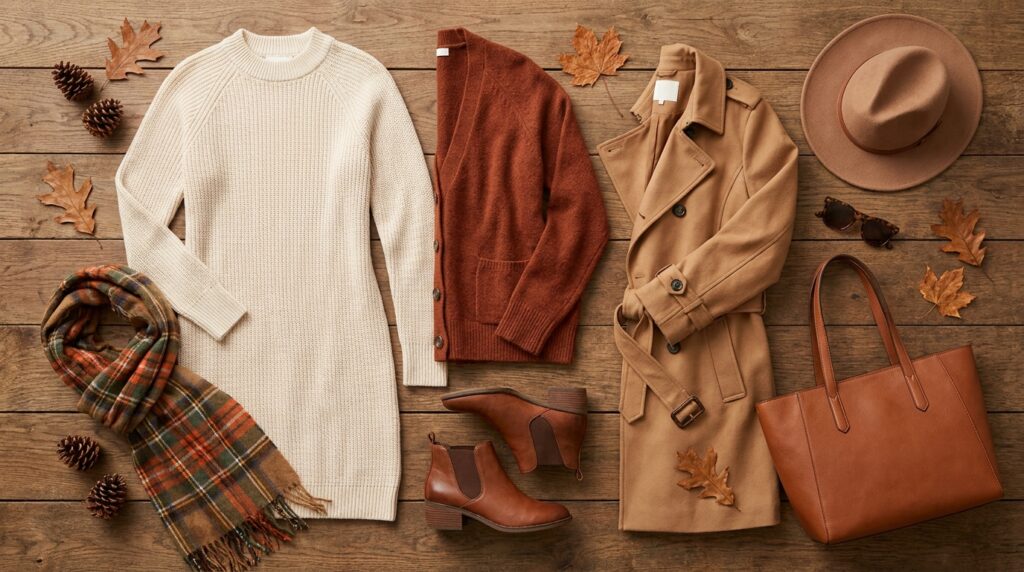
Denier measures the thickness of the yarn, so the number on the package is a reliable proxy for both warmth and opacity across every brand you are likely to buy. Hosiery brands use the same scale, which makes this the one spec you can shop on with confidence.
| Denier | Look | Warmth | Suits |
| 8 to 15 | Barely visible | Almost none | Polish, not temperature |
| 20 to 30 | Sheer, skin still reads | Takes the edge off | 65 to 70°F |
| 40 to 60 | Semi-opaque | Real, not much | 55 to 65°F, the workhorse |
| 70 to 100 | Solid opaque | Noticeable | 45 to 55°F |
| 120 to 200+ | Matte, often fleece-lined | Serious | Under 45°F |
Expect roughly $12 to $25 a pair for something in the 40 to 60 range that survives a season. Opaque tights with a real gusset and a flat waistband run $30 to $60. The patterned pairs the runways pushed this year- polka dot, argyle, ribbed cobalt- mostly land between 40 and 80 denier, so they double as your 55-degree option.
Hems, boot shafts, and the bare shin gap
Here is the geometry that no styling roundup covers. Between the bottom of your hem and the top of your boot shaft sits a stretch of leg. How that stretch reads decides whether the outfit looks deliberate or unfinished. Close the gap, or make it obviously intentional. Never split the difference, because a hem that lands within an inch of the boot top reads like a mistake to every eye in the room.
Here are the measurements that matter, on most women between 5’4″ and 5’8″.
- Mini, 32 to 35 inches from the shoulder. Works with everything. A tall boot leaves 4 to 6 inches of thigh, which is the point.
- Midi, 43 to 47 inches from the shoulder. The hem lands mid-calf, so an ankle boot leaves a 3 to 5 inch bare stripe. Opaque tights close it. Bare legs do not.
- Knee-high boots with a midi. Only if the hem clears the boot top by 2 inches or more, or overlaps it entirely. Landing exactly on the shaft cuts the leg in half.
- Maxi. The hem covers the shaft, so shaft height stops mattering, and traction takes over.
Suede is doing the heavy lifting in fall 2026 boots, in chocolate and in a deep plum, and it stains the first time you underestimate a puddle. Our walkthrough on cleaning suede boots without wrecking the nap is worth ten minutes before the first wet week.
Layering order that keeps bulk out of the shoulder
Order matters. Bulk is not about how many layers you own. It is about where the thickness collects, and it collects in two places: the armhole and the shoulder seam. Get the order right, and four layers read slimmer than two badly stacked ones.
- Thinnest and smoothest next to the skin. A silk or modal slip, never a cotton tee under a fitted dress.
- A fine-gauge long sleeve if you need one. Merino at 150 to 190 gsm disappears under a sleeve; a waffle henley does not.
- The dress.
- Knitwear only if it is going over the head, not through the armhole. A vest or a tabard adds warmth with zero sleeve bulk.
- The structured piece last, sized to clear everything under it.
Volume at the hip is its own problem, and it is why a heavily gathered dress fights a coat that a column dress does not. Same mechanics we broke down in how pleats add width at the hip. Every fold you add at the waist has to fit inside whatever you button over it.
Belt the outer layer, not the dress. That is the 2026 shift, and it solves the waist problem without compressing anything underneath.
One dress, three temperatures
Take a black rayon challis midi shirtdress, long sleeve, hem at mid-calf. Here is how you restyle a single dress across three temperatures in one day, which is a normal October Thursday in most of the country.
78 degrees at noon
Sleeves rolled to the elbow, top two buttons open, bare legs, flat leather sandals. A thin belt at the natural waist. Nothing else. The challis moves, so it does not stick.
61 degrees at 5 p.m.
Sleeves down, 40 denier tights, brown suede ankle boots, and the bare shin stripe closed by the tights. Add a cropped cardigan or throw a trench over the top and belt it over the dress belt. Total time to change: two minutes, and everything you added fits in a tote.
47 degrees after dark
Swap to 80 denier opaque tights and knee-high boots that clear the hem. A fine merino long sleeve goes under the dress, not over it, and a wool coat goes on last. The shirtdress becomes the middle layer, which is what a midi in a drapey fabric is built to do. That is the trick.
What to look for in fall dresses this year

Sleeves are back on almost everything, which quietly solves half the layering problem before you start. Basque and drop waists are the strongest silhouette on the fall 2026 runways. They push the hem 2 to 3 inches lower than a natural-waist version of the same dress. Check your boot math before you buy.
Two things worth paying for, and one worth skipping.
- A real lining. It stops tights from grabbing the hem and riding up, which is the single most common reason a good outfit fails by 3 p.m.
- Set-in sleeves cut with room. A tight armhole cannot take a base layer, and that ends the dress in November.
- Sheer organza layering. Gorgeous on a runway, and it needs a slip, a base layer, and a coat to be wearable at 50 degrees.
Expect $50 to $90 at the mass-market end for a lined midi in a midweight knit, and $150 to $280 for contemporary labels using real wool blends. Browse the rest of the fashion archive if you want the silhouette and care detail behind any of this.
Where to start
Pull the three dresses you already wear most, then check each one against the map. What fabric is it? Which denier does it need? Which boot closes the gap at its hem? Two of them will cover you into November with nothing new bought. The third tells you exactly what to shop for.
Frequently asked questions
Yes, through most of September in most of the United States. Change the shoes to loafers or low boots, add a knit over the shoulders, and swap sandals out once evening lows sit under 60 degrees. The dress itself is fine.
Around 60 degrees for most people, and around 65 if there is wind or you will be standing still. Wear the tights. Below 55, bare legs stop reading as a choice and start reading as an oversight.
70 to 100 denier. That is true opaque, warm enough to walk several blocks in, and thin enough to fit inside a boot shaft without bunching at the ankle.
They do, with opaque tights in a color close to the boot. Bare legs plus an ankle boot plus a mid-calf hem leaves a short pale gap that shortens the whole leg line.
A trench, a cape, or an unlined blazer one size up. All three clear a sleeve without pulling at the armhole. Puffers are the worst offender because the loft sits exactly where a gathered skirt already has volume.
Not necessarily, and a sleeveless one is often the smarter buy. It takes a base layer cleanly, which a fitted long sleeve cannot, so it works across a wider band of the season.