
Where the frill sits determines how the garment fits your body, and no other detail comes close. A ruffle dress tiered from waist to hem reads far fuller than the same shape carrying one narrow trim at the collar. Fabric and gather ratio, then settle whether that fullness holds or wilts by lunchtime. Rank the placements first, and every other choice gets easier.
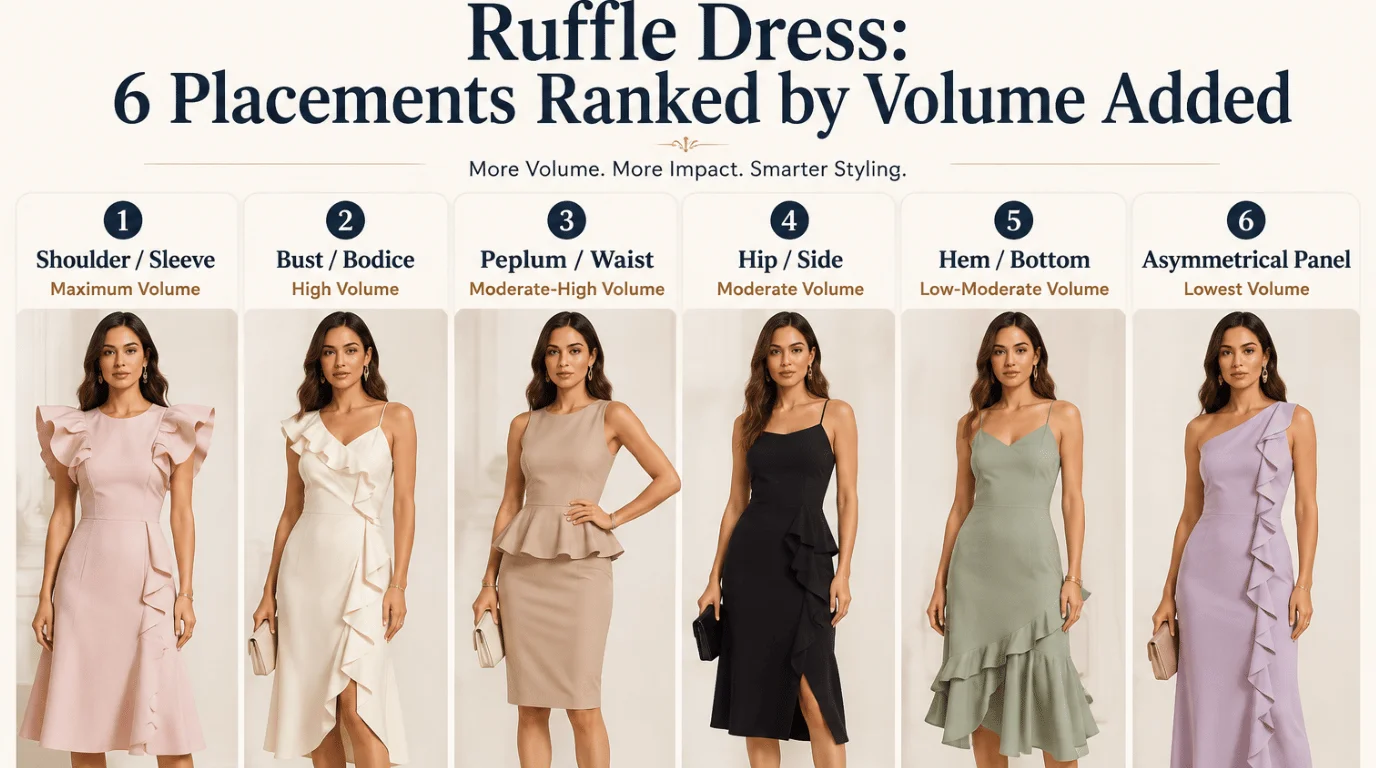
The six placements, ranked by volume added
This order runs from most volume to least. It follows how much extra cloth each placement carries and how far that cloth sits from the body.
- Full tiered skirt. Three or more stacked tiers, each gathered onto the one above it. Volume compounds downward, so the hem can finish at two or three times your hip measurement.
- Deep hem flounce. One band of roughly 8 to 14 inches, added at the bottom edge. It widens the sweep without touching the waist, which keeps the top half quiet.
- Waist or peplum frill. Short flare stitched at the natural waist, flicking out over the hip. Width lands exactly where most people already carry it.
- Bust cascade. A frill running diagonally across the chest, often asymmetric. It builds the upper body and pulls attention to the center front.
- Shoulder frill. A flounce over the shoulder line or an off-shoulder band. Width goes to the very top of your frame, which is why the rest of you look narrower.
- Collar or cuff trim. Gathered edge under 2 inches deep. Almost no volume, all detail.
Placement, volume, and who it suits
| Placement | Volume added | Who it flatters |
| Full tiered skirt | Highest. Hem up to 3x the hip | Straight, slim frames that want curve built in |
| Deep hem flounce | High, but all of it below the knee | Tall frames, and anyone balancing broad shoulders |
| Waist or peplum frill | Medium, concentrated on the hip | Narrow hips and a defined waist |
| Bust cascade | Medium, upper body only | Smaller bust, or fuller hips that want balance |
| Shoulder frill | Low to medium, top of the frame | Pear shapes wanting a wider shoulder line |
| Collar or cuff trim | Minimal | Anyone, including anyone avoiding added width |
Key takeaways
- Volume goes where the frill goes. Pick the half of your frame you want widened, then pick the placement.
- Gather ratio, not placement, decides how full a single frill looks.
- Depth matters as much as position. A shallow frill can out-fluff a deep one.
- Chiffon and organza hold a frill. Jersey and washed linen do not.
- Expect $25 at the bottom of the market and past $1,000 at the top.
What a ruffle dress actually is
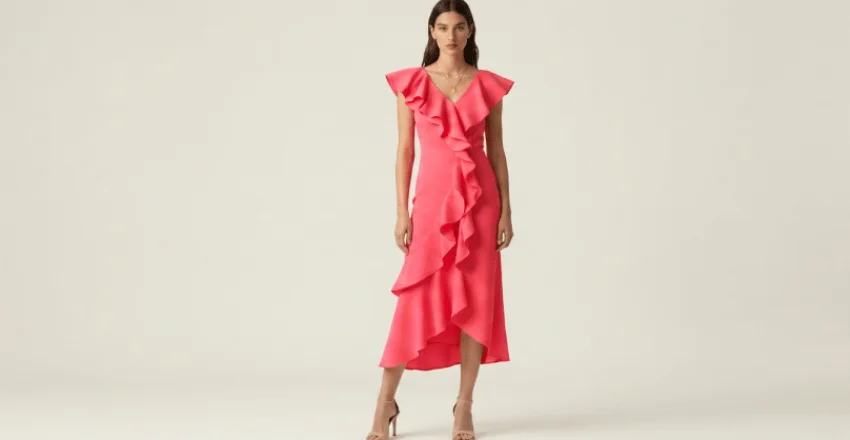
A ruffle dress is any dress carrying a strip of cloth fixed along one edge and left loose along the other. The loose edge is the part that moves. Tiers, flounces, peplums, and cascades are all variations on where that strip goes and how much slack it holds.
Gather ratio: the number that sets fullness
Gathering means sewing a longer strip onto a shorter seam. The multiplier between the two lengths is the gather ratio, and it does more to the finished look than the placement does.
- 1.5x. Soft ripple. Reads as a flutter rather than a frill.
- 2x. The workhorse ratio for most ready-to-wear.
- 3x. Maximum fullness. Chiffon and voile take it happily.
Push a heavy cloth to 3x, and the seam allowance fills with so much fabric that the join sits proud of the body. Folding solves what gathering cannot: how pleated skirts build volume without the bunching at the waist. Knife-pleated frills still eat roughly three times their finished length, but the folds stack flat instead of bulking.
Gathered frill versus circular flounce
These two look alike from ten feet away and behave nothing alike. The gathered version is a straight strip crushed onto a shorter seam, so the cloth bunches at the join and flares out from there. Cut a circular flounce, and you get a ring instead. Its inner edge matches the seam exactly, while the outer edge runs longer because the circle is bigger. That surplus length has nowhere to go but into waves.
On the body, that difference is obvious. A circular flounce stays flat at the seam and adds nothing at your waist or shoulder, so every bit of volume lands at the outer edge. The gathered kind bulks up right where it’s stitched. Shrink the inner circle and the wave gets deeper, which is why a tight armhole flounce ripples harder than a wide one at the hem.
Depth changes the read as much as placement
Ruffle depth is the distance from the seam to the loose edge, and it works independently of everything else. A 2-inch frill gathered at 3x looks denser than a 6-inch frill gathered the same amount, because the surplus has less length to spread across. Deep frills drape and swing. Shallow ones stand up and fluff.
Fabrics that hold a ruffle, and the ones that collapse it
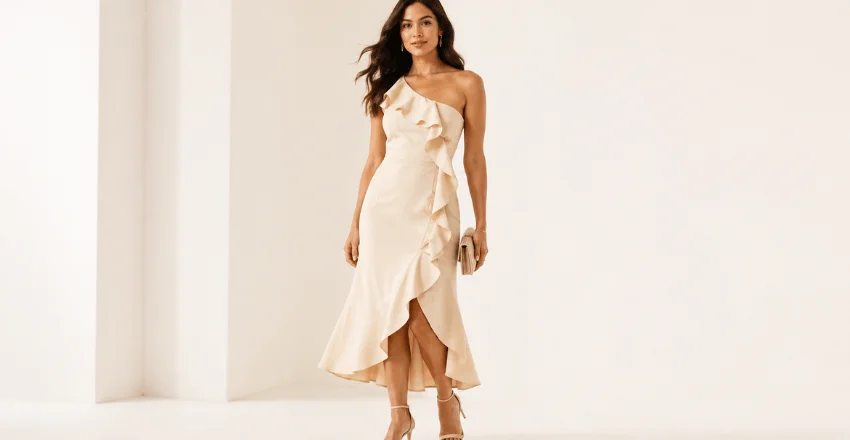
Fiber and weight decide whether the shape survives the first wear. Here’s how the usual suspects behave.
| Fabric | What it does to a frill | Best placement |
| Chiffon, georgette | Takes a 3x gather, floats, holds no crease | Tiers and deep hem flounces |
| Organza | Stands away from the body on its own stiffness | Shoulder frills, single sculptural bands |
| Crisp cotton poplin | Sharp edge at 2x, bulky and stiff at 3x | Hem bands, collars, cuffs |
| Washed linen | Goes soft after two washes and collapses at the seam | Shallow tiers only |
| Jersey and rib knit | No edge memory, hangs limp within an hour | Bias-cut cascades, nothing gathered |
| Satin, crepe de chine | Heavy drape that swings well but flattens | One deep hem flounce |
This is why warm-weather formalwear keeps circling the same three cloths. Chiffon, georgette, and organza carry a frill in heat without wrinkling into a mess. They matter as much when you’re choosing a beach wedding gown that has to survive sand and wind.
What do frilled dresses cost in the US?
Prices track construction more honestly than they track branding. Count the tiers and check the gauge before you judge a price tag.
- Mass market (Old Navy, Target, H&M): about $25 to $50. Usually polyester, two tiers at most, gathered near 1.5x.
- Contemporary mall brands (Abercrombie, Madewell, Anthropologie): roughly $80 to $160. Real tiers, cleaner hems, cotton or a cotton blend.
- Designer contemporary (Reformation, Free People, and the labels stocked on Revolve): $180 to $400 for most of what we saw.
- Occasion and runway labels: $600 upward, and the ruffled edits we checked ran past $1,000 for a single gown.
The jump from the first price band to the second buys fabric weight and gather ratio. The jump from the third to the fourth mostly buys hand finishing on the frill edges.
Keeping tiers from going flat
Frills die from pressure, not from wear. Fold a tiered skirt under a stack of jeans, and it loses its gathers for good in some fabrics. No amount of steam brings them back.
- Hang it. Use a wide hanger so the shoulder line keeps its shape.
- Steam rather than press. Hold the head about 4 inches off and let each tier move.
- If you must iron, work the flat panels and go around every frill edge, never over it.
- Give it room on the rail. Compressed tiers keep the crease they were squashed into.
Structured garments all want this kind of storage, and you’ll find more fashion and garment care guides covering pleats, nap fabrics, and knits on the site.
Where to wear it: styling by occasion?

Placement decides the occasion more reliably than length or color does.
- Wedding guest. Deep hem flounce in chiffon or georgette. Volume stays below the knee, which photographs well and leaves your shoulders free for a wrap.
- Office collar or cuff trim only, in poplin. Add a straight blazer and the frill becomes a detail instead of a statement.
- Vacation and beach. Two shallow tiers in washed cotton or a cotton blend. Skip linen frills here, since they lose their shape by the second day.
- Evening and party. Bust cascade or one-shoulder flounce in satin. Keep jewelry minimal, because the frill already occupies the neckline.
- Everyday. Shoulder frill on a plain shift. It’s the smallest amount of volume that still changes the outline of the garment.
Start with the half of your frame you want widened, then take the matching placement off the ranking. If you want one safe pick that suits nearly everyone, take the deep hem flounce: it adds movement and sweep without putting a single inch on your waist or shoulders.
FAQ
Yes, with one rule: keep the tier count low and the tiers deep. Four shallow bands chop a short frame into segments. Two deep ones read as a single long line.
Nothing technical. American patterns say ruffle, British ones say frill, and both mean a gathered strip. A flounce is genuinely different because it’s cut curved instead of gathered.
Only in the place they sit. That’s the whole point of the ranking above. A shoulder flounce widens your shoulders and makes your waist read smaller by comparison.
Collar trim or a shallow cuff works in almost any office dress code. Tiered skirts and bust cascades usually read too soft for a formal one, though a blazer over a cascade neutralizes them.
Past four, the skirt starts wearing you out. Three is the sweet spot for most heights, and two suits anyone under 5’4”.