

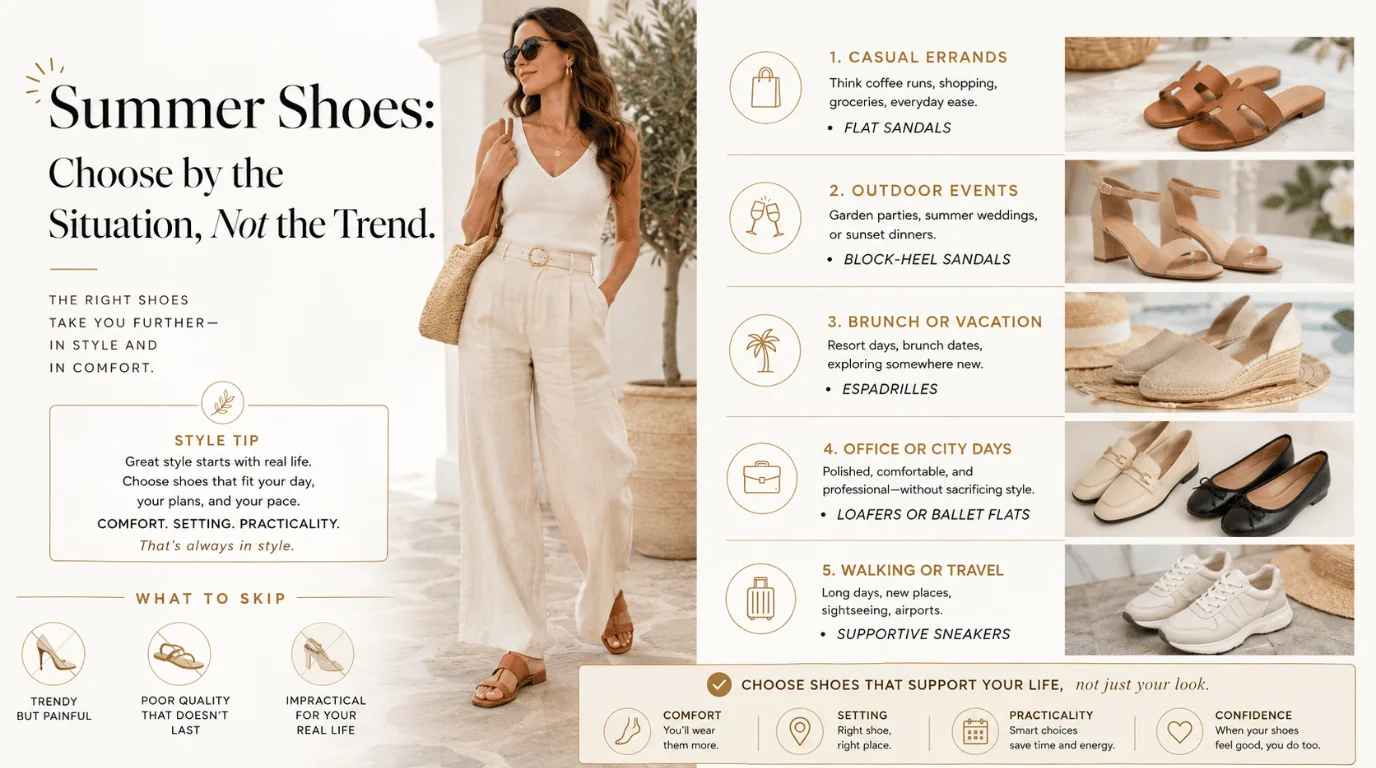
Most footwear roundups sort by style. Real life sorts by situation. You are not shopping for a wedge; you are shopping for six hours on hot sidewalks, a lawn ceremony, or a red-eye flight. Those are three different problems.
Pick summer shoes by the situation you will actually be in. City heat needs breathable uppers and real cushioning. Beach and pool need rubber or EVA that shrugs off salt and chlorine. Grass needs a wide, low heel. Travel days need slip-on ease and room for swelling.
Key takeaways
- Match the shoe to the situation first, then to the outfit.
- Rubber and EVA rinse clean after salt water or chlorine. Leather does not.
- A heel base as wide as a quarter stays on top of grass instead of sinking in.
- Budget $24 for basic flip-flops and $105 to $205 for a jute wedge espadrille.
- Foot powder, a liner sock, and a strip of moleskin fix most warm-weather blisters.
City Walking in Heat
Sidewalks run hotter than the air above them. On a 90°F afternoon, a stretch of city concrete can read far above that number, and your soles feel every degree of it through a thin sole. Foam, cork, or rubber puts a buffer between you and the ground. Paper-thin leather soles do not.
Breathability matters more than weight here. Mesh and knit uppers move air across the skin. Unlined leather breathes reasonably well, but a fully lined leather sandal traps sweat against your foot, and trapped moisture is what starts a blister on mile three.
What to look for on a long day of walking miles:
- A contoured footbed rather than a flat plank
- An upper you can loosen once your feet swell after lunch
- Straps that cross the widest part of the foot, never a toe knuckle
- A rubber outsole with real tread for wet marble and subway stairs
Then rotate. Wearing the same pair two days in a row means putting a damp footbed back on a warm foot, which is how odor and fungus get started. For style-led picks across the whole calendar, browse our wider shoe coverage.
Beach, Pool, and Anywhere Wet
Salt and chlorine damage footwear in different ways. Salt water dries into crystals that stiffen leather fibers and leave a pale tidemark you cannot brush out. Chlorine bleaches color and slowly eats the adhesive holding a sole to an upper, which is why a poolside pair starts gaping at the toe by August.
Molded rubber and EVA shrug off both. Neither absorbs water, both rinse clean under a tap, and both dry in about an hour. Leather is the opposite story. A vegetable-tanned leather sandal copes with a rain shower or a splash, but a full swim warps the footbed, and the shape never quite comes back.
Grip is the other half of it. Rubber holds on wet tile and pool coping. EVA turns skittish the moment the surface is slick, so save the foam slide for the dry side of the deck.
Outdoor Events on Grass
A stiletto on a lawn behaves like a lawn aerator. Your whole body weight lands on maybe a quarter inch of heel tip, and soft ground swallows it at the first step off the path.
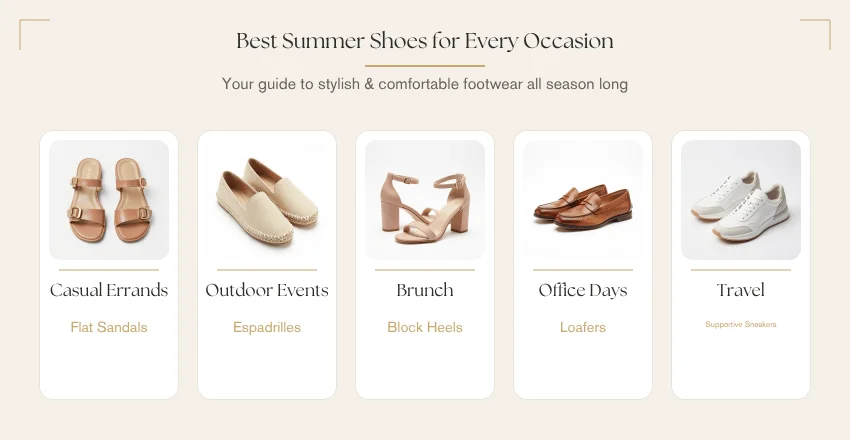
Surface area is the fix. Block heels, wedges, and flatforms spread that load across a wider footprint and stay on top of the turf. A jute espadrille wedge remains the classic garden party answer, and it reads dressier than a flat sandal without costing you the evening.
- Heel base at least the width of a quarter
- Wedge or flatform when the ground is soft or uneven
- Clear plastic heel caps if you refuse to give up a slim heel
Hem length matters as much as heel width, since grass and gravel chew through anything that skims the floor. Our notes on midi and maxi dresses cover the lengths that survive a long time.
Travel Days
Feet swell on planes. Cabin pressure plus hours of sitting push fluid down into your ankles, so the pair that fit at the gate can pinch by landing. Adjustable beats are fitted every time. We cover this in more depth in Cute Shoes.
- Buckles or elastic, so you can let the fit out mid-flight
- Slip-on ease for the security line
- A thin liner sock, because bare feet on an airport floor is a bad plan
- Half a size up if your feet already run swollen by evening
Knit sneakers handle a fourteen-hour door-to-door day better than any sandal will. Style it with the rest of your warm-weather seasonal outfits, and it still looks deliberate rather than defeated.
The Office in Summer

Workplace rules loosened far more slowly than the weather changed. Plenty of business-casual offices still read a bare toe as informal, and finance, law, and client-facing roles hold the line the hardest. The usual compromise is a closed toe with an open back.
Mules, covered-toe slingbacks, and woven raffia loafers all pass as professional while letting air move around the foot. The peep toe in a mid-heel is the next step out, and it works better in a neutral color than a bright one. If your office genuinely allows an open toe, keep everything else conservative and keep the pedicure tidy. Save the foam slide for the pool.
Summer Shoes Compared: Price, Grip, and Wear Time
Prices below are current US retail for women’s styles, checked in July 2026. Wear time means how long the average person lasts before the pair starts complaining.
| Shoe type | Situation: It wins | Material to look for | Price (USD) | Comfortable wear time |
| Flat flip-flops | Pool deck, beach shower | Molded rubber | $24 to $40 | 1 to 2 hours |
| Sport sandals | Rough beaches, boardwalks, rain | Quick-dry webbing, rubber outsole | $45 to $80 | All day |
| Cork footbed slides | Errands, campus, travel | Cork or EVA footbed | $50 to $145 | 4 to 6 hours |
| Leather flat sandals | Dinner, city strolling | Vegetable-tanned leather | $70 to $160 | 3 to 5 hours |
| Mesh or knit sneakers | City walking, flights | Knit upper, foam midsole | $70 to $150 | All day |
| Espadrille wedges | Garden parties, grass | Jute wedge, canvas upper | $105 to $205 | 5 to 6 hours |
| Block heel sandals | Outdoor weddings, evenings | Leather, wide heel base | $80 to $180 | 4 to 5 hours |
| Raffia mules or loafers | The office | Woven raffia or unlined leather | $90 to $200 | All day |
Two anchors worth memorizing. Havaianas Top flip-flops sit at $24, while the Birkenstock Arizona runs $49.95 in EVA against $139.95 in oiled leather at REI. Material drives most of that gap, not the logo.
The Problems Nobody Writes About
Sweaty feet inside leather
Leather soaks up sweat, and then it stretches. A sandal that fit on Monday gapes by Friday, and your foot starts roaming inside the straps. Dust the footbed with a cornstarch-based foot powder before you put the pair on, and give it a full day to dry out between wears.
Blisters from new straps
Stiff new straps saw at the skin. Break in a pair at home across two or three short wears before you take them to an event, not on the day itself. Anti-chafing balm along the strap line helps. Moleskin over the hot spot helps more, and it works only if you apply it before the skin turns red.
Feet sliding forward
Sliding is a friction problem far more often than a sizing problem. Sweat turns a smooth footbed into a ramp. Suede-topped footbeds grip better than glossy leather or plastic, and a gel forefoot pad plus a snugger ankle strap stops the forward creep. If your toes hang over the front edge, though, the pair really is too small.
Your next step
Go through your closet tonight and sort what you own by situation instead of by color. Most people find three pairs fighting over the same job and one situation with nothing covering it at all. Shop for that gap only, and try the new pair on after 6 pm.
Apart from that, if you want to know about designer sandals in 2026, then please visit our shoes category.
FAQ
Three covers most people. One wet-safe pair, one all-day walking pair, one dressier pair. Add a closed-toe office shoe if your job asks for it.
Yes, and it solves real problems. Thin liner socks kill friction and absorb sweat before it reaches the footbed. Keep the sock plain and low, and keep the sandal chunky rather than delicate.
Wipe the footbed with a cloth dipped in diluted white vinegar, then let it air dry out of direct sun. Baking soda left overnight handles whatever survives. Cork and suede hold odor the longest, so start there.
For a pool deck, no. For a day on your feet, yes. Your toes have to grip to hold them on, which changes your stride and tires the arch inside a mile or two.
Buy for your afternoon feet. Try shoes on late in the day, when swelling peaks and heat has done its work. Half a size up beats a pair you can only stand until lunch.