
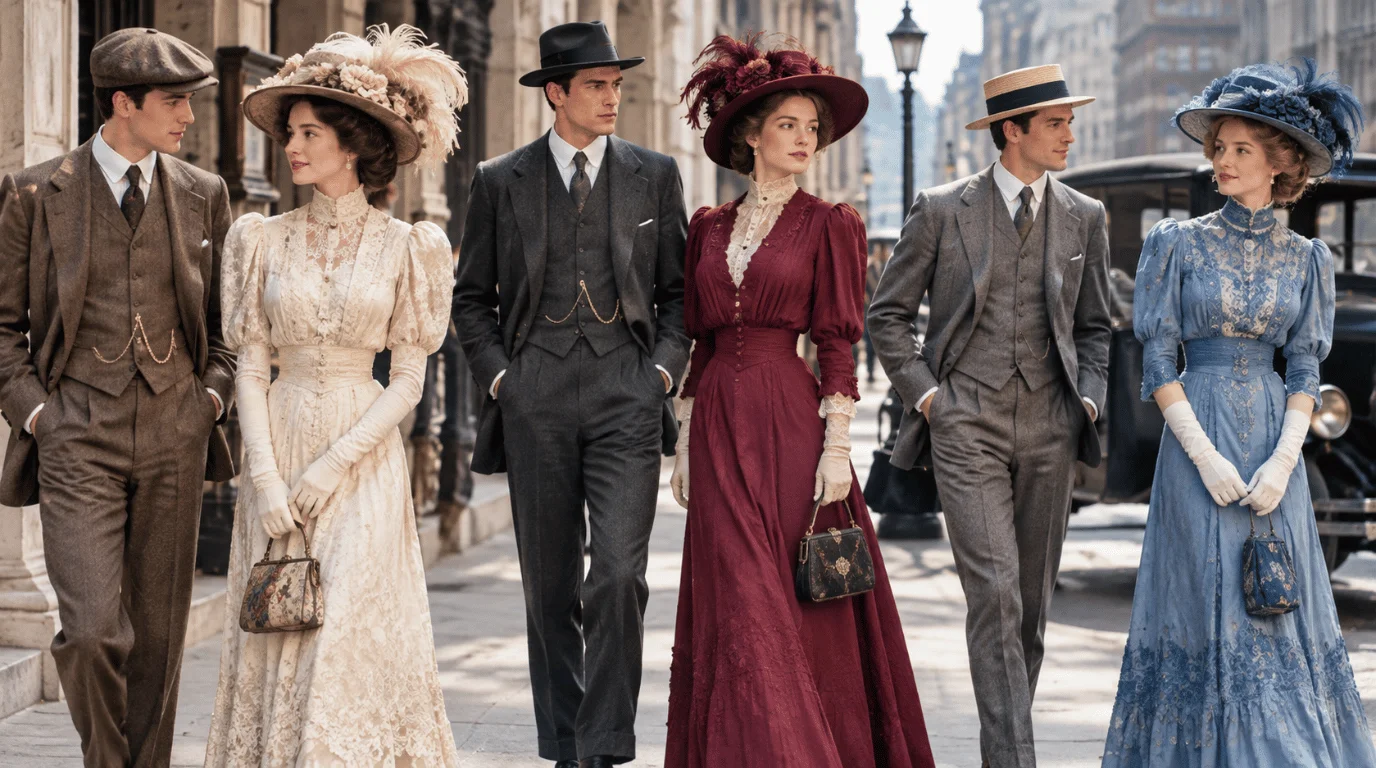
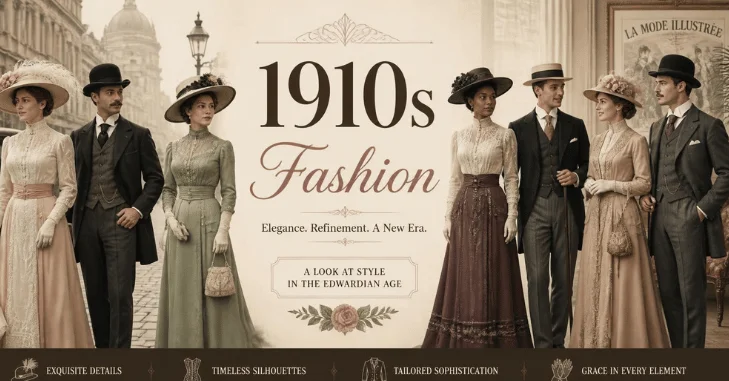
1910s fashion moved from Edwardian elegance toward the simpler shapes that would define modern dress. Women wore long skirts, tailored suits, elaborate hats, and increasingly relaxed dresses. Men relied on structured suits, formal hats, sturdy shoes, and practical outerwear throughout much of the decade.
Direct answer: Fashion from 1910 to 1919 changed dramatically as social life, work, and World War I reshaped clothing. Early styles favored narrow skirts and decorative details. By the late 1910s, women’s clothes became shorter and more practical, while men’s tailoring remained structured but increasingly functional.
| 1910s style element | Women | Men |
|---|---|---|
| Silhouette | Long, narrow early; fuller and shorter later | Structured and tailored |
| Everyday clothing | Blouses, skirts, day dresses, suits | Three-piece suits and separates |
| Formal clothing | Draped evening gowns | Dark suits, dinner clothes |
| Outerwear | Long coats, capes, tailored jackets | Overcoats and trench-style coats |
| Popular accessories | Large hats, gloves, parasols, boots | Hats, ties, watches, walking sticks |
| Major influence | Changing roles and World War I | Tailoring and military clothing |
What Defined 1910s Fashion?
The decade began with clothing that still carried clear Edwardian influences. Women’s silhouettes remained long and elegant, although the exaggerated S-shaped figure of the previous decade was fading. The Fashion Institute of Technology describes the early period as moving toward a softer, more natural silhouette.
That transition makes the decade especially important in fashion history. Clothing in 1910 can look noticeably different from clothing made only eight years later. The First World War accelerated practical changes, although several new silhouettes had appeared before the conflict began.
Women’s 1910s Fashion Changed Quickly.
Women’s clothing during the early years often created a long vertical line. Dresses could feature high or open necklines, narrow skirts, draping, decorative trims, and layered fabrics. Evening clothes allowed richer materials and more elaborate construction than ordinary daytime garments.
Parisian designers helped move fashionable clothing away from heavily structured nineteenth-century forms. Paul Poiret became especially influential through draped garments and straighter construction. The Metropolitan Museum of Art notes that his work used flowing forms instead of tailoring garments tightly around a corseted figure.
Not every American woman dressed like a Paris couture client, of course. Ready-made clothing, department stores, sewing patterns, occupation, income, and location shaped what women could wear. Looking at everyday garments alongside couture gives a more realistic picture of the period.
The Shirtwaist Became an Everyday Staple
The shirtwaist was one of the most recognizable garments worn by American women. It was essentially a blouse worn with a separate skirt, creating a practical outfit for work and daily activities. PBS records its popularity among the growing number of women entering the American workforce.
A typical combination paired a light shirtwaist with a long skirt. Details could include high collars, pleats, lace, embroidery, or fuller sleeves, depending on the year and wearer. The separate pieces also made the outfit adaptable for women who needed functional daytime clothing.
The shirtwaist also reflected larger social changes in American life. More women were visible in offices, shops, factories, schools, and other workplaces. Their clothing still followed contemporary standards of respectability while offering greater practicality than elaborate formal dress.
Skirts Shifted From Narrow to Fuller Shapes
Early-decade skirts could be surprisingly narrow around the lower legs. The hobble skirt became an extremely fashionable example, restricting the wearer’s stride through its tight lower shape. It became closely associated with experimental Paris fashion and designers such as Poiret.
Fashion did not remain narrow for the entire decade. Skirts became fuller as the 1910s progressed, while hems gradually rose from the floor. Wartime clothing often favored easier movement and less complicated construction.
This evolution helps distinguish authentic decade-inspired outfits from generic “old-fashioned” costumes. A 1911 silhouette should not automatically look identical to one from 1918. Studying the year within the decade creates a much more convincing historical reference.
Corsets, Draping, and a Changing Silhouette
The corset did not suddenly disappear when the calendar reached 1910. Foundation garments remained part of many women’s wardrobes, but fashionable shapes were changing. Designers increasingly experimented with clothing that depended less on the dramatic structured curves of earlier years.
Poiret is frequently connected with this change, although he was not its only source. The Met describes his 1910s designs as using draping and straight construction to create softer forms. His chemise-style garments also anticipated the straighter shapes that became prominent later.
The change matters because it links Edwardian clothing with the 1920s. The transition did not happen overnight after World War I. Several ideas associated with later fashion were already developing before 1914.
For readers interested in what happened next, Styleblor’s drop-waist dress guide explains the low-waisted silhouette strongly associated with the following decade. Comparing those shapes makes the shift between the 1910s and 1920s easier to recognize. It also shows how quickly women’s proportions changed across two neighboring periods.
Hats and Accessories Made a Strong Statement
Large hats dominated fashionable women’s outfits during the opening years. Wide brims could carry ribbons, flowers, feathers, and other decoration. PBS documents these dramatic hats in American fashion imagery from 1910.
Accessories also included gloves, handbags, parasols, jewelry, and decorative footwear. Evening ensembles could use jeweled details or richer fabrics, while daytime accessories tended to reflect the wearer’s activity and income. A fashionable hat could provide an important statement even when the rest of an outfit remained modest.
Shoes generally had closed toes and practical heels by modern standards. Boots remained common, especially for daytime wear and colder conditions. Coordinating footwear with a historical outfit helps establish the period without relying on theatrical accessories.
Evening Dress Was More Experimental
Formal fashion allowed designers to experiment with color, draping, embroidery, and unconventional silhouettes. Surviving Callot Soeurs evening dresses show elaborate materials combined with increasingly relaxed construction. The Met connects this approach with the broader movement away from highly structured late-nineteenth-century gowns.
Poiret pushed experimentation further through vivid colors and designs influenced by his interpretations of Middle Eastern and Asian clothing. These included harem-style trousers and lampshade tunics. Today, these designs should also be understood within the period’s European Orientalism rather than treated as neutral representations of those cultures.
That distinction helps explain why museum collections are useful when researching historic dress. They show garment construction while also supplying cultural context. Fashion history becomes more accurate when both elements remain visible.
How World War I Changed 1910s Fashion
World War I began in Europe in 1914, while the United States entered the conflict in 1917. European fashion production slowed, and wartime conditions increased the value of practical clothing. Women’s changing work also encouraged garments that allowed easier movement.
Tunics over skirts became a recognizable wartime combination. Women working in some industrial roles also wore uniforms, overalls, and trousers when their jobs required them. These garments did not instantly replace conventional civilian dress, but they expanded ideas about what women could practically wear.
By the late decade, everyday silhouettes looked less cumbersome than many early-1910s styles. Skirts were generally easier to move in, and practical tailoring had gained importance. Those developments helped prepare the visual transition into postwar fashion.
What Did Men Wear in the 1910s?
Men’s clothing changed less dramatically than women’s fashion during the same period. Suits remained central to respectable urban dress, with jackets, waistcoats, trousers, shirts, and ties forming familiar combinations. Clothing varied according to occupation, wealth, activity, and level of formality.
Three-piece suits remained important, particularly before and after wartime military service. Darker fabrics suited formal and business settings, while lighter fabrics could appear during warm weather. Hats remained normal outdoor accessories for many men.
Men also needed specialized clothes for sport, labor, travel, and military service. These practical categories make the decade more varied than formal photographs sometimes suggest. A complete view of menswear should include ordinary work and leisure clothes alongside tailored suits.
Military Clothing Left a Lasting Mark
Military service made uniforms an unavoidable part of men’s appearance during the war years. FIT notes that photographs from 1914 onward frequently show men wearing military uniforms. The war therefore changed the visual record of the decade even though civilian menswear remained conservative.
The trench coat has one of the strongest long-term connections with this period. Its wartime use helped establish the garment’s name and reputation for practical weather protection. It later moved beyond military clothing and became a lasting civilian outerwear style.
That history helps explain why classic outerwear can carry military references without looking like a uniform today. Styleblor’s winter coat guide examines how modern coat shapes balance function, weather, and appearance. Modern construction differs, but the continuing relationship between practicality and style is easy to see.
Children’s Clothing in the 1910s
Children’s clothing was also becoming more practical. Younger boys often wore sailor-inspired outfits or short trousers, while older boys moved toward trousers and jackets. Knitted garments became useful because they supported easier movement.
Girls wore dresses that increasingly allowed more freedom than scaled-down adult fashions. Age still strongly affected hem length, detailing, and appropriate clothing. School clothing also became more recognizable as uniforms developed in many settings.
Wartime influence reached children’s clothing through military details and practical materials. Yet children’s dress still differed clearly from adult formalwear. Photographs of families can therefore provide useful clues when dating clothing from this period.
Fabrics and Colors of the Decade
Fabric depended heavily on season, occasion, income, and garment type. Wool was useful for suits and outerwear, while cotton supported practical blouses and daywear. Silk, lace, embroidery, beads, and other decorative materials appeared more often in expensive evening clothing.
Colors were more varied than sepia photographs might suggest. Surviving museum garments include vivid shades alongside black, cream, white, brown, blue, and softer tones. Fashion plates from the period also demonstrate an appetite for stronger color combinations.
Texture mattered as much as color. Lace, layered sheer fabrics, fur, embroidery, and decorative trims could create visual richness without changing the basic silhouette. Modern vintage-inspired styling can borrow one or two of these details without reproducing a full costume.
How to Wear 1910s-Inspired Style Today
A modern outfit does not need historical reproduction to reference the period. Start with one recognizable feature, such as a high-neck blouse, long skirt, structured coat, or vintage-style boot. Keep the remaining pieces simpler so the outfit feels inspired rather than theatrical.
For a softer approach, combine classic tailoring with neutral colors and traditional fabrics. Styleblor’s light academia style guide offers modern examples using blouses, pleated bottoms, loafers, knits, and tailored layers. These pieces are not replicas, but they can echo the polished mood of early twentieth-century dressing.
Historical accuracy requires more care if you are creating a museum interpretation or period costume. Choose a specific year before selecting garments, because 1910 and 1919 produced different silhouettes. Museum collections, dated photographs, surviving garments, and period fashion plates provide stronger evidence than generalized vintage imagery.
Why the Decade Still Matters
The 1910s sit between two highly recognizable fashion periods. Edwardian formality remained visible at the beginning, while simpler postwar clothing pointed toward the 1920s. That position makes the decade a useful case study in how fashion changes alongside everyday life.
It also shows why fashion history is rarely a clean sequence of sudden replacements. Old and new styles coexist, while expensive couture differs from what ordinary people wear. War, employment, technology, income, and cultural expectations all affect which changes spread.
For modern readers, the decade offers more than costume inspiration. It demonstrates how clothing responds when social roles and daily routines change. Looking closely at those changes makes historical photographs and surviving garments easier to understand.
Frequently Asked Questions About 1910s Fashion.
What was 1910s fashion like?
1910s fashion began with long, elegant silhouettes and strong Edwardian influences. Women’s clothing gradually became simpler and easier to move in, especially during the war years. Men continued wearing tailored suits while military clothing became increasingly visible.
What did American women wear in the 1910s?
American women wore day dresses, shirtwaists, long skirts, tailored suits, coats, hats, gloves, and boots. Clothing depended greatly on occupation, class, location, and occasion. Working women helped make practical blouse-and-skirt combinations especially visible in American life.
Did women still wear corsets in the 1910s?
Yes, corsets and other foundation garments remained in use during the decade. Their shapes changed as fashion moved away from the exaggerated curves associated with earlier Edwardian dress. Designers also experimented with looser garments that required less rigid shaping.
How did World War I affect clothing?
The war encouraged simpler, more practical clothing and changed the types of work many women performed. Uniforms and occupational garments became more visible, while European fashion production faced wartime disruption. The effect was significant, but fashion had already begun changing before 1914.
What is the difference between 1910s and 1920s clothing?
The earlier decade generally retained longer skirts, more waist definition, larger hats, and stronger Edwardian connections. The 1920s became known for straighter shapes, shorter hems, and lower waistlines. Several ideas associated with twenties fashion had roots in experiments from the previous decade.
What should I use as a reference for an accurate 1910s outfit?
Start with museum collections, dated photographs, period magazines, and documented surviving garments. Pick a specific year, social setting, and occasion before assembling the clothing. This approach produces a more accurate result than combining unrelated “vintage” pieces.
A Decade Between Edwardian Dress and Modern Fashion
The clearest way to understand the period is to view it as a decade of transition. Early clothing retained elegance and structure, while later styles increasingly reflected movement, work, and wartime practicality. By 1919, fashion had moved considerably closer to the simplified silhouettes that followed.
Explore neighboring periods and modern vintage-inspired styles to see how those ideas continued. Comparing garment proportions is especially useful because waist placement, skirt shape, and outerwear changed rapidly. Those details tell the story of fashion more clearly than any single accessory.