
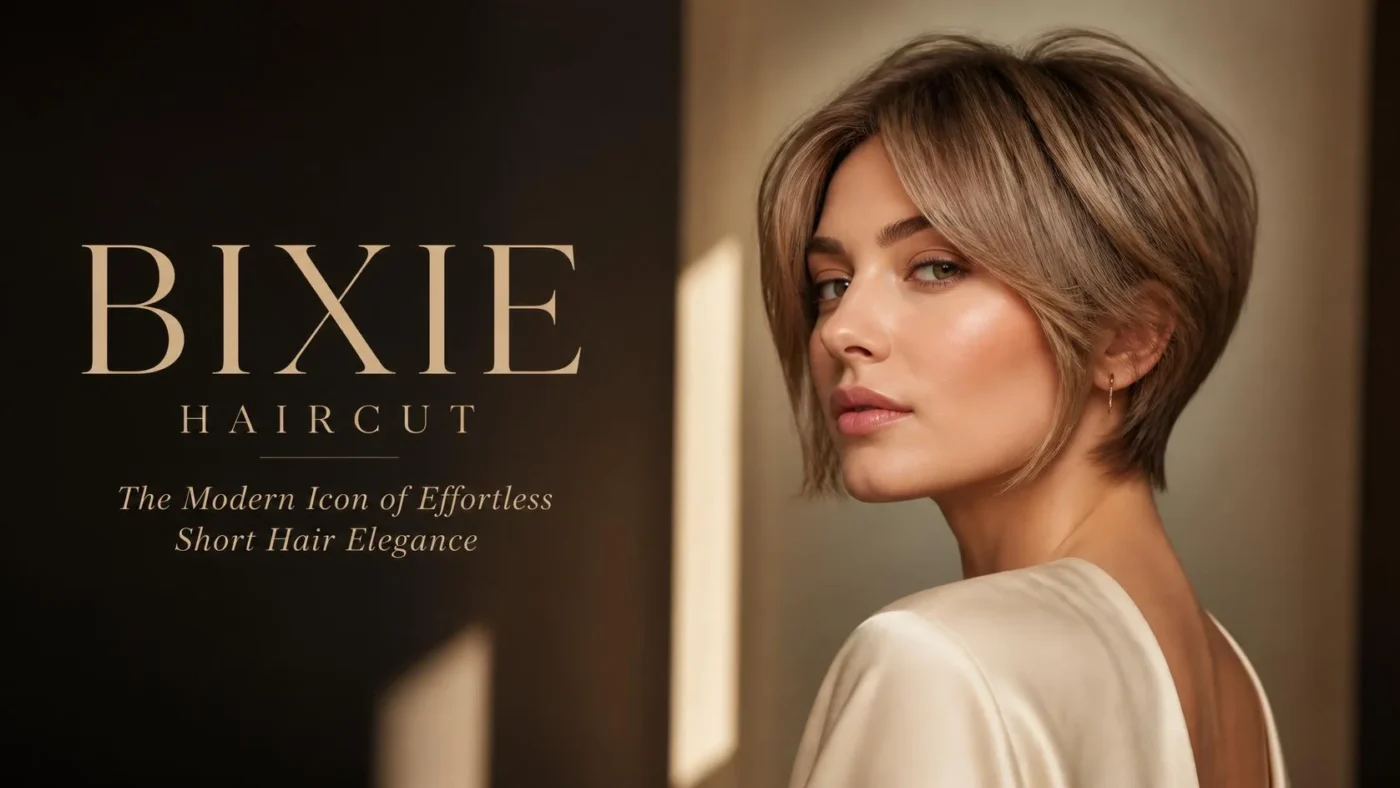
Short hair trends move fast. The bixie haircut has outlasted most of them, and 2026 gave it another push after a run of red carpet sightings. Readers keep asking one question: where does a pixie stop and a bob start? This guide draws that line in inches, then scripts the salon conversation.
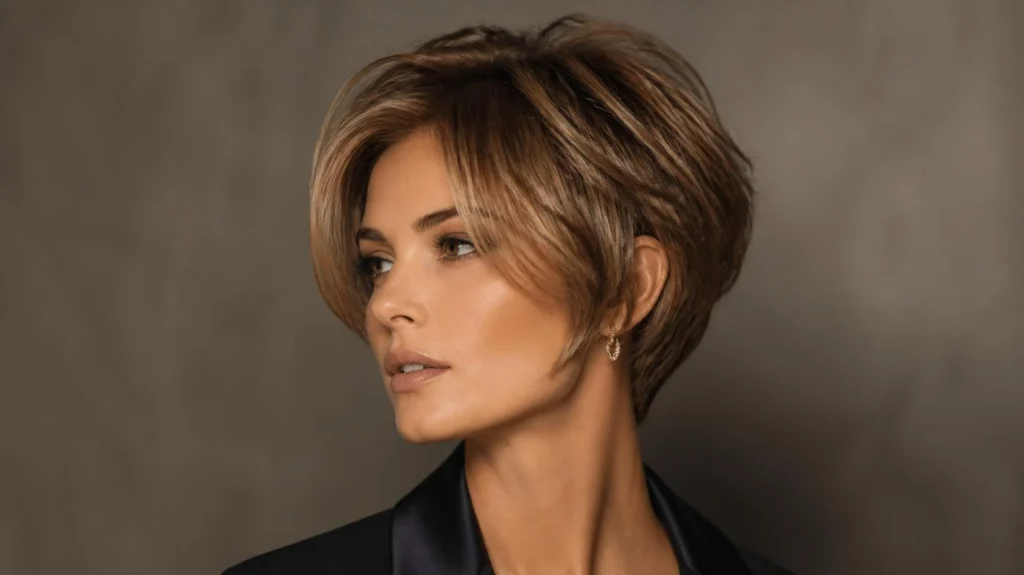
A bixie sits between a pixie and a bob. Crown layers run about 2 to 3 inches. The nape is tapered close to the neck—the longest front pieces land between the earlobe and the jaw, usually 4 to 6 inches. Interior layering pulls out weight without shortening that outline.
Key Takeaways
- Length lives at the ear, not the chin. Front pieces may graze the jaw.
- The shape comes from weight removal inside the hair, not from the perimeter line.
- Ask for interior layering, a tapered nape, and point-cut ends. Say the words out loud.
- Expect $65 to $150 for the cut, and a trim every 6 to 8 weeks.
- Roughly four to five months of growth turns it into a chin-length bob.
The Length, In Inches And On Your Face

Stylists describe the Bixie haircut shape with landmarks rather than a ruler. That is fine in the chair and useless on the internet. So here are both. Measure from the part line down. Interior layers at the crown sit at 2 to 3 inches, which creates that lifted, slightly rounded top. Side sections reach the middle of the ear or just past the lobe. At the back, the perimeter is short, sometimes an inch of hair at the hairline, and it hugs the neck. Face-framing pieces are the longest thing on your head.
Here is the practical test. If the back of your hair touches your collar, you have a bob. If your sideburn area is above the top of your ear, you have a pixie. Anything in between is the cut we are talking about.
Bixie Vs Pixie Vs Bob: The Length Chart
| Feature | Pixie | Bixie | Short bob |
| Nape | Clipper tapered, skin close | Scissor tapered, short but soft | Blunt, sits on the collar |
| Side length at the ear | Above or over the ear | Mid ear to earlobe | Below the earlobe |
| Longest front piece | 2 to 4 inches | 4 to 6 inches | 6 to 9 inches |
| Weight at the perimeter | Almost none | Removed inside, kept at the edge | Kept, that is the point |
| Crown volume | High, cropped | High, layered | Flat to soft |
| Grow-out behavior | Awkward at 8 weeks | Stays wearable | Turns into a lob |
Read that table twice before you book. The row that matters most is weight at the perimeter, because that single decision is what separates this cut from a layered bob.
How To Ask For A Bixie Haircut At The Salon?
This is where the Bixie haircut goes wrong. Not in the scissors, in the sentence you say first. Photos help, but photos are not instructions. Two clients can hand over the same picture and walk out with different heads, because one of them said the technical words and one of them did not. Bring three images: front, side, and back. Then talk.
The Terms Your Stylist Needs To Hear
- Weight removal. Say you want internal weight taken out while the outline stays. That is the whole architecture of the shape.
- Interior layering. Layers built inside the hair, not stacked visibly on the surface. It buys movement without a mullet edge.
- Tapered or stacked nape. Tapered gives you a soft, close neckline. Stacked builds a small shelf of graduation for lift. Pick one and name it.
- Point cutting or slide cutting on the ends. This softens the tips so the layers separate instead of sitting in a blunt block.
- Fringe length. Give a number. Cheekbone, brow, or “leave it long enough to tuck behind my ear” are three different haircuts.
Say your styling reality too. If you air dry four days a week, your stylist should cut less bulk out of the crown and leave more length in front. If you blow dry daily, the cut can be shorter and choppier. For more short hair inspiration and styling ideas, our hair archive is a good place to browse before your appointment.
What Happens If You Ask Badly?
Three bad asks, three predictable results. “Just take it short.” You get a pixie, because short is the only instruction you gave, and a nervous stylist defaults to the safest recognizable shape. “Give me some layers.” You get a layered bob with the length still there and none of the lift needed for a Bixie haircut. “Do whatever you think.” You get whatever that stylist cuts most often, which in a lot of chairs is a one-length bob with a razored edge.
The other classic failure is the mushroom. It happens when the sides are taken short, but the interior is left heavy, so the top puffs out over a scooped neckline. Ask for weight removed through the middle, and you avoid it.
Face Shapes, And The Textures That Fight This Cut
Oval and heart shapes take it easily. Diamond and square faces do well with longer front pieces that soften the jaw. Round faces need height at the crown and length at the front, so ask for both.
Texture is the honest part, and most articles skip it.
- Straight, medium density: the natural fit. Minimal effort, clean separation.
- Wavy and loose curly, up to about 3B: excellent, as long as the cut is done dry so the stylist sees the spring.
- Thick and coarse: works, but only with real weight removal. Otherwise it inflates by hour three.
- Very fine, low density: risky. Aggressive layering leaves the ends see-through. A blunter short bob usually flatters more.
- Tight type 4 coils: the shape has to be rebuilt entirely around shrinkage. Go to a stylist who cuts textured hair, or skip it.
One more warning. A strong cowlick at the nape or hairline will fight a tapered neckline every single day.
The Celebrity Bixie Versus The One You Will Get
That red carpet photo is a haircut plus 90 minutes of work. Not the same product. Density is the first gap. Thick, high-density hair can lose a lot of interior weight and still look full, so the cut reads sculpted. Take that same amount out of fine hair, and you get wispy, not piecey. Your stylist is doing math on how much there is to remove before deciding how choppy to go.
Color is the second gap. Those visible layers photograph as separate pieces, partly because dimensional lowlights catch the edges. Flat single-process color hides the layering, so the look is softer and rounder than the reference. Time is the third gap. A polished version needs a round brush at the Bixie haircut crown and a flat iron bent through the ends. That is eight minutes on your own, and closer to an hour when a professional does it for a camera.
Styling It In Under Ten Minutes: The routine is short because the cut does the work.

On damp hair, work a lightweight styling cream through the mid lengths and a volume mousse at the roots only. Rough dry with your fingers, pushing the crown against its natural fall for lift. Once dry, bend three or four pieces around the face with a flat iron, alternating direction. Finish with texturizing spray at the crown, then break the ends apart with a pea-sized dab of balm.
Product prices sit around $29 to $52 for the popular options, with a texturizing spray at $52 and a 3-in-1 styling cream near $30. Drugstore versions run $9 to $16 and perform fine on this shape. Skip anything heavy or oil-based on the roots.
Short hair changes what reads well around your neck and ears, which is why this cut pairs so neatly with sculptural jewelry and statement earrings.
The Grow-Out Path
This is the strongest argument for the cut. It ages well.
| Time since the cut | What it looks like | What to do |
| Weeks 0 to 6 | Sharpest version, crown lift at its peak | Nothing |
| Weeks 6 to 10 | Nape creeping, fringe in your eyes | Neckline and fringe trim only, $15 to $30 |
| Months 3 to 4 | Reads as a short textured bob | Re-cut, or let it ride |
| Months 4 to 6 | Chin-length bob with soft layers | Trim the ends, keep the length |
| Months 7 to 12 | Collarbone lob | Decide whether to go back short |
Cost And Upkeep In Dollars
Expect $65 to $150 for the cut at a mid-tier salon in a US metro area. Small town pricing starts closer to $40. A senior stylist in New York or Los Angeles can run $180 or more. Short precision work is often priced above a long trim, because it takes the same time on less hair.
Budget the year, not the appointment. At a trim every 7 weeks, you are looking at roughly seven visits, so maintaining a Bixie haircut can mean $500 to $900 annually before tip. Add 18 to 20 percent for the tip. Neckline cleanups between full cuts cost $15 to $30 and stretch each shape by two or three weeks. That upkeep number is the honest catch. Short hair is cheap to style and expensive to maintain, and the reverse is true of long hair.
Your Next Step
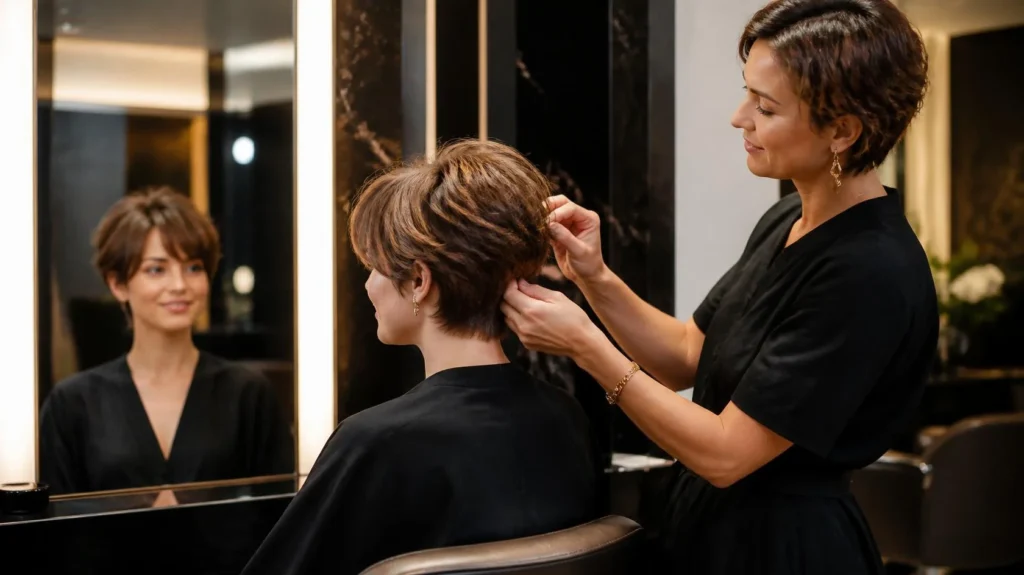
Book a consultation before you book the cut. Bring three photos and say the five terms from the list above. Then ask one direct question: how much weight does my hair have to lose for this shape to sit right? Their answer tells you whether your density supports the version you have pictured. Then plan the outfits that suit the new neckline, starting with our fashion edit.
FAQs
No. A shaggy pixie keeps the sides above the ear. This cut takes the sides down to the lobe and keeps longer weight in front.
Sometimes. Ask for less interior layering and a blunter perimeter, so the ends still look dense.
Every 6 to 8 weeks for a sharp shape. Stretch to 10 weeks if you like it softer and grown in.
Not a full one. You can clip the crown back, and by month four a small low ponytail usually works.
Yes, with height at the crown and front pieces that fall past the jaw. Flat crowns widen a round face.
Daily styling, yes. Salon visits, no. That trade is the thing people misjudge most.