

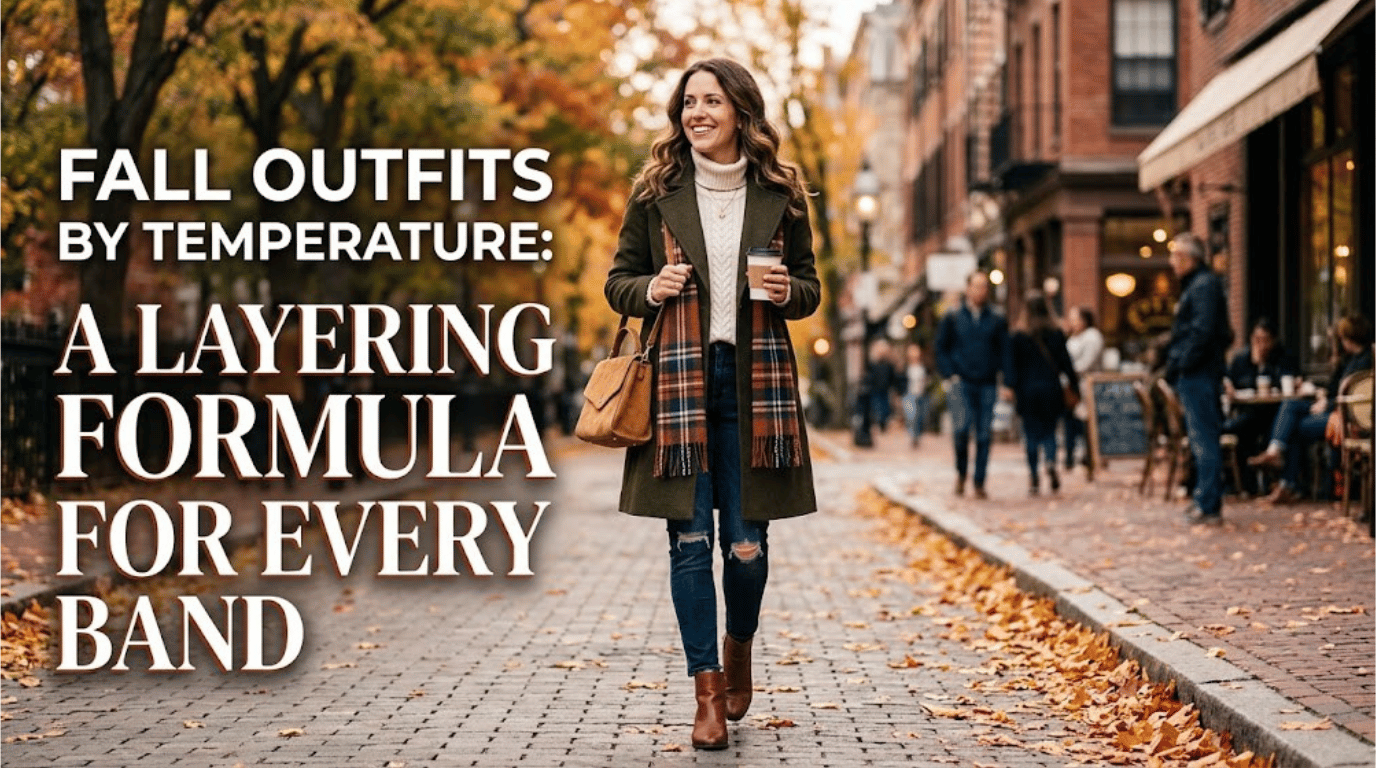
Your weather app says 46°F at breakfast and 71°F by lunch. That is one day and two climates. Most guides to fall outfits answer that with a mood board, which helps nobody standing at a bus stop in September. This one answers with a thermometer. Our related guide, 90s Outfits by Subculture, goes further into this.
Dress by temperature band, not by trend. At 65 to 75°F, wear one light layer over a summer piece. From 55 to 65°F, add a knit and swap sandals for loafers. Once you hit 45 to 55°F, a real coat earns its place. Below 45°F, run three layers.
Key Takeaways
- Sort your closet by temperature band first. Trends can wait.
- One removable middle layer solves most of a 25-degree swing.
- The band between 55 and 65°F eats most of September and October, so spend your money there.
- A cotton trench runs about $120 to $290 and covers two bands by itself.
- Slip dresses and summer skirts do not retire. They move under knits.
Why Temperature Bands Beat Trend Lists
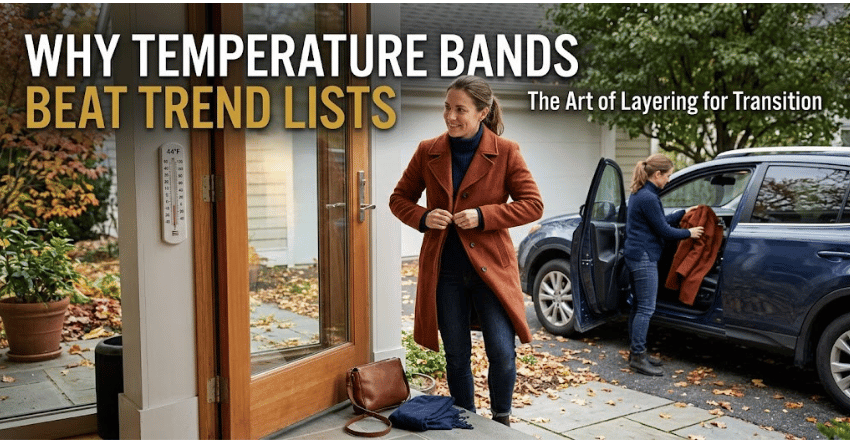
A trend list tells you burgundy suede is having a moment. True, and useless at seven in the morning when the porch thermometer reads 44°F and your calendar says outdoor lunch. Bands fix the sequencing problem. You pick the band, then the formula, then a color you like.
There is a second reason, and it is the whole argument. This is the only season where you dress for a range instead of a number. So the outfit has to come apart cleanly in a parking lot, then go back together without a mirror.
The Four Bands at a Glance
Find the row that matches your afternoon high, then look at the morning low. If those two numbers land in different rows, dress for the lower one and carry the difference.
| Band | Base layer | Layer doing the work | Outfit that holds up |
| 65 to 75°F | Cotton tee or ribbed tank | Unbuttoned overshirt | Straight jeans, tank, open overshirt, low sneakers |
| 55 to 65°F | Fine-gauge long sleeve | Cardigan or blazer | Midi skirt, thin knit, loafers, visible sock |
| 45 to 55°F | Merino tee or turtleneck | Quilted vest or trench | Wool trousers, turtleneck, trench, ankle boot |
| Below 45°F | Merino long sleeve | Wool sweater plus coat | Insulated coat, scarf, lined pants, tall socks |
65 to 75°F: Fall Outfits That Still Show Skin
Early September across most of the country. Late October in Texas and Arizona. Skin still shows, the sun still bites midafternoon, and the layer you add is mostly decorative. Keep it thin. Keep it open.
- Straight-leg jeans, a ribbed tank, and a cotton overshirt worn unbuttoned.
- A midi slip dress with a cropped cardigan knotted at the waist.
- Wide linen-blend pants, a fine knit polo, sleeves pushed to the elbow.
Sandals are still fine here, and so are bare ankles and white denim. For month-by-month styling across the rest of the year, our seasonal outfits archive goes further.
Between 55 and 65°F: The Band That Runs the Season
Most of the season lives here.
Mornings bite, afternoons do not, and the light disappears around five o’clock. What works in this band is a genuine long-sleeve base plus one mid layer light enough to carry by hand for three blocks. Nothing more.
- Fine-gauge crewneck, straight trousers, loafers with a contrast sock.
- Denim jacket over a floral midi, tights optional depending on wind.
- Blazer, white tee, dark jeans, plus a scarf that lives in your tote.
Two rules apply. Nothing should force you to stay outdoors, and nothing should trap heat the second you walk into a heated office.
45 to 55°F: Coat Weather Starts Here
Somewhere in this band a cardigan quietly stops being enough. You feel it at the wrists first, then the small of your back. Trade the open knit for outerwear with a closed front, and put some weight on your legs.
- Turtleneck, wool-blend trousers, cotton trench, ankle boot.
- Corduroy shirt jacket over a merino tee, with a quilted vest underneath on windy days.
- Sweater dress with opaque tights in the 40 to 60 denier range.
Wet leaves and cold rain change the math underfoot. Sort out shoes for cooler weather before you shop for a coat.
Below 45°F: Three Layers, No Bulk
Three layers, not three sweaters. A merino long sleeve sits against the skin, a wool sweater goes over it, and an insulated coat closes the system. That combination beats two thick pieces every time, because the trapped air between layers does the insulating.
Add a scarf before you add another sweater. Necks lose heat faster than torsos, and a scarf comes off in a warm store without a fitting room.
The Transitional Weeks Nobody Plans For
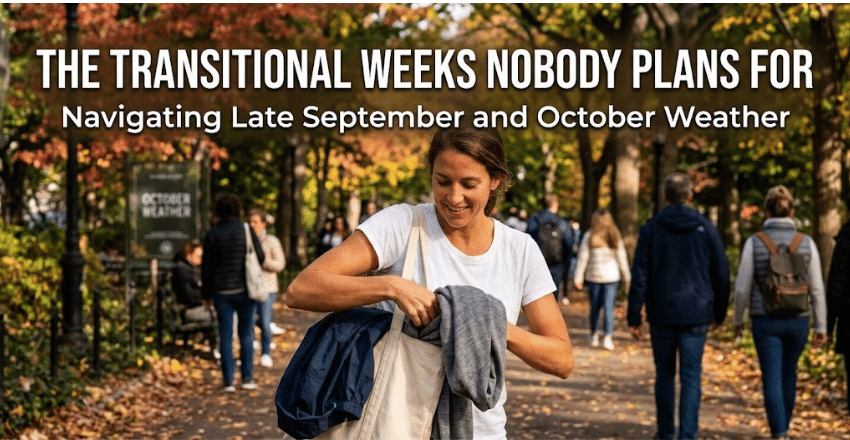
Late September through mid-October is where people give up and default to a hoodie. A single day that starts at 45°F and reaches 70°F by lunch is completely ordinary across the Midwest and the Northeast. A hoodie handles one end of that day and fails the other.
Build these weeks around a removable middle. Pick a base you would happily wear alone at 70°F, then a mid layer that folds flat into a tote. Add an outer shell only if rain shows up in the forecast.
One practical trick. Check the four o’clock temperature instead of the daily high, because that is the hour most people walk back to the car.
Layering Pieces Worth Real Money
Five pieces cover all four bands. Prices below reflect current US retail at mid-market brands, not designer. Buy in this order if you are starting from nothing.
| Piece | Bands it covers | Typical price |
| Cotton overshirt | 65 to 75°F | $45 to $90 |
| Fine-gauge cashmere or merino crewneck | 55 to 65°F | $50 to $150 |
| Cotton trench coat | 50 to 65°F | $120 to $290 |
| Quilted vest | 45 to 60°F | $60 to $120 |
| Merino long sleeve base layer | Below 45°F | $40 to $90 |
The $50 cashmere crewneck is real, and it has reset what shoppers expect to pay. A comparable knit ran $200 five years ago. Spend the savings on the coat instead, since that is the piece you will reach for four days a week from October through March.
Rework What You Already Own
You do not need a new closet. Plenty of your summer dresses and skirts work fine once a knit goes over or under them. What changes is the order of operations.
- Slip dresses go over a long-sleeve tee, not under a jacket on their own.
- Flat sandals become a 65°F shoe the moment you add a sock.
- A linen button-down stops being a shirt and becomes a mid-layer worn open over a knit tank.
- Shorts survive to 60°F with opaque tights and a long coat over the top.
- Sundresses gain a season under a crewneck sweater, with the skirt left showing below.
Two Mistakes That Cost You the Whole Season

The first is buying for the coldest week. People shop in October, see a puffer, and buy for 20°F weather they will face for maybe eleven days. Meanwhile, the 55 to 65°F band goes uncovered for two months.
The second is layering pieces that cannot come off gracefully. A thick sweater under a fitted jacket is one outfit at one temperature. A vest under a trench is three.
Your Next Step
Pull up the ten-day forecast tonight. Write down the morning low and the four o’clock reading for each day, then assign a band to every row. You will see within a minute which band you actually live in, and which one you have been shopping for.
If you want to know about Summer Outfits for Women then visit our Seasonal Outfits category.
FAQ: Dressing for the Swing
Dress for 45°F and plan to shed. A merino tee, a cardigan, and a light trench get you out the door warm. By noon you are down to the tee, holding two things.
No, not for most people. A cardigan, blazer, or denim jacket handles 60°F unless the wind is up or the sky stays overcast.
Yes. Cream and winter white read seasonal in wool, corduroy, or heavy cotton. The old rule was about fabric weight, not calendar dates.
Four. One overshirt, one knit, one vest, one coat. Good fall outfits come from recombining those four across the bands, not from owning twelve jackets you wear twice.
Below 55°F, opaque tights extend every dress and skirt you already own. That is the cheapest band-crossing purchase on this page.