

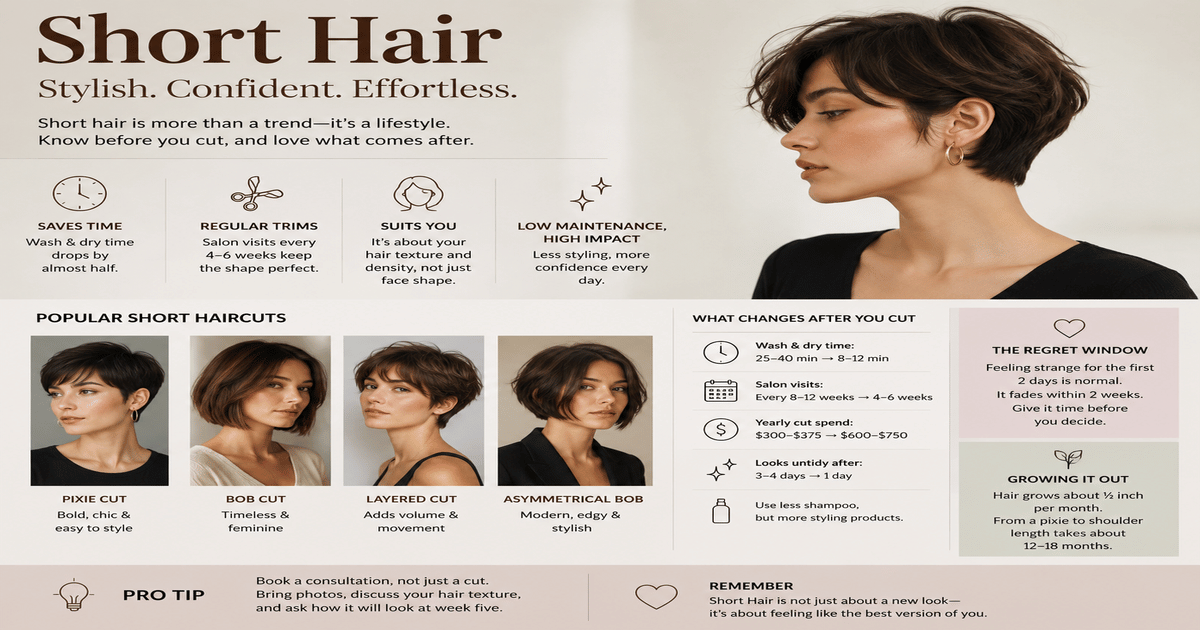
You have been staring at the same saved photo for three weeks. That is usually how this starts. Cutting it off is a small decision with a large daily footprint, and almost nobody describes what that footprint feels like. So this is about the choice and the month after it, not a gallery of cuts.
Short hair suits you if your density and texture can hold a shape, not if your face measures a certain way. Expect wash and dry time to drop by roughly half. Salon visits move to every four to six weeks. Give yourself two full weeks before you judge the result.
| Topic | Summary |
|---|---|
| Main Idea | Short hair should be chosen based on hair density and texture, not just face shape. |
| Best Candidates | Fine, thick, curly, and coily hair can all suit short styles with the right cutting technique. |
| Face Shape | The 2.25-inch rule is only a guideline, not a reliable way to choose a haircut. |
| Daily Changes | Short hair dries faster, needs more frequent washing, and requires trims every 4–6 weeks. |
| Maintenance | Styling is quicker, but regular salon visits and styling products become more important. |
| Curly Hair Tip | Curly and coily hair should be cut dry because curls shrink significantly after drying. |
| Regret Period | Most people adjust to short hair within two weeks after the initial change. |
| Growing It Out | Hair grows about ½ inch per month and usually takes 12–18 months to reach shoulder length again. |
| Expert Advice | Book a consultation first, discuss your hair texture and density, and understand maintenance before cutting. |
| Key Takeaway | Choosing short hair is about understanding your hair type, lifestyle, and maintenance—not following trends alone. |
Key Takeaways
- Density and texture predict the outcome better than face shape does.
- Drying time falls sharply. Salon spend roughly doubles.
- The regret feeling usually peaks in the first two days and fades within two weeks.
- Curls can shrink 20 to 50 percent, so the wet length lies to you.
- Growing back to the collarbone takes about 12 to 18 months at half an inch a month.
Face Shape is the Received Wisdom and the Weaker Predictor.

Almost every page you have read leans on the 2.25-inch rule. Hold a pencil under your jaw and a ruler under your ear, and measure where they cross. Under 2.25 inches, cut it. Short hair over, do not. It is a tidy trick, and it makes for a nice photo, but it was never a rule so much as a rough guide to proportion.
Here is the problem. A jaw measurement tells you nothing about whether the shape will sit or collapse by noon. Two people with identical bone structure can walk out of the same chair with wildly different results. One has coarse, dense growth that stacks. The other has fine, sparse growth that slides flat. Your face sets the outline. The material decides whether that outline survives the day.
Use the measurement as a tiebreaker, not a verdict. If you want more on shape and styling, our hair archive goes deeper on individual looks.
Density and Texture: The Honest Predictors
Ask your stylist to say these two words out loud before anything is cut. Density is how many strands you have per square inch. Texture is how thick each strand is and how much it bends.
Fine and Sparse
Losing length is the single fastest way to make fine growth look fuller, because weight is what drags it flat. A blunt line at the jaw reads twice as thick as the same amount at the collarbone. The tradeoff is that fine strands hold a shape for hours, not days, and they show a bent night on the pillow more clearly than anything else. You will wash more often. Budget for it.
Thick and Dense
Thick growth does not get lighter when it gets shorter. It gets wider. Cut without internal weight removal, and it will sit like a triangle by the third day, heavy through the middle and flared at the ends. This is a technique problem, not a you problem. Ask specifically for interior thinning and a soft perimeter. Then ask what it will look like at week five, once it has grown half an inch and started to push out sideways.
Curly and Coily
Shrinkage is the part that catches people out. Loose waves pull up around 5 to 15 percent as they dry. Classic curls pull up 20 to 50 percent. Coily and kinky patterns can lose 60 to 80 percent of their visible length. Six inches wet can land at two and a half inches dry, which is a completely different haircut than the one you agreed to.
So insist on a dry cut, or at minimum a dry check, before the final shape is set. A stylist who cuts your curls flat and wet is guessing.
What Genuinely Changes Day to Day With Short Hair

This is the part the inspiration photos leave out. None of it is bad. It is just different, and knowing it in advance removes most of the shock.
| What changes | Below the shoulders | Chin length or above |
| Wash and dry time | 25 to 40 minutes, mostly drying | 8 to 12 minutes, often air-dried |
| Wash frequency | Every two or three days | Most days, roots show fast. |
| Salon visits | Every 8 to 12 weeks | Every 4 to 6 weeks |
| Yearly cut spend | About $300 to $375 | About $600 to $750 |
| Shampoo and conditioner | A bottle every few weeks | The same bottle lasts twice as long. |
| Styling product | Oil or a leave-in cream | Paste, powder, or texture spray: $18 to $32 |
| Looks untidy after | Three or four days | Roughly 24 hours |
Those salon figures use a $75 national average for a women’s cut, which runs anywhere from $45 to $150 depending on your city. The math is blunt: you keep the drying time you save and hand a chunk of it back at the front desk. Most people find that trade worth making. Some do not, and that is a real reason to wait.
Then there is the small stuff nobody warns you about. You will wake with a dent on one side and a wing on the other, and water alone fixes it faster than any product. Hats crush the crown. A bike helmet flattens the whole top in ten minutes, and there is no ponytail to hide behind afterward. The nape grows into a fuzzy shelf around week four, well before the front needs anything, which is why short cuts drift out of shape from the bottom up.
One upside gets undersold. Your ears and neck are suddenly on display, so earrings do real work now instead of hiding under a curtain. A pair you never wore will become the pair you wear constantly. There is more on that in our jewelry pairing guides.
Can you still tie it up?
Partly, and the answer changes fast as it grows. A pixie ties into nothing at all, and you will live on headbands, bandanas, and a wide claw clip that holds the top while the sides stay put. A chin-length bob gives you a small stub of a ponytail that catches most of the back and leaves the front pieces loose. Anything at the jaw or below can be pinned up entirely with two clips. If you run, swim, or work out daily, that gap of two or three months is the thing to weigh. Not the mirror.
The Regret Window Is Real, And Shorter Than You Think

Almost everyone feels strange in the first 48 hours. That is not regret. That is your face looking unfamiliar to you, which happens with any change big enough to notice, and it passes as your eye recalibrates. Most people report the odd feeling fading within a week or two.
Two Weeks is the Honest Checkpoint.
If you still dislike it at week six, the issue is rarely the length. It is the shape, the parting, or a fringe that was cut for a different texture. Go back and say so plainly. A fifteen-minute adjustment fixes far more of these than a year of growing does, and most salons will do it free within a month of the original appointment.
Your First Month, in Order
- Days 1 to 3: do nothing new. Wash it, rough-dry it with your fingers, and let your eyes adjust before you buy a single product.
- Week 1: Learn one styling move. Usually that is drying the roots in the opposite direction to the way you want them to sit, then letting them fall back.
- Week 2: Buy a texture spray or a matte paste and use half what you think you need. Overloading short lengths is the most common early mistake.
- Weeks 3 to 4: adjust the rest of your look. Necklines and collars read differently now, and a lot of people rebuild their outfit habits around it. Our fashion coverage is a decent place to start.
Book the first follow-up trim before you leave the salon. You will need it sooner than you expect.
Going Back: What Growing It Out Actually Looks Like

Growth averages about half an inch a month. That is six inches a year, and no supplement meaningfully changes it. From a pixie, here is the sequence.
- Months 1 to 2: the nape and sideburns thicken first, and the shape softens. Trim the perimeter, never the length.
- Month 3: the ears get covered, and the sides flick out. This is the stage people quit at.
- Months 4 to 6: a shaggy in-between, roughly two to three inches longer. Clips and a middle part carry you through.
- Months 7 to 10: a real bob at the jaw, and the awkwardness ends.
- Months 12 to 18: collarbone- or shoulder-length, depending on where you started.
The trick during the middle stretch is to keep cutting the shortest layers so they catch up, which feels backward and works.
The Next Step
Short Hair: a consultation, not a cut. Fifteen minutes, no scissors, and bring three photos of the look you want plus one of a shape you hate. Ask the stylist to name your density and texture out loud, then ask what it will do at week five without any product in it. If the answer is confident and specific, book the appointment. If it is vague, you have saved yourself a year.
FAQ
Not by itself. Length is neutral. What ages a face is a shape that is set too rigidly, or a color with no movement in it, and both of those are fixable without growing anything.
No. Growth happens at the scalp, and a trim does not touch it. Cutting removes damage, so more of what grows survives, which looks like faster growth over a year.
Two days for most of the shock, two weeks for the rest. If you are still uneasy at six weeks, book an adjustment rather than waiting it out.
Every four to six weeks to hold the shape, compared with eight to twelve weeks at longer lengths. Skip two and the outline blurs from the nape up.
You are a good candidate. A blunt line and a strong perimeter give fine, straight strands the density they cannot produce on their own.