
Jelly shoes are having another summer, and most styling posts say the same three things. Almost none of them tell you what happens at 2 pm on a hot sidewalk. Your foot slides forward. The strap starts sawing at your skin.
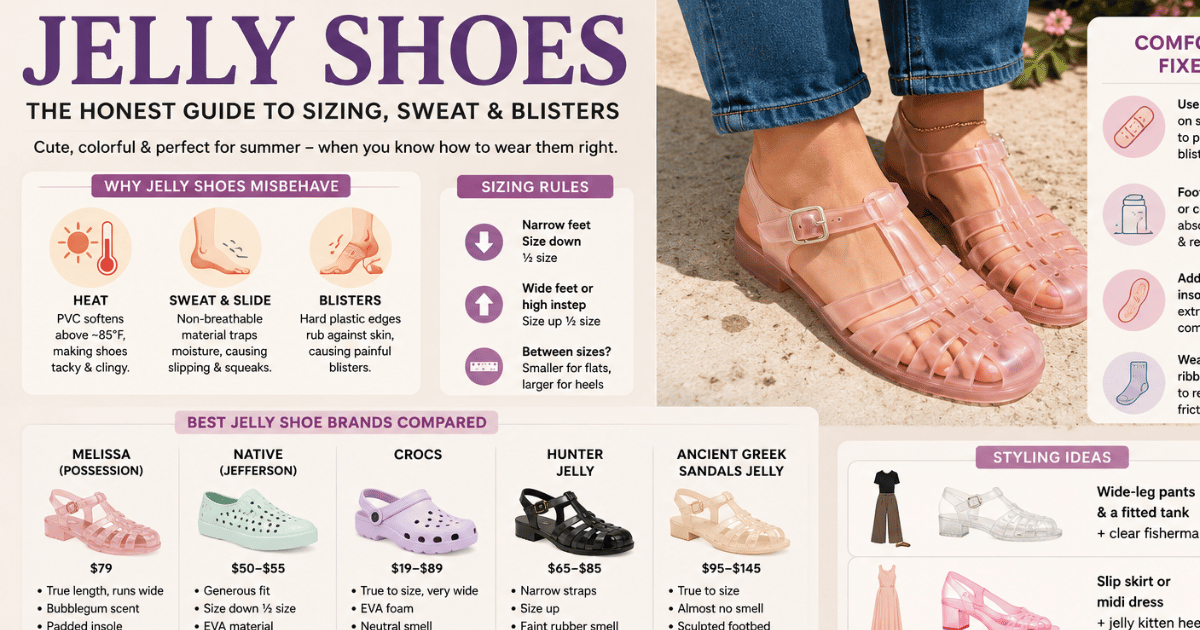
Jellies are molded plastic sandals, usually PVC, sometimes EVA or a plant-based blend. Most run true to size but a little wide, so narrow feet should size down. They do not breathe, which is why sweat, sliding, and blisters show up after a few hours. Simple fixes handle all three.
| Topic | Key Information |
|---|---|
| Main Focus | Complete guide to choosing, wearing, and caring for jelly shoes in 2026. |
| Best Materials | PVC is traditional but traps heat; EVA and sugarcane-based EVA are softer, cooler, and more comfortable. |
| Sizing Tips | Most jelly shoes run true to size but slightly wide. Narrow feet should size down; high insteps may need to size up. |
| Common Problems | Heat, sweaty feet, sliding, squeaking, and blisters caused by non-breathable plastic materials. |
| Easy Fixes | Use moleskin, foot powder, suede insoles, anti-chafe balm, and antiperspirant to improve comfort. |
| Stretching | Jelly shoes stretch slightly in width with heat but do not become longer. Avoid boiling water to reshape them. |
| Best Brands | Melissa, Native, Crocs, Hunter, Mini Melissa, and Ancient Greek Sandals. |
| 2026 Price Range | Budget: $19–$60 • Mid-range: $50–$90 • Premium: $95–$145+ |
| Styling Tips | Pair with linen trousers, midi skirts, slip dresses, denim, or tailored outfits for a modern summer look. |
| Best Overall Pick | Melissa Possession ($79) for style, comfort, and adjustable fit; Native is the best PVC-free alternative. |
| Buying Advice | Choose the right size, test indoors before wearing outside, and use comfort accessories to prevent blisters and extend wear time. |
Key Takeaways
- Size down a half if your foot is narrow. Size up if your instep is high.
- PVC softens above roughly 85°F, so it clings and slips at once.
- Moleskin along the strap line prevents almost every blister.
- Native and Crocs use EVA rather than PVC, and they cost less.
- The Melissa Possession sits at $79 and smells like bubblegum for months.
Why jelly shoes misbehave in real heat
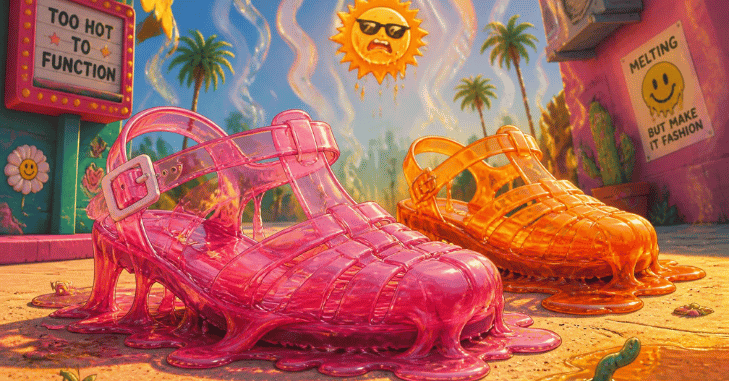
PVC is a thermoplastic. That is not marketing language; it is the whole problem. Warm the material, and it goes softer, tackier, and slightly more flexible. The strap that felt firm in an air-conditioned store turns into a suction cup by noon.
Two things happen at once. Jelly Shoes: The footbed gets grippy against dry skin, which sounds good until your skin turns damp. Then a film of sweat sits between two non-porous surfaces, and your foot skates across a sticky plastic plate.
Cold weather does the opposite. Below about 50°F, PVC stiffens, and the edges get sharp against the ankle bone. So these are genuinely a warm-weather item, and they belong in the same rotation as your other summer warm-weather shoes rather than a year-round staple.
EVA behaves better. It stays foam-soft across a wider temperature band, which is why Crocs feel the same in June and October.
Sizing: up, down, or true?
Start with the honest baseline. Most adult jellies from Melissa, Hunter, and the Greek labels run true to length and generously through the width. That combination fools people. The number is right, the shoe still slops around, and the wearer blames the size.
Here is the sorting rule I use.
- Narrow foot: go down a half size. The plastic will not mold to you, so you need the shell closer from the start.
- Wide foot or a high instep: stay true to size, or go up a half in a closed-toe style. Buckle straps sit across the widest part of the foot, and there is no give in the vamp.
- Between sizes: take the smaller one in flats and the larger one in anything heeled.
Toe overhang matters more than it does in leather. A quarter-inch of toe past the sole edge is fine on a sandal. Half an inch and the front lip will cut a line across your toes by hour three.
Do Jellies Stretch?
A little, and only in one direction. Width gives slightly with wear because body heat keeps the material near its softening point. Length does not change. If the shoe is short, it stays short.
You can speed the width up. Put on a thick sock, force your foot in, then run a hair dryer over the tight spot on medium for about 30 seconds while flexing. Let it cool with your foot still inside. Warm water from a faucet works too, though it is slower and messier. Never use boiling water. PVC deforms permanently, and you will end up with a wavy strap.
The sweat, the slide, and the squeak
These three complaints are the same complaint. Moisture is trapped between skin and plastic, and it has nowhere to go.
For sweat, the fix is a barrier. A light dusting of cornstarch or foot powder in the footbed each morning absorbs the first hour of moisture, which is when sliding starts. Antiperspirant on the soles of your feet sounds strange, but it works better than anything else.
For the slide itself, add friction that is not plastic. A thin suede or leather insole pad, the kind sold for about $8 to $15, changes the whole experience. Some people use a cheap gel ball of foot cushion instead, and that works if your shoe has a strap holding it down.
The squeak comes from two plastic surfaces rubbing, usually the footbed against the ball of your foot or the sole against a smooth floor. Powder kills the first kind. For the second, scuff the outsole lightly with sandpaper.
Blisters on bare skin, solved
Bare skin against a molded edge is the harshest combination in footwear. There is no lining, no break-in period, and no forgiveness.
Do this before you leave the house, not after the damage.
- Find the contact line. Wear the shoe for ten minutes indoors and look for the pink mark.
- Cover the skin, not the shoe. A strip of moleskin or a hydrocolloid blister patch on your foot stays put better than tape on plastic.
- Add an anti-chafe balm anywhere the strap crosses a bone.
- Break the day up. Three hours in, two hours out, if the shoe is new.
Socks are the other answer, and they stopped being a joke around 2024. A sheer or ribbed sock under a jelly sandal looks deliberate now, and it removes the friction problem completely. It also lets you carry the style into cooler weeks and into more structured transitional seasonal outfits.
PVC, Recycled, and Plant-Based Jellies
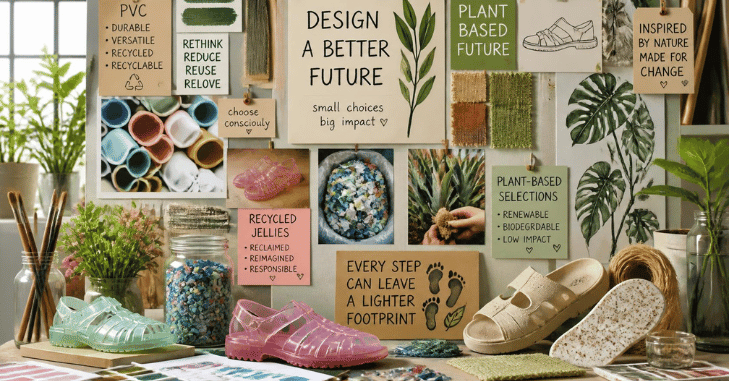
Traditional jellies are PVC softened with plasticizers. That is what gives the material its bend and its glassy shine. Independent testing has flagged phthalates in some low-cost imports, and sweat is the pathway people worry about most.
Melissa recycles its own PVC in a closed loop and takes shoes back for regrinding, which is a real program rather than a slogan. Still, the base polymer is PVC.
If you want to skip PVC entirely, look for these instead:
- EVA: the foam in Crocs and most pool slides. Light, soft, no phthalates.
- Sugarcane-based EVA: Natives use it across the Jefferson line.
- TPU: firmer and clearer than EVA, used in higher-priced clear straps.
One honest caveat. Recycled plastic is not automatically cleaner, because the recycled feedstock carries whatever was in the original material. Traceability matters more than the recycled label.
Brand comparison: Price, Fit, Smell, and Comfort
| Brand | Typical US price | Fit | Smell | Comfort |
| Melissa (Possession) | $79 | True length, runs wide | Strong bubblegum lasts months. | Padded insole, good for 4 to 6 hours |
| Mini Melissa (kids) | $50 to $65 | Roomy for chunky toddler feet | Same bubblegum | Fine for playground wear |
| Native (Jefferson) | $50 to $55 | Generous, size down a half | Neutral | Softest all-day option |
| Crocs | $19 to $89 | True to size, very wide | Neutral | Best arch support here |
| Hunter jelly | $65 to $85 | Narrow straps, size up | Faint rubber | Stiff for the first week |
| Ancient Greek Sandals Jelly | $95 to $145 | True to size | Almost none | Firm sole, sculpted footbed |
Verdict. Our pick for most people is the Melissa Possession at $79, because the padded insole solves the old flat jelly complaint and the buckle lets you tune the fit. Native is best for anyone avoiding PVC or shopping for a child. Ancient Greek sandals are best for a dressed-up look that reads expensive rather than nostalgic.
Styling jellies as an adult, not as a memory
The trick is contrast. A molded plastic shoe next to a tailored trouser or a crisp poplin shirt reads as a choice. The same shoe next to a scrunchie and a butterfly clip reads as a costume.
Three combinations that hold up. A clear fisherman sandal with wide-leg linen pants and a fitted tank. Try a jelly kitten heel with a slip skirt. Colored jelly mules work with dark denim and a blazer.
Color does a lot of work. Clear and smoke-gray disappear into an outfit. Cherry red, cobalt, and butter yellow become the whole point, so keep the rest quiet. Longer silhouettes help too, which is why these sit so easily under midi summer dresses. Skip the anklet. That is the detail that pushes the look backward.
Kids Versus Adults: What Actually Differs

Mini Melissa and the kid-focused lines are built wider and shallower, with rounder toe boxes and simpler closures. Children sweat more per square inch than adults do, so the sliding problem is worse for them and matters less, because they are not walking two miles in them.
For kids, buy pool decks and playgrounds sized to a thumb’s width of room, and rinse after every beach day. For adults, buy for the specific outfit and accept a three- to five-hour window unless the footbed is padded.
Your Next Step
Jelly Shoes: Pick one pair and one purpose. If you want a wearable everyday flat, order the Possession in your usual size and add a suede insole pad the same week. If your feet are narrow, go down a half and skip the pad.
Then test them indoors for an hour before the first real outing. That single hour tells you where to put the moleskin, and it is the difference between a shoe you love and a shoe that lives in the closet.
FAQ
Often, yes. There is no break-in like leather, so the first two or three wears are the roughest. Cover the contact points with moleskin instead of waiting it out.
Yes. Both PVC and EVA are waterproof and rinse clean under a faucet. Dry them out of direct sun, since prolonged heat can warp thin straps.
The bubblegum scent is molded into the plastic and fades on its own over four to six months. Foot odor is different. Wipe the footbed with a mix of white vinegar and water, then let it air dry overnight.
Clear styles do, mostly from sunscreen, oils, and UV exposure. A magic eraser sponge takes off surface haze. Deep yellowing in the plastic itself is permanent.
Under $60, they are a low-risk seasonal buy. Above $100, you are paying for a sculpted footbed and a shape that will not date quickly.