

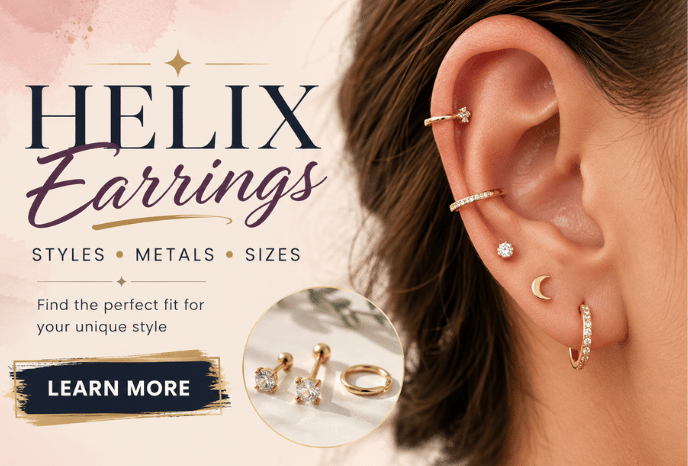
A helix piercing sits on the upper curve of your ear. Everything after that is a jewelry decision. Helix earrings look tiny, yet the metal, the backing, and the post length decide whether the spot stays calm or stays sore. This guide covers the jewelry, not the appointment.
Upper ear jewelry means a flat back stud, a hoop, a huggie, a continuous ring, a clicker, or a small curved barbell worn in cartilage. Most of it sits at 16 gauge or 18 gauge. Implant-grade titanium and solid 14k gold are the two materials experienced piercers reach for first, and the price gap between them is wide. There is more on this in Ring Shapes.
Key takeaways
- Flat back labret studs beat butterfly backs in cartilage, full stop.
- Buy implant-grade titanium marked ASTM F136, or nickel-free solid 14k gold.
- Gauge, post length, and hoop diameter are three separate numbers. Get all three.
- Titanium pieces run roughly $16 to $75. Solid gold starts near $95.
- Skip gold-plated brass and unmarked “surgical steel” for an upper ear piercing.
Helix Earrings Styles You Will Actually See
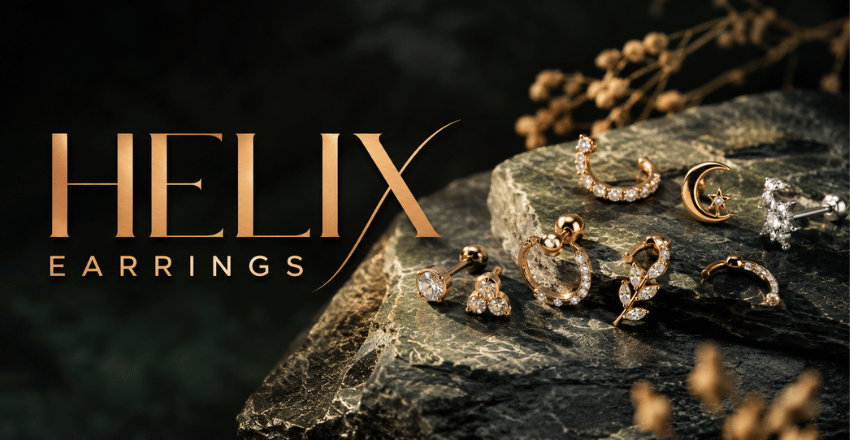
Most shops offer helix earrings in five or six cartilage jewelry styles. They are not interchangeable, and a fresh piercing limits which styles are suitable.
- Flat back stud (labret): a straight post with a flat disc behind the ear and a decorative top in front. The default for new piercings.
- Huggie hoop: a thick, close-fitting ring that hugs the cartilage edge. Reads polished rather than punk.
- Seamless ring: a thin continuous circle with no visible join. Beautiful, and a nuisance to open and close yourself.
- Clicker: a hinged ring with a snap closure. Easier to handle than a continuous ring, and usually chunkier.
- Curved barbell: a shallow arc with a bead on each end, useful when a straight post sits awkwardly against the rim.
- Chain and connector pieces: two ends linked by a fine chain, worn across two piercings.
- Ear cuff: no piercing at all. It clamps the cartilage edge and fakes the look.
Cuffs are the low-commitment answer. Still deciding? Wear one for a month first. Then browse our jewelry styling ideas for pairings that suit your ear shape.
Why a flat back beats a butterfly back
A butterfly back is the little friction clutch you grew up with on lobe studs. It sits proud of the skin, it loosens, and it catches on collars and pillowcases. In an earlobe, that is annoying. In cartilage, it is a problem because the post has to pass through stiff tissue that punishes any tugging with swelling and bumps.
A flat back replaces that clutch with a smooth disc that lies against the skin. Nothing protrudes. Nothing snags on how you wear your hair, which matters a lot at shoulder length or longer. Sleeping on the ear stops being an event.
There are two ways the front end attaches. Threadless posts use a bent pin that friction locks into a hollow post, so you push the top in and pull it out. Internally threaded posts screw the top on, with the threads hidden inside the post so nothing sharp passes through the channel.
Externally threaded jewelry, where the screw threads sit on the outside of the post, drags across the piercing on every insertion. Avoid it.
Metals worth your money
Nickel is the reason piercers get picky about material. A 2020 review in the International Journal of Environmental Research and Public Health notes the EU limit on nickel release. It is 0.2 micrograms per square centimeter per week for posts inserted into pierced ears. That figure never appears on a US product page. So the material marking on the listing, and the seller’s willingness to name a standard, is what you have to go on.
| Material | Mark to look for | Nickel risk | Best use | Typical price |
| Implant grade titanium | ASTM F136 or F1295, ISO 5832-3 | Very low | Fresh piercings, sensitive skin | $16 to $75 |
| Commercially pure titanium | ASTM F67 | Very low | Reactive ears | $20 to $60 |
| Solid 14k or 18k gold | Karat stamp plus a nickel-free alloy statement | Low if the alloy is stated | Healed helix, daily wear | $95 to $400 |
| Niobium | Elemental, not an alloy | Very low | People who react to everything | $30 to $80 |
| Gold plated brass or steel | Usually unmarked | Climbs as plating wears through | Short-term lobe wear | $10 to $30 |
| Unmarked “surgical steel” | No standard cited | Real steel alloys carry nickel | Not for cartilage | $5 to $20 |
Two traps hide in that table. “Surgical steel” is a marketing phrase with no legal definition, and the common 316 stainless alloy behind it contains nickel by design. Gold plating is worse than it sounds. Plating thickness is measured in microns, and an upper ear rubs against hair, hats, and phone screens all day. Once it wears, you are wearing the brass underneath.
Solid gold is different. Ask for 14k or 18k, ask whether the white gold is alloyed with nickel or palladium, and buy from a seller who answers.
Sizing: gauge, length, and diameter

Three numbers, three jobs. Gauge is the thickness of the post. Length is how far it travels through your ear. Diameter is how big a hoop looks from the front.
| Measurement | Common range | What it controls |
| Post gauge | 16 gauge (1.2mm) or 18 gauge (1.0mm) | Post thickness. 16 gauge is the US studio default for cartilage |
| Flat back post length | 6mm to 8mm | Room between the disc and the decorative top |
| Hoop inner diameter | 6mm to 10mm | How tightly the ring sits against the rim; 8mm suits most placements |
| Curved barbell length | 8mm to 10mm | Fit across a thicker fold of cartilage |
| Decorative top | 2mm to 4mm | Visual scale, and how much post it needs behind it |
What the wrong length does
Too short and the jewelry presses into tissue the moment your ear swells, which is how embedded posts and irritation bumps start. Too long and the extra shaft lets the top tilt, catch, and lever the channel sideways every time you brush your hair.
Piercers usually fit a longer post at 8mm for the first stretch, then downsize to 6mm once the swelling settles. Downsizing is a real appointment, not an upsell. Healing timelines and aftercare belong with your piercer, who can look at the actual anatomy. Bring the jewelry question to them too.
Building an ear stack around a helix
A curated ear is a composition, not a collection. Pick one hero piece and let the rest support it.
- Choose the focal point. Usually that is the largest stone or the boldest hoop, and it often lives in the helix.
- Vary scale down the ear. A 4mm top up high wants 2mm accents nearby, not four more 4mm stones.
- Match hoop diameters within about 2mm of each other so the curve of the ear reads as one line.
- Mix metals on purpose. Yellow gold with a single titanium piece looks intentional. Three golds do not.
- Leave one gap. Space is what makes the busy part look designed.
Asymmetry is doing well through 2026, so a heavy left ear and a bare right ear is a legitimate choice. Photograph your ear before you buy anything. It is easier to judge spacing from a photo than from a mirror.
It stops you buying a fourth thing that duplicates the third. For pairing your ear with the rest of an outfit, our everyday fashion looks section is a decent starting point.
What helix earrings cost
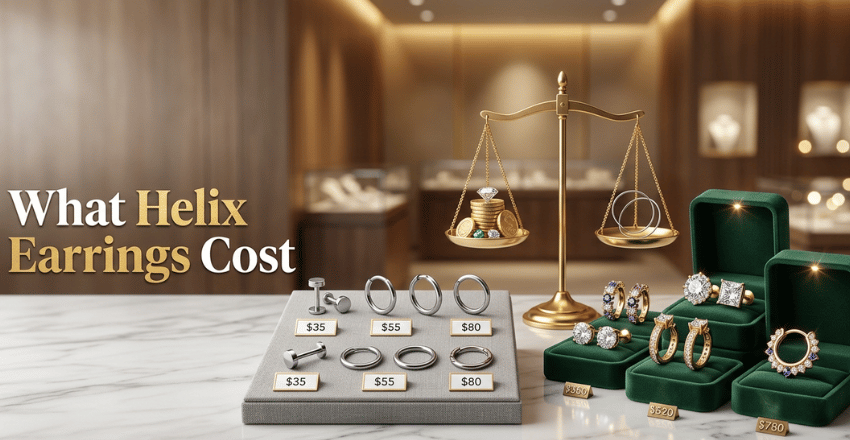
Prices split cleanly by material. Titanium flat backs and hoops from piercing-focused brands run about $16 to $40 for plain and crystal set designs. Add pave work or an opal, and you are at $40 to $75—clickers in titanium land around $36 to $38.
Solid gold is a different tier. A 14k flat back with a small stone starts near $95, and $100 to $125 is normal for a 14k clicker or a bezel set piece. Diamond and designer work climbs from there without a ceiling.
Here is the honest math. One good titanium piece you wear daily costs less than four plated ones you replace every season. Buy the backing first and the sparkle second.
Your next step
Measure what you already wear. Note the gauge, the post length, and the hoop diameter, then shop with those three numbers written down rather than guessing from a product photo. Order one implant-grade titanium flat back and one solid gold piece you genuinely love, and let the rest of the stack build slowly around them.
Helix earrings FAQ
Not at first. A hoop moves inside the channel and slows healing, so most piercers start you on a flat back stud and switch you to a ring later.
Sixteen gauge in most US studios, 18 gauge in some. Ask before you order. A thin stud rattles in a thicker channel, and forcing a thick post into a thin one hurts.
Roughly. Cartilage is the tissue, helix is the specific spot on the outer rim, and the jewelry sold for both overlaps almost completely.
Titanium for anything still settling or easily irritated. Solid gold for a healed piercing where you want the piece to look like fine jewelry.
The seller names a standard, such as ASTM F136, and can produce a mill certificate. Vague words like hypoallergenic or medical grade with no number behind them mean nothing.