
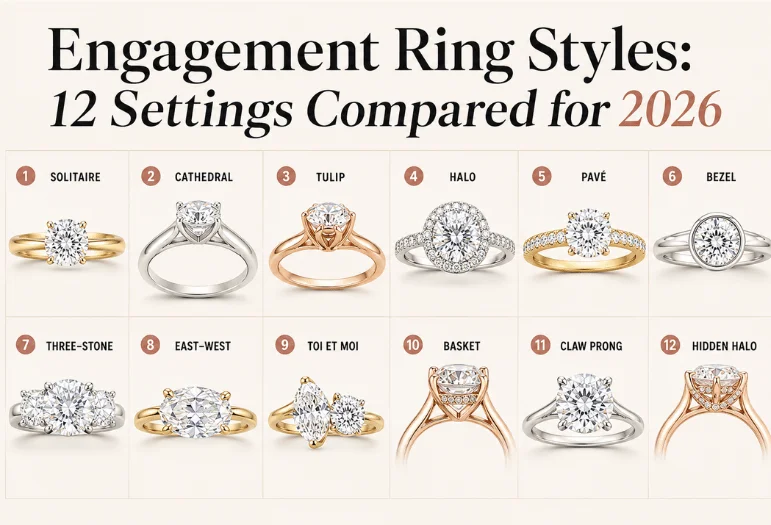
Two rings can hold the same diamond and look nothing alike. The setting does that work. Engagement ring styles are a conversation about metal: how it grips the stone, how high it lifts, how it survives ten years of dishes. This guide compares the options on protection, sparkle, upkeep, band fit, and price. For the full picture, read Megan Fox Ring.
A setting is the metal structure that holds your center stone. Solitaire settings show the most stone. Halo and pave settings add sparkle around it. Bezel and channel settings protect it best. Cluster and toi et moi designs change the ring’s whole shape. Price follows metal weight and stone count.
Key takeaways
- Bezel and channel settings protect a stone better than any prong design.
- A halo can make a center stone read up to half a carat larger.
- Pave and halo bands trap lotion film and need a soft brush weekly.
- Have prongs checked every 6 to 12 months if you work with your hands.
- Setting alone runs roughly $500 to $3,500 in 14k gold. Platinum adds 20% to 30%.
Engagement ring styles compared at a glance
Here is the whole field in one table. Prices are for the setting alone in 14k gold, with no center stone.
| Setting | Stone protection | Makes stone look larger? | Cleaning | Sits flush with a band? | Setting price (14k) |
| Solitaire (prong) | Moderate | No, but shows full stone | Easy | Usually yes | $500 to $2,000 |
| Halo | Good on the sides | Yes, strongest effect | Fussy | Often no | $1,200 to $3,500 |
| Hidden halo | Moderate | Slightly, from above | Fussy | Usually yes | $900 to $2,600 |
| Three stone | Moderate | Yes, widens the top | Medium | Usually yes | $1,000 to $3,000 |
| Pave | Moderate | Slightly | Hardest | Yes | $900 to $2,500 |
| Channel | High for side stones | Slightly | Medium | Yes | $900 to $2,400 |
| Bezel | Highest | Yes, a rim adds width | Easiest | Yes | $800 to $2,200 |
| Tension | Low | Yes, stone floats | Easy | Rarely | $1,200 to $3,500 |
| Cluster | Good | Yes, by area | Fussy | Often no | $700 to $2,500 |
| Vintage or antique | Varies | Yes, with milgrain detail | Hardest | Often no | $1,000 to $3,200 |
| East-west | Moderate | Reads wider on the hand | Easy | Usually yes | $600 to $2,000 |
| Toi et moi | Moderate | Yes, two stones | Medium | Often no | $1,200 to $4,000 |
Solitaire, halo, and hidden halo
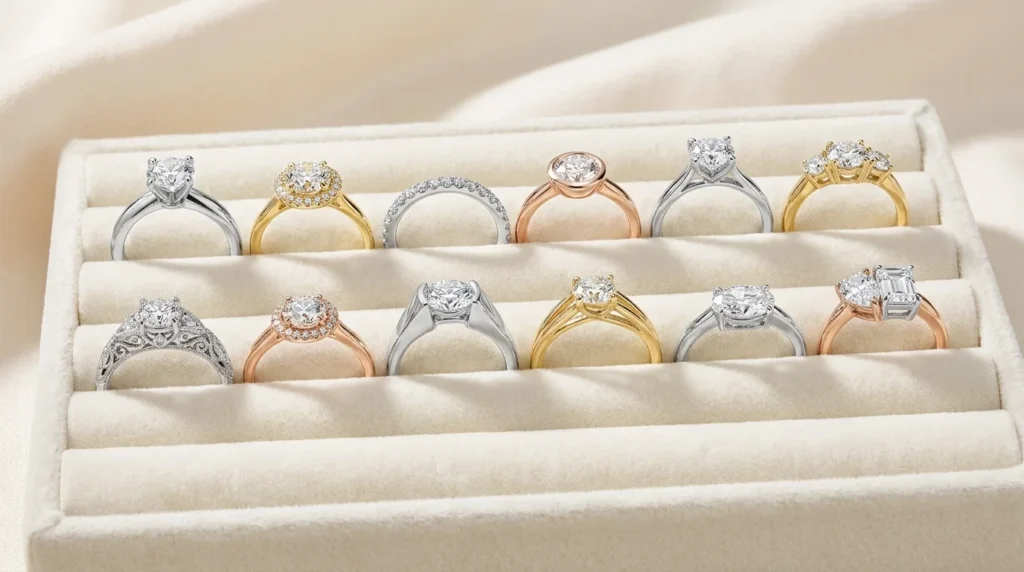
The solitaire is the default for a reason. One stone, four or six prongs, nothing competing. It shows every millimeter of what you paid for, and it cleans in thirty seconds under warm water. The trade is exposure. A raised prong head catches on sweaters, car doors, and the inside of a pocket, and a knocked prong is how stones get lost.
A halo rings the center stone with tiny pave diamonds. That thin border does something no cut can: it borrows visual size. A 1 carat stone in a well-made halo reads closer to 1.5 carats from arm’s length. Buyers who want scale without the stone budget end up here more often than anywhere else.
The hidden halo puts that ring of small stones under the center stone instead of around it. You see it from the side, not from above. It flatters the profile and keeps the top clean. Grime collects in a spot that is annoying to reach. Treat it like any detailed jewelry piece and brush the underside.
Pave, channel, and bezel
These three decide how much maintenance you sign up for. Pave scatters small stones across the band, held by beads of metal. It sparkles constantly. It also loses a stone now and then, usually after a knock, and jewelers see this often enough that annual checks are standard advice. Lotion and soap film settle under the beads and dull the whole band within weeks.
Channel setting sinks side stones between two metal walls. Nothing sticks up. Nothing snags. It is far more secure than pave and much easier to live with, though resizing a channel band is harder because the walls have to be recut.
Bezel wraps a continuous collar of metal around the stone’s edge. No prongs at all. It is the most protective mainstream option, the fastest to clean, and the one that slides under a glove without fighting. Some buyers think a bezel hides too much of the stone. A half bezel, open at two sides, splits the difference.
Three stone, cluster, east-west, and toi et moi
Three stone rings put a center gem between two smaller ones. The setup widens the top of the ring, so the whole thing reads bigger without a bigger center. Side stones are usually held by prongs or a small channel, and prongs on the outer stones are the ones that bend first.
Cluster settings build one shape out of many small stones. They deliver a lot of face-up area cheaply. They also have dozens of tiny prongs, which means more to check and more to clean.
East-west turns an elongated stone sideways so it lies across the finger. Oval, emerald, and marquise stones suit it. The look is modern, and it flatters short fingers, since the horizontal line adds width. Toi et moi sets two stones side by side on one band. The design resurfaced hard in the last few years. It now turns up across bridal fashion coverage constantly.
Vintage, antique, and tension settings
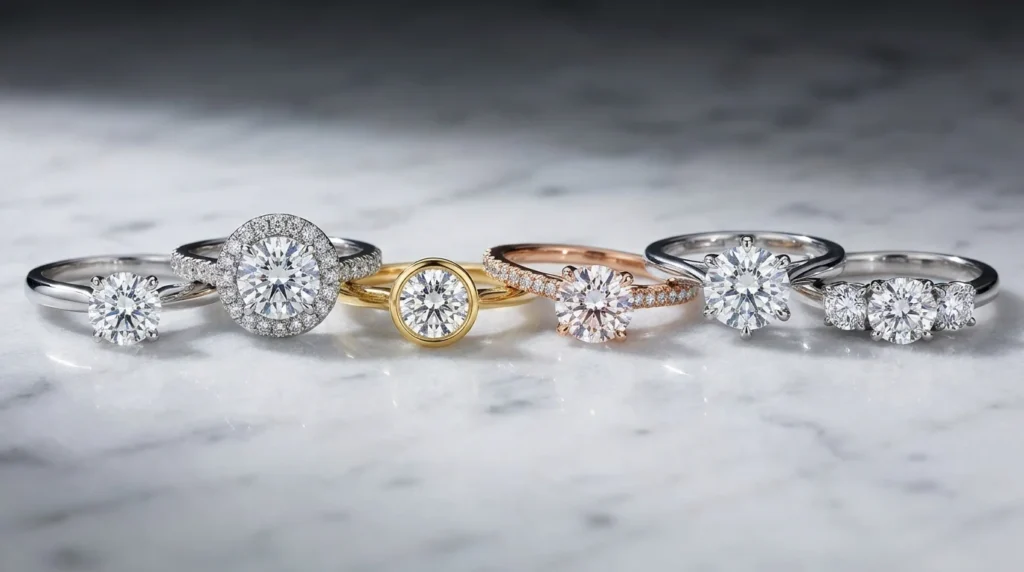
Vintage settings lean on filigree, milgrain beading, and engraved shoulders. Art Deco geometry is the most requested version. All that texture is beautiful, and it is a nightmare to clean, because dirt packs into every groove. Genuine antique rings carry another risk: worn prongs made a century ago that may need rebuilding before you wear the ring daily.
Tension settings look like the stone is floating between two ends of the band. Pressure holds it. Jewelers hesitate, and they are right to. Resizing is difficult or impossible; a hard knock can release the stone, and the design needs platinum or another stiff metal to keep its grip.
Will it sit flush with a wedding band?
This question gets asked after the proposal, which is too late. Flat-bottomed settings like solitaires, bezels, and pave bands usually meet a straight wedding band with no gap. Halos, clusters, and most vintage rings do not. Their wider heads push the band away and leave a visible V of daylight. Two fixes exist: order a contoured band shaped to hug the outline, or buy the pair as a stacked set from the start. A stacked set costs more up front and solves the problem permanently. That matters on the day you are choosing wedding dresses and everything else at once.
Metal choice: platinum, 14k, and 18k gold
Metal decides durability and long-term cost more than any single design choice.
| Metal | Wear behavior | Color over time | Upkeep | Setting cost |
| Platinum | Dense, bends rather than wears away, holds prongs tightest | Develops a soft gray patina | Polish occasionally, no plating | $1,400 to $2,400 |
| 14k gold | Harder alloy, best all-round for daily wear | Stable in yellow and rose | Low | $1,000 to $1,700 |
| 18k gold | Softer, scratches sooner, richer color | Warmer yellow, deeper rose | Low, but scratches show | $1,300 to $2,400 |
| White gold (14k or 18k) | Same as its gold base | Warms to pale yellow as plating wears | Rhodium replating, $25 to $150 | Matches its karat |
White gold deserves its own warning. It is not naturally white. It is yellow gold alloyed with pale metals and then coated in rhodium, and that coating wears off. Most wearers need replating every 18 to 24 months, and heavy daily wear pushes it to every 6 to 12 months. Budget around $69 to $90 per visit at a typical jeweler.
Platinum skips that cycle entirely. It never changes color. What it does is scuff into a matte finish that many people grow to love, and a polish brings back the shine whenever you want it. Rose gold, meanwhile, gets its blush from copper, which makes it the hardest of the golds and a quiet favorite for people who bang their hands around.
Match the setting to your lifestyle
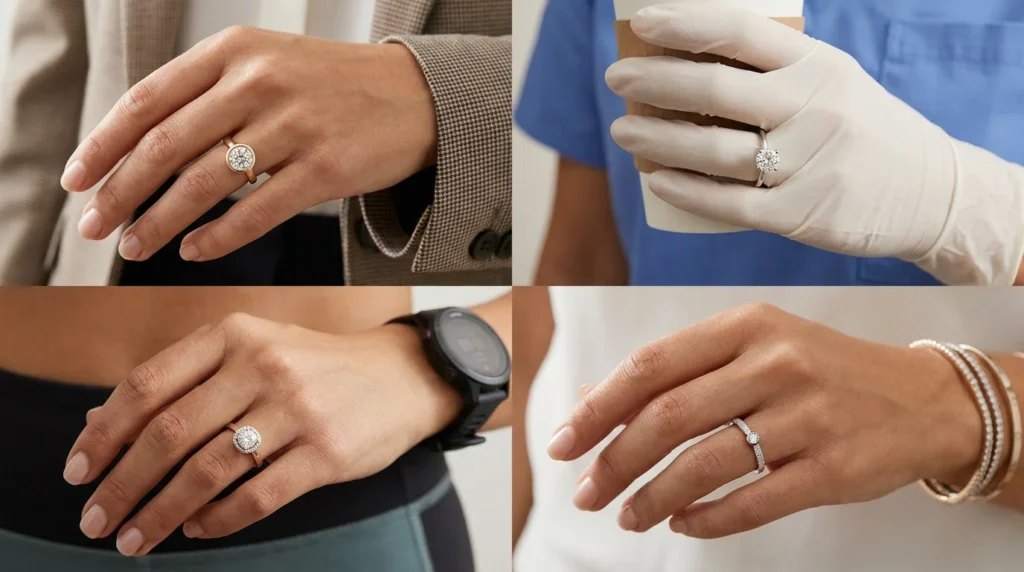
Nobody answers this part honestly, so here it is. Nurses, dental hygienists, and anyone in and out of gloves all day should be looking at bezel or flush settings. Prongs snag nitrile and tear it. A low-profile ring slides on and off without catching, and a bezel has nothing to bend.
If you lift, take the ring off for barbell work or wear a silicone band instead. A loaded bar will bend a prong and can compress a thin shank against your finger. Gardeners and hairstylists face the opposite problem. Grit and product build up fast, so pave and vintage settings become a chore.
Desk workers can wear anything. Cathedral shoulders, tall halos, tension settings, all of it survives a keyboard fine. Height is the number that matters most. Ask the jeweler how many millimeters the setting sits above the finger, and anything under 6mm behaves itself.
What each setting actually costs
Setting price and total ring price are different numbers, and stores blur them. The mounting by itself runs about $500 to $3,500 in 14k gold, depending on how many small stones it carries. Platinum versions of the same design cost 20% to 30% more. Add the center stone and the total shifts hard.
A 1 carat lab grown solitaire in 14k lands near $2,500. A 1 carat natural halo in platinum can pass $8,000. Average spend across the market sits around $4,600 in 2026, pulled down from the old $5,200 to $6,500 range by lab-grown stones.
Our pick for most buyers is a bezel or low-profile solitaire in 14k gold. It survives real life, cleans in seconds, and takes any band you want later.
Your next step
Write down two numbers before you shop: your total budget, and the height in millimeters you can live with. Then try on a solitaire, a halo, and a bezel in person, in that order. Twenty minutes at a counter tells you more than a month of scrolling.
FAQ about engagement ring styles
Bezel. Its metal rim covers the girdle of the stone and leaves nothing to catch or bend.
A halo, by a wide margin. A cluster gets close on face-up area for less money.
Once a year for office wear. Every 6 to 12 months if you use your hands hard.
Yes if you want prongs that hold and a color that never needs plating. No if you prefer a bright white surface at a lower price, in which case 14k white gold with regular rhodium works.
Usually. A jeweler can reset your stone into a new mounting, which typically costs a few hundred dollars plus the new setting.