

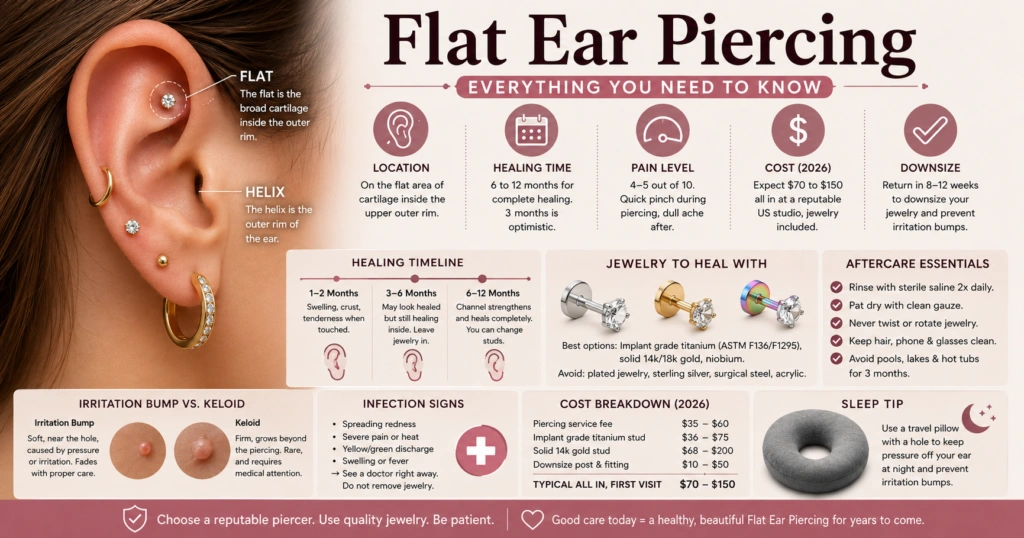
Your piercer points at a spot high on your ear and calls it the flat. You nod along. Then you get home and wonder whether a flat ear piercing is just a helix under a different name. It is not, and that difference changes how you heal it.
Flat Ear Piercing at a Glance
| Topic | Summary |
|---|---|
| Piercing Location | The flat piercing goes through the broad upper cartilage inside the ear’s outer rim, not the helix. |
| Pain Level | Moderate pain, typically 4–5/10, with mild soreness for a few days after piercing. |
| Healing Time | It usually takes 6–12 months for complete healing, even if it looks healed earlier. |
| Average Cost (2026) | Expect to pay $70–$150, including piercing service and implant-grade titanium jewelry. |
| Best Jewelry | Choose implant-grade titanium (ASTM F136/F1295), solid 14k/18k gold, or niobium. |
| Aftercare | Clean twice daily with sterile saline, avoid touching or twisting jewelry, and keep the area dry. |
| Downsizing | Return after 8–12 weeks to replace the longer starter post with a shorter one. |
| Common Problems | Irritation bumps often result from pressure, sleeping on the piercing, or delayed downsizing. |
| Signs of Infection | Spreading redness, severe pain, yellow or green discharge, swelling, or fever requires medical attention. |
| Best Tip | Sleep on a travel pillow, avoid pressure on the ear, and be patient throughout the healing process. |
Key Takeaways
- The flat is the broad plane of cartilage inside the outer rim, not the rim itself.
- Budget 6 to 12 months of healing. Page one often says three, and three is optimistic.
- Expect $70 to $150 all in at a reputable US studio, jewelry included.
- Ask for implant-grade titanium stamped ASTM F136 if metal has ever irritated your skin.
- Book a downsize at 8 to 12 weeks. Skipping it causes most irritation bumps.
Where the Flat Sits, and How It Differs From the Helix
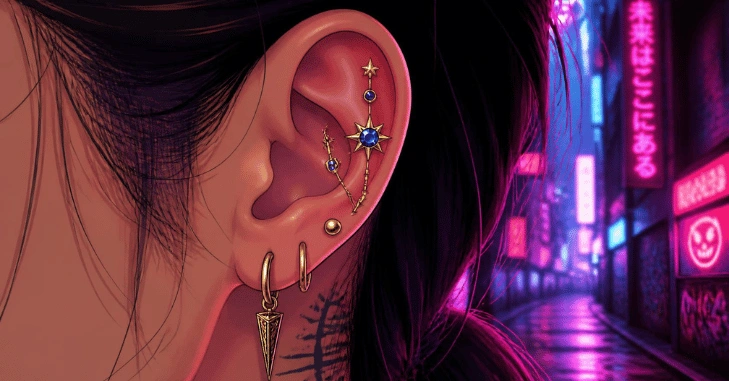
The flat is the broad, level section of cartilage in the upper ear. It sits inside the raised outer rim and above the ridge that curves down toward your ear canal. Your piercer works from the front, and the flat back of the jewelry rests behind the ear.
Flat Ear Piercing guide covering healing time, pain, aftercare, costs, jewelry materials, infection signs, and expert tips for faster recovery. Run a finger around the outside edge of your ear. That raised ridge is the helix, and a helix piercing goes straight through it. Now slide your finger inward about half an inch. The wide shelf you land on is the flat.
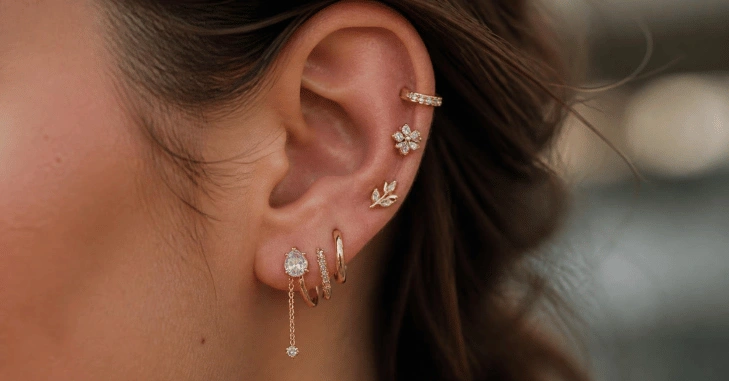
Between the two you will feel a shallow groove. Anatomists call it the scapha, and some piercers name a stud placed in that dip a scapha piercing. In photos it looks nearly identical to a flat. Ask your piercer to mark the spot and hand you a mirror before the needle comes out. The area also holds two or three studs comfortably, which is why it anchors so many curated ear jewelry looks.
How Much Does a Flat Ear Piercing Hurt?
Cartilage hurts more than a lobe. Most people rate this one around 4 or 5 out of 10, roughly level with a helix and milder than a daith. The needle itself passes through in about two seconds. What catches people off guard is the ache afterward, a dull throb that can hang around for a day or two.
Eat something beforehand. Bring a friend if needles make you lightheaded.
Healing Time and Why Cartilage Takes So Long
Cartilage has almost no blood supply of its own. Nutrients seep in slowly through the thin membrane wrapped around it, so repair runs in months rather than weeks. A lobe settles in 6 to 8 weeks. A flat needs 6 to 12 months before the channel inside is genuinely stable.
Plenty of guides quote 3 to 6 months. That figure describes the point where the outside looks calm, not the point where the tissue underneath has finished. Swap the jewelry at month three and you can reset yourself to week one.
- Months 1 to 2: swelling, crust, and tenderness whenever something touches it.
- Months 3 to 6: it looks healed and is not. Leave the jewelry alone.
- Months 6 to 12: the channel toughens up. Now you can start changing studs.
What is Normal at Each Stage?
Read the table as a rough map, not a diagnosis. Your piercer knows your ear.
| Stage | Normal | Get it looked at. |
| Days 1 to 7 | Swelling, warmth, a little blood, clear or straw-colored crust | Pain that climbs after day three, or redness spreading outward |
| Weeks 2 to 8 | Crust in the morning, tenderness if you knock it, mild pink skin | A bump forming, jewelry sinking in, thick yellow discharge |
| Months 3 to 6 | Quiet most days, occasional flare after sleeping on it | The post looks shorter, or the skin is thinning over either end. |
| Months 6 to 12 | No crust, no soreness, and jewelry moves freely. | Any pain that returns without an obvious knock |
Why Sleeping on It Causes Irritation Bumps
Pressure is the enemy here. Eight hours of your skull resting on a stud bends the post inside the channel, and the tissue answers by swelling at the exit point. That swelling is the angry little bump people photograph at week six and panic about.
A travel pillow with a hole in the middle solves it for most people. Sleep with your ear over the gap. Tie long hair back too. A snagged strand does the same damage in one second that a pillow does overnight, and simple hair styles that stay off your ears help more than any aftercare spray.
Irritation bump or keloid?
These two get confused constantly, and the responses are opposite. An irritation bump is soft, sits right against the hole, and shrinks once you remove whatever caused it. A keloid is firm and rubbery, and it keeps growing past the edge of the original wound. Keloids are rarer than the internet suggests, and they tend to run in families.
- Irritation bump: shows up within weeks, soft, and fades once pressure and bad jewelry stop.
- Keloid: shows up months later, firm, spreads beyond the piercing, needs a dermatologist.
Do not attack either one with tea tree oil or aspirin paste. Those tricks trend on social media and they only make the tissue angrier.
Jewelry Materials and the Nickel Question
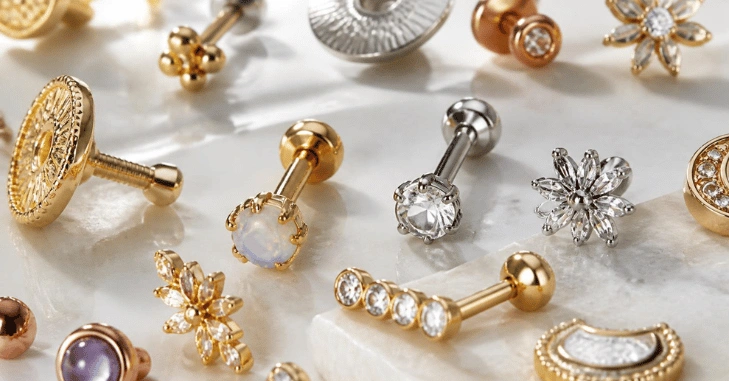
Ask for implant-grade titanium, stamped ASTM F136 or ASTM F1295. It carries no nickel. Solid 14k gold and niobium are also safe to heal in. Surgical steel sounds clinical, but most grades of it contain nickel, and a fresh wound is a terrible place to discover you react.
Nickel is not a fringe problem. The NIH National Library of Medicine’s review of North American patch test data reports that 17.5% of more than 44,000 patients tested positive for nickel sensitivity. That reference page was last reviewed in 2023, and the analysis behind it spans 1994 to 2014.
- Safe to heal in: implant-grade titanium, solid 14k or 18k gold, and niobium.
- Not for a fresh flat: plated pieces, sterling silver, unmarked steel, and acrylic.
Downsizing the Post, the Step Almost Nobody Explains
Your first study is deliberately too long. Swelling needs somewhere to go, so the post sits a few millimeters proud of your ear on purpose. Once that swelling drops, the extra length turns into a lever. Every knock and every pillow rocks the jewelry inside the channel.
So you go back at 8 to 12 weeks and have the long post swapped for a shorter one. The appointment takes five minutes. Studios often charge around $10, and some do it free for piercings they performed themselves.
Miss it and you invite the exact bump you were trying to avoid.
Infection versus Normal Healing
Normal healing is boring. Mild pink skin, a bit of crust, and soreness that fades week by week. Infection is loud. Spreading redness, heat, throbbing pain, thick yellow or green discharge, or a fever means you call a doctor that same day.
Cartilage infections behave differently from a grumpy lobe. A 2023 outbreak report in Emerging Infectious Diseases, published by the CDC, found that 30 of 53 confirmed and probable cases needed hospital admission, or 57%. Cartilage sites featured far more often in that group than lobes did.
Leave the jewelry in while you wait to be seen. Pulling it out can trap the infection under closed skin.
What Flat-Lying Piercing Costs in 2026
Costs split into two parts, the piercer’s fee and the jewelry itself. US studios we checked charge $35 to $60 for the service alone. Then you pick a stud, and that is where the range widens. Treat it as a fashion piece you wear daily, because that is exactly what it becomes.
| What you pay for | Typical US range |
| Piercing service fee | $35 to $60 |
| Implant-grade titanium stud | $36 to $75 |
| Solid 14k gold stud | $68 to $200 |
| Downsize post and fitting | $10 to $50 |
| Typical all-in, first visit | $70 to $150 |
Aftercare That Actually Works
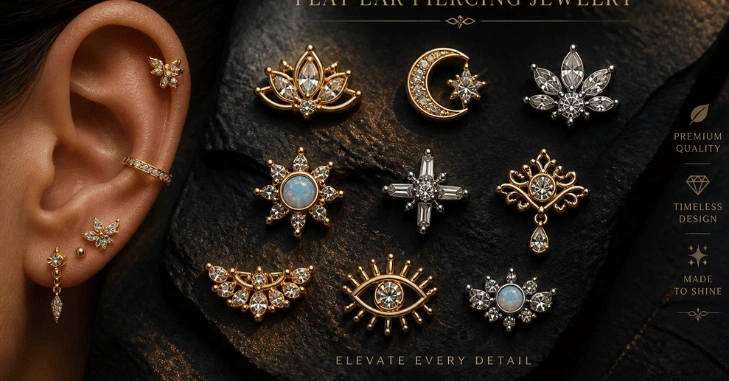
Keep it simple. Sterile saline, twice a day, nothing else.
- Rinse with sterile saline morning and night, then pat dry with clean gauze.
- Never twist or rotate the jewelry. That advice is decades out of date.
- Wipe eyeglass arms and phone screens daily, since both press against the flat.
- Skip pools, lakes, and hot tubs for the first three months.
Your next step
Flat Ear Piercing: Find a studio that pierces with a needle, stocks implant-grade titanium, and offers a downsize check. Ask to see the mill certificate for the jewelry if metal has bothered you before. This article is general information, not medical advice. A professional piercer reads your anatomy, and a doctor handles anything that looks infected.
FAQ
Yes, if your anatomy allows it. Two healing wounds on the same ear means no sleeping on that side for months, so many piercers suggest spacing them out.
A flat ear piercing rarely suits a hoop at all. The jewelry sits on an open plane rather than a rim edge, so a ring has nothing to hug. Flat-back studs are the sensible long-term choice.
No. Guns crush cartilage instead of removing a clean channel, and reputable studios use a single-use needle.
Migration happens when a post is too short, too long, or knocked repeatedly. Skin thinning over either end of the bar is the early warning. See your piercer quickly rather than waiting it out.