
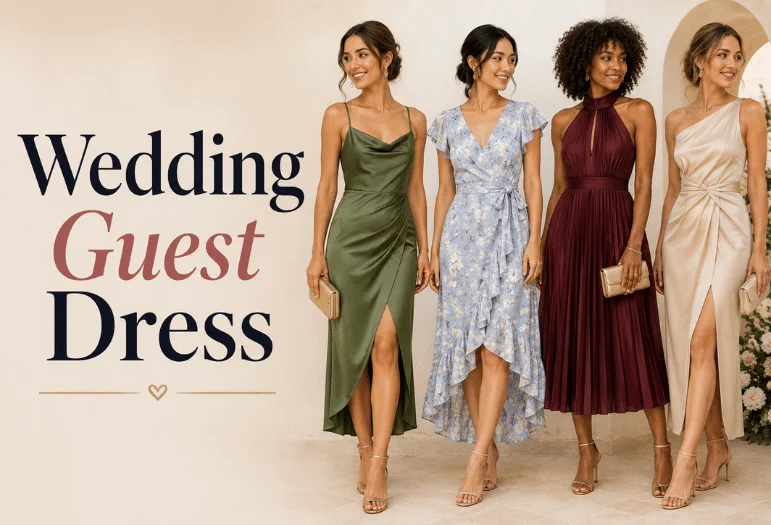
The invitation is on the fridge. Your date is three weeks out. Nothing in the closet works, and the shopping tabs are already open. Most people start there, which is backward.
Choose a wedding guest dress by answering four questions in order: what the dress code says, what season it is, where the ceremony happens, and when it starts. Dress code sets the formality floor. Season sets fabric and color. Venue sets your hem and your heel. Time of day sets how much shine you can get away with.
Key takeaways
- Four inputs settle the outfit: dress code, season, venue, plus start time.
- Bridal shades stay home: white, ivory, cream, champagne. So does anything louder than the bride.
- One-time designer rental: $35 to $75 on a gown retailing for $320 to $1,100.
- Repeating an outfit is fine unless the same crowd already saw it on you.
- Attending a wedding averages about $610 once the gift and travel are counted.
Start With Four Inputs, Not a Shopping Cart
Shopping first is how smart people end up with a gorgeous gown that sinks into a lawn. Work through these four in sequence, then browse.
- Dress code. This is a floor, not a ceiling. You may dress slightly up. You may not dress down.
- Season. Fabric weight and palette come from here. Velvet in July is punishment, and chiffon in a December ballroom reads unfinished.
- Venue. Grass, sand, cobblestone, marble. Each one rewrites your shoe and your hem.
- Time of day. Before 4:00 p.m. leans matte and lighter. After 6:00 p.m. earns satin, sequins or metallic.
Sometimes two inputs pull against each other. A later section sorts that out. If you want more background on how these pieces fit together across an entire season, our wedding fashion coverage goes wider than one event.
What the Invitation Words Actually Mean
Couples invent phrasing all the time. Here is the honest translation of what lands on the card.
| What the invitation says | What it really asks for |
| White tie | Full-length ball gown, gloves optional. Rare, and the couple means it literally. |
| Black tie | Floor-length gown. These receptions almost always begin after 5:30 p.m. |
| Black tie optional | A long gown or a polished knee-length dress. Both read as correct. |
| Formal | Long or midi in a substantial fabric. Fabric matters more than hem length. |
| Cocktail | Knee to midi length, the most common code on American invitations. |
| Semi-formal | Midi dress or a tailored jumpsuit. Heavy beading is unnecessary. |
| Dressy casual | A printed midi with some structure. No denim, no flip-flops. |
| Garden party | Florals, midi length, block heels. A hat is genuinely welcome. |
| Festive | Color and sparkle encouraged. The couple wants loud photographs. |
| Beach formal | Long and light in a fluid fabric. Flat sandals, never a stiletto. |
| No code listed | Read the venue and the start time instead. Default to semi-formal. |
Invitation phrasing and what it asks of a guest
One line overrides everything else. If the couple names a palette or asks you to avoid a shade, that request outranks every rule below.
The Master Wedding Guest Dress Table
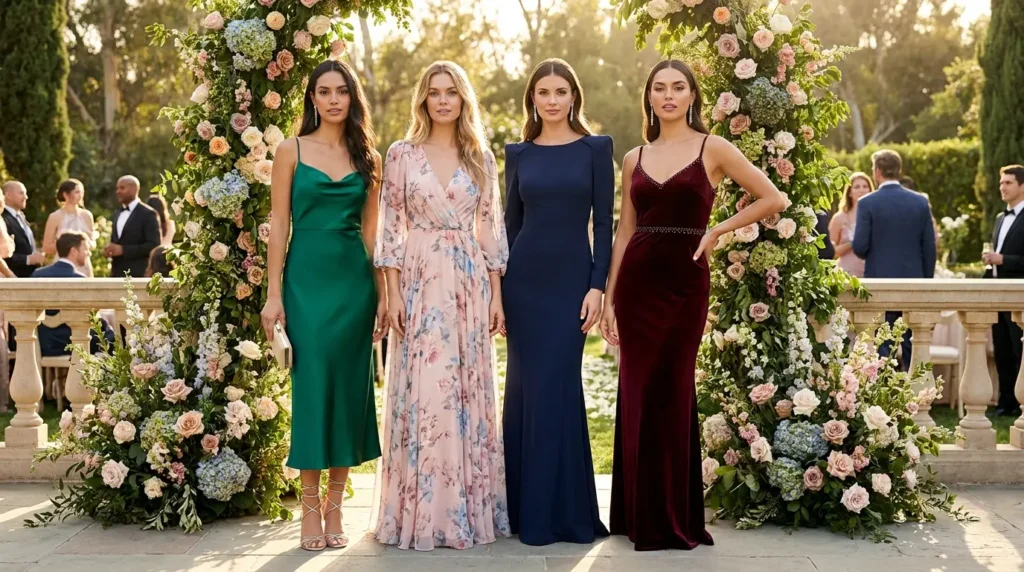
Feed your four answers into this grid. The verdict column is your outfit. Rows cover the situations that show up most on American invitations.
| Dress code | Season | Venue | Start time | Verdict |
| Black tie | Winter | Hotel ballroom | 6:30 p.m. | Floor-length velvet or crepe gown, closed-toe heel, a wrap for the walk in |
| Black tie optional | Fall | Vineyard | 5:00 p.m. | Long satin slip or a jewel-tone midi, block heel, structured clutch |
| Formal | Spring | Church, then a hotel | 2:00 p.m. | Midi with sleeves or a shawl for the ceremony, low heel, covered shoulders |
| Semi-formal | Summer | Garden | 4:00 p.m. | Printed midi in a cotton or linen blend, block heel or dressy flat |
| Dressy casual | Fall | Barn | 3:00 p.m. | Structured midi in rust or olive, ankle boot or wedge, minimal jewelry |
| Beach formal | Summer | Oceanfront | 5:30 p.m. | Long chiffon in a bright shade, flat sandal, hair pinned back |
| None listed | Any | Restaurant | 7:00 p.m. | Dark midi in a heavier fabric, heel, small bag, no bare shoulders |
Dress code, season, venue, and start time mapped to a verdict
Reading the verdicts
Each row assumes a ceremony of about an hour, then a reception. Adjust one variable and the verdict shifts one notch, not three. A 3:00 p.m. black tie start, for instance, still means floor length, just in a matte fabric rather than a mirrored sequin.
Two Rules Nobody Waives
Rule one is color. White is out. So are ivory, cream, champagne, and any blush pale enough to photograph as ivory under a flash. Test it on your phone with the flash on before you commit. If the shade goes ghostly in the picture, it will do the same in the group shot at the altar.
Rule two is volume. Nobody outdresses the couple. That rules out cathedral trains, floor-length lace in bridal white, plus anything with a veil-adjacent headpiece. Bridal stylists put it plainly: skip anything you could also wear to a club. Sheer panels, rib-high cutouts and thigh-high slits read wrong in a church pew.
When Two Inputs Disagree
The dress code wins on formality. The venue wins on construction. A formal code at a beach wedding still means floor length, but in chiffon with a flat sandal instead of silk with a stiletto. Split the decision that way and conflicts stop being confusing.
Rent or Buy, and What Each Really Costs
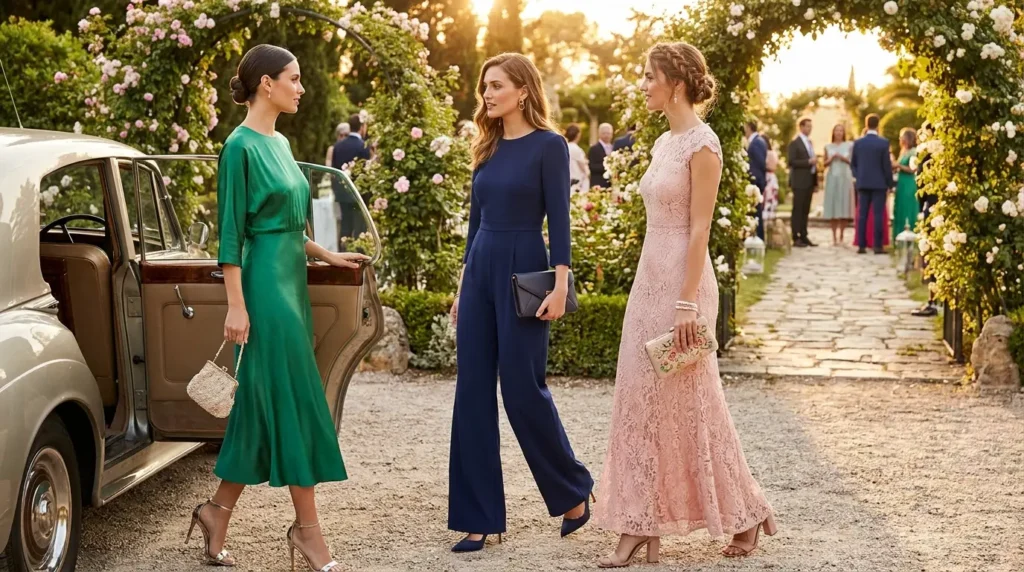
Rental earns its keep when the formality is a one-off. A single rental at a service like Rent the Runway runs roughly $35 to $75. That covers a four- or eight-day window, on gowns retailing between $320 and $1,100. Subscription plans that rotate several pieces a month sit around $89 to $98. For one black-tie invitation a year, renting wins on price by a wide margin.
Buying wins on cost per wear. Do the math honestly. Worn four times over two years, a $180 midi costs $45 a wear. That beats a $60 rental used once. A $700 gown worn a single time does not. If you are browsing dresses by silhouette with three invitations already on the calendar, buying almost always pencils out.
One caution on rentals. Sizing is a gamble, so order a backup size and leave a week of buffer before a Saturday wedding.
Budget Tiers and What Your Money Buys
Most guides skip prices entirely. Here are real budget tiers and what a dress costs at each one.
- Under $100. Lulus, Zara, and Mango live here, roughly $39 to $99. A Zara halter dress runs about $70. Expect polyester, thin lining, and a hem you may need to fix.
- $100 to $300. The sweet spot for most guests. A Mango satin style lands near $140, a Reformation silk near $278. Real lining, better drape, fabric that photographs well.
- $300 to $800. Structured construction and seams that hold shape after eight hours of sitting, dancing and hugging people.
- Above $800. Designer occasionwear. A beaded Rachel Gilbert gown sits near $1,795, which is a wardrobe investment rather than an outfit.
- Rental. $35 to $75 for a single wear, or $89 to $98 a month for a rotating plan.
Keep it in proportion. The average guest spends about $610 to attend one wedding once the gift and the travel are counted, and guests who fly average closer to $1,680. Your dress is rarely the largest line on that list.
Can You Wear the Same Dress Twice?
Yes, with one condition: a different guest list. Nobody is auditing your closet. Photographs are the only real constraint, and photographs only matter to the people who appear in both sets.
If the two weddings share a crowd, change the read instead of the dress. Swap a satin heel for a metallic sandal. Trade the clutch for a beaded bag, or add sleeves with a fine-knit shrug. Wear your hair up when it was down last time. To every eye at the table, that is a different outfit.
Shoes, Layers, and the Parts People Forget
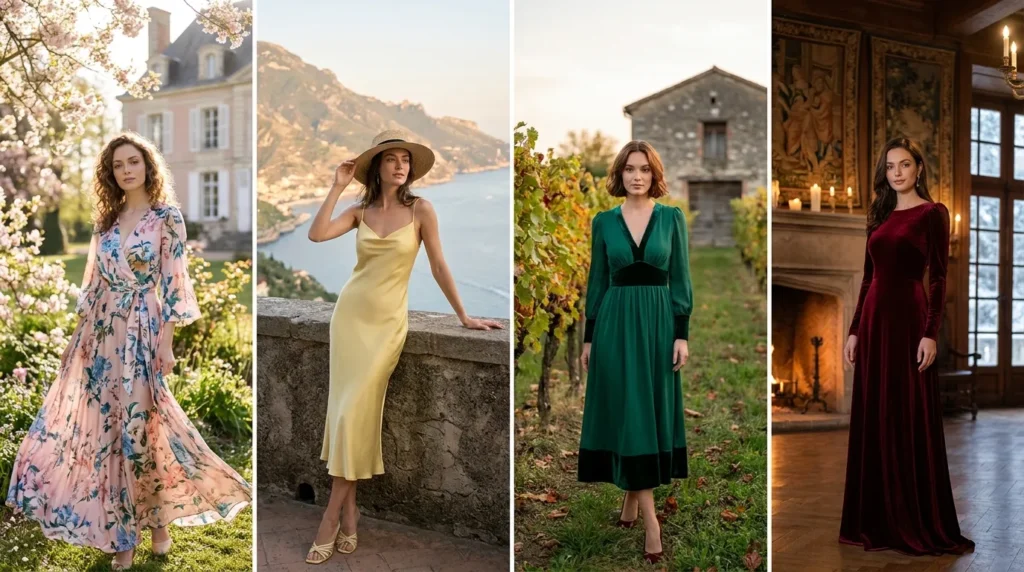
- Grass and sand. Block heels, wedges, or flats only. Stilettos sink, and heel protectors help less than the packaging claims.
- Cobblestone or a historic venue. A stacked heel under two inches, or a dressy flat you can walk a quarter mile in.
- Marble ballrooms. Anything goes, though a rubber sole grip is worth four dollars.
- Outdoor evening in fall or winter. A wrap, a tailored coat, or a fine-knit cardigan that reads intentional in photos.
- Every wedding. Blister patches, a backup earring, and a bag small enough to sit on the table.
Ground surface decides more than style does. Pick shoes that handle grass and sand before you fall for a heel that only works on carpet.
Your Next Step
Write your four answers on the invitation itself: code, season, venue, time. Find your row in the master table above, then shop only that verdict. Set a budget tier before the first tab opens, and decide on rent or buy in the same sitting. Do it four weeks out, and alterations stay possible.
FAQs
Read the venue and the start time. A 7:00 p.m. reception at a hotel means semi-formal at minimum. Backyard ceremony at 2:00 p.m.? Printed midi and a dressy flat.
A wedding guest dress passes the test when it looks deliberate in a photo taken from ten feet away. Fabric with weight, a clean hem, and shoes that match the ground will read correctly even at a modest price.
Absolutely, at semi-formal and below. Tailored, wide-leg, and in a fabric with drape. For black tie, a floor-length gown is still the safer read.
Yes, especially for daytime and garden weddings. Bright color and painterly florals are having a strong run for 2026, and stylists report guests moving away from safe neutrals.
Four to six weeks. That leaves room for a return, a size swap, and a trip to a tailor, which most dresses need at the hem or the strap.
No. Two strong pieces plus rotating shoes and jewelry will carry four invitations. Rent for the one black-tie event and buy for the rest.