
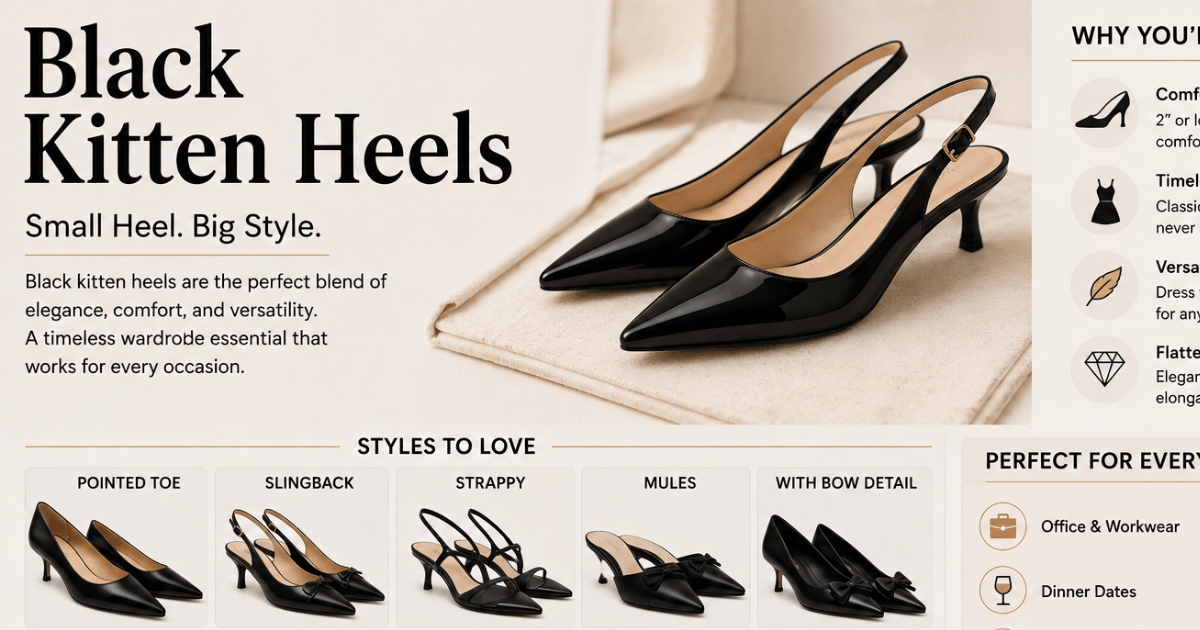
A low heel sounds like an easy buy. It rarely is. Black kitten heels arrive in a dozen toe shapes and back styles, and each one changes how your leg reads and how long you can stand in them. This guide sorts height, toe, and fit before you spend a cent.
| Topic | Key Information |
|---|---|
| Main Focus | Complete guide to choosing black kitten heels based on heel height, toe shape, comfort, and styling. |
| Ideal Heel Height | The classic kitten heel measures 1.5–2 inches, offering the best balance of comfort and elegance. |
| Best Toe Shapes | Pointed for a longer leg line, almond for versatility, square for wider feet, and round for all-day comfort. |
| Back Styles | Pumps offer the most support, slingbacks are ideal for warm weather, and mules are stylish but less secure. |
| Comfort Tips | Prioritize a roomy toe box, forefoot cushioning, stable heel placement, and shop later in the day when feet naturally swell. |
| Best Materials | Smooth leather is durable and versatile, and suede is softer but less weather-resistant, while satin is best for formal occasions. |
| 2026 Price Range | Budget: $24–$65 • Mid-range: $70–$175 • Premium: $150–$280 |
| Recommended Style | A 1.75-inch pointed slingback offers the best mix of comfort, elegance, and versatility for most wardrobes. |
| Styling Ideas | Pair with wide-leg trousers, jeans, midi skirts, or dresses for polished office, casual, and evening looks. |
| Buying Advice | Measure your feet in the evening, verify the actual heel height, test the shoes indoors, and return pairs that slip at the heel. |
Key Takeaways
- Budget $40 to $180 for a pair you will wear twice a week.
- Height: 1.5 to 2 inches is the working range. Lower loses the lift. Higher loses the ease.
- Pointed toes stretch the leg line. Square-toe shoes stop it flat at the toe box.
- Slingbacks frame the ankle bone. Pumps stay put. Mules slide off fastest.
- Comfort tracks forefoot pressure and toe box width, not heel height on its own.
What Counts as a Kitten Heel?
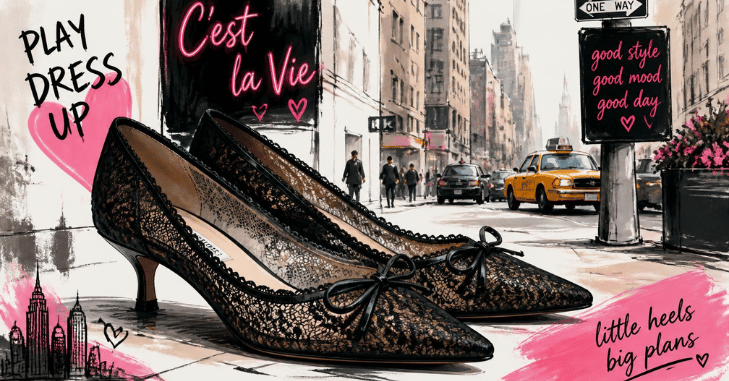
A kitten heel is a slim, tapered heel measuring roughly 1.5 to 2 inches, sitting slightly forward of the back edge of the shoe. Anything under 1 inch reads as a flat with a lift. Anything past 2.5 inches walks and feels like a low stiletto, not a kitten heel.
Curve matters as much as the number. A real kitten heel narrows toward the tip, so the base is wider than the point that meets the ground. That taper gives you lift without the steep pitch of a stiletto.
If you are weighing this against flats and block heels, our guide to women’s shoes covers the wider category.
Heel Height in Inches and What It Buys You
Half an inch of heel changes almost nothing about your posture. Two inches tips your weight forward enough that you notice it in the front of the foot after a few hours. That is the whole trade. It is also why the number printed on the box deserves a second look.
- 1 to 1.25 inches. Barely a heel. Reads as a polished flat and holds up through a long day on your feet.
- 1.5 to 2 inches. The classic range. Enough lift to clear a wide-pant-hem off the floor, low enough to walk a city block without planning your route.
- 2.25 to 2.5 inches. Plenty of stores still label these kitten heels. They sit at the border, so read the spec instead of the category name.
Toe Shape: Pointed, Square, or Almond
Toe shape does more for the leg line than the heel does. Four shapes cover almost everything on the shelf.
| Toe shape | Effect on the leg line | Flatters | Watch for |
| Pointed | The longest line carries the eye past the foot. | Narrow- to medium- to feet, cropped, and wide-leg pants | Squeeze across the ball of the foot. |
| Square | Stops the line flat, so the foot looks shorter. | Wide feet, bunions, high insteps | Can look heavy under a full skirt |
| Almond | Soft taper, a middle path | Almost every foot shape | Less of a statement than a point |
| Round | Shortest visual line, most relaxed | Wide-forefoot, all-day wear | Reads casual next to sharp tailoring |
Pointed toes keep the eye moving. Your shin runs into the vamp and out through the point, so the leg reads longer than it measures. A square toe stops that line flat. Neither choice is wrong—one suits a cropped pant, the other suits a long skirt.
Slingback, Pump, or Mule?
Three back styles dominate the low-heel shelf. They behave nothing alike.
- Pump: Closed-heel cup and the most secure of the three. It handles cold weather and hosiery well. The trade is heat in July.
- Slingback. A strap crosses behind the heel and leaves the ankle bone visible, which is why it flatters a midi hem. Look for an elastic gore or a buckle, because a fixed strap slips on a narrow heel. A slingback also earns its place in warm-weather seasonal outfits.
- Mule. Open back, the fastest to slip on, and the hardest to walk in. You grip with your toes to keep it on, and that grip is where the ache starts.
The Comfort Question, Answered Honestly

Low heels are not automatically comfortable heels. That myth sells a lot of shoes. Every heel shifts your weight forward. At 2 inches, a real share of your load lands on the ball of the foot and the long bones behind the toes. That pressure is what burns after hour three. Height alone will not predict it.
Four details decide whether a pair holds up:
- Toe box width at the widest part of your foot, checked while you stand.
- Padding under the forefoot, which most fashion labels skip to keep the sole slim.
- Heel tip width. A slim tip sinks into grass and catches in sidewalk cracks.
- Heel placement. A tip that sits under your heel bone feels steadier than one set behind it.
Shop for them late in the day. Feet swell.
Leather, Suede, or Satin: Picking a Black Finish
Smooth black leather is the workhorse. It takes polish, hides scuffs after a quick buff, and reads formal enough for an office or a dinner. Patent leather looks sharper but shows every crease across the vamp within a season.
Suede is softer on the foot and forgiving over a wide instep, though rain ruins it fast. Satin belongs to evening only. It marks if you so much as brush a chair leg, which is a fair trade for two hours under good light.
Black Kitten Heels by Style and Price
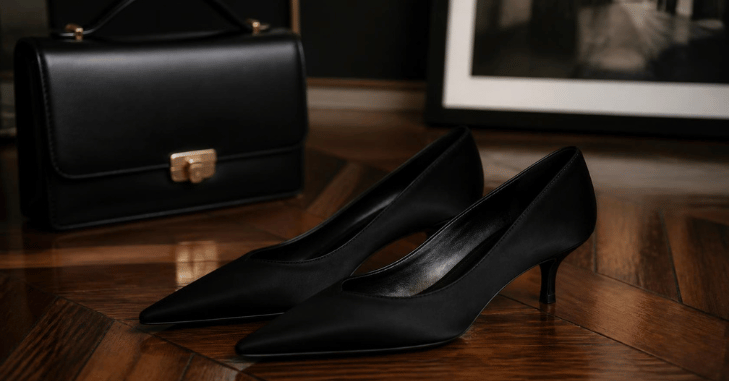
The ranges below reflect current US retail for new pairs, not clearance racks.
| Style | Typical heel height | Price range | Best for |
| Budget-Pointed Pump | 1.9 to 2 in | $24 to $65 | Occasional wear, weddings, one season |
| Slingback, mainstream | 1.25 to 2.25 in | $50 to $100 | Midi skirts and warm weather |
| Pointed pump, mid-tier | 1.4 to 2 in | $70 to $150 | Office wear and tailoring |
| Leather pump, mid-tier | 1.4 to 2 in | $83 to $175 | Daily rotation, several years |
| Square-toe mule | 2 to 2.5 in | $150 to $280 | Evenings and dinners out |
Names worth knowing at each tier: Dream Pairs and Zara sit near the bottom. Sam Edelman and Charles & Keith land in the $80 to $150 band. Everlane and Reformation start around $175.
Our pick for most closets is a pointed slingback near 1.75 inches in the $60 to $100 band. It carries an office day, a dinner, and a wedding without ever looking like a compromise.
Styling Them With Wide-Leg Pants and Midi Skirts
Here is where a low heel earns its keep. A wide-leg pant needs its hem lifted clear of the floor, and 2 inches does that without pushing the outfit too much.
Hem length does the heavy lifting here. Set it so the fabric clears the ground by about half an inch with the shoe on. Any longer and the fabric drags on wet sidewalks. Any shorter and the crop looks like a hemming error rather than a choice. With a cropped wide leg, aim the hem at the ankle bone. That lets a slingback strap show, which breaks up the column of fabric and keeps the leg from looking chopped.
Skip visible socks with a slingback or a mule
Midi skirts follow one rule. The hem should land on the narrow stretch of leg just below the calf muscle, never across the widest part of it. A 2-inch heel lifts you enough to move that hem into the better zone. The same logic applies to midi dresses and slip dresses.
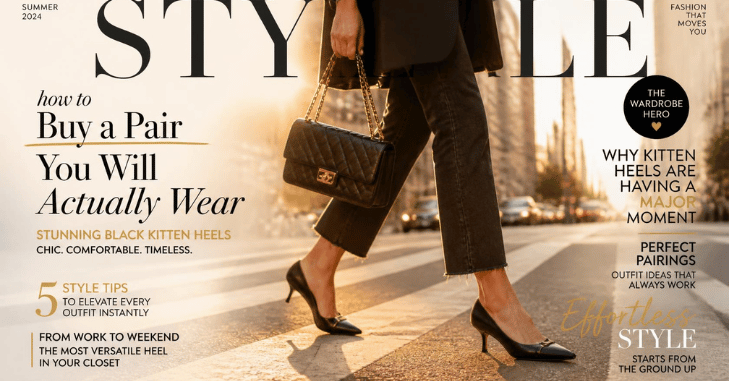
How to Buy a Pair You Will Actually Wear?
- Measure your foot in the evening and shop that number.
- Check the listed heel height in inches and ignore the word kitten.
- Pick the toe shape that matches your pants, not the one on the model.
- Walk 20 steps on a hard floor at home before you remove the tags.
- Return anything that slips at the heel, because a half size down rarely fixes it.
Start with one versatile pair. Wear it hard for two weeks, then decide whether a second shape has earned space in your closet.
Conclusion
Black kitten heels remain one of the most versatile footwear choices in 2026, offering an ideal balance of elegance, comfort, and everyday practicality. Choosing the right pair comes down to more than heel height—toe shape, back style, materials, and overall fit all play an important role in how the shoes look and feel throughout the day.
Whether you prefer a pointed pump for a polished office outfit, a slingback for warm-weather styling, or a square-toe mule for evening wear, investing in a well-fitting pair will give you years of reliable use. Focus on comfort first, select a timeless black finish, and you’ll have a pair of heels that transitions effortlessly from work meetings to special occasions without sacrificing style.
FAQ
Roughly 1.5 to 2 inches. Some brands stretch the label to 2.5 inches, so check the product spec rather than the category page.
Yes. Low heels have held their ground for four seasons running. Square toe and slingback versions keep landing in new drops from Zara, Mango, and Sam Edelman.
The ache usually starts at the ball of the foot, not the arch. A wider toe box and a padded forefoot matter more than shaving half an inch off the height.
Yes, and straight or wide leg cuts work better than skinny ones. Let the hem graze the top of the shoe.
Consider a half-size up. A pointed toe borrows length from the toe box, so your usual size often feels short across the ball of the foot.